A domain name can spend years waiting for somebody to want it. It has an owner, a renewal bill and, sometimes, an asking price that requires a very straight face. Fred Hsu has spent much of his working life trying to give that waiting room a business model. In 2000, he helped start Oversee.net, which put advertising in front of people arriving at internet addresses. A quarter-century later, as D3’s co-founder and chief executive, he is trying to make the addresses themselves easier to trade.
There have been other businesses in between: mobile advertising at Manage.com, games at Ember Entertainment, and an exploration of membership technology at ClubID. Yet domains keep returning to the conversation. Asked in a podcast what he would buy if he could purchase anything available, Hsu chose the .com registry from Verisign. Some people dream of an island. His answer came with a root zone.
That attachment makes D3 more interesting as a personal story. Hsu has already worked on the machinery that makes domains earn money. Now he wants to change the machinery that lets their owners sell, share and finance them. The old address has acquired a new set of possibilities, and a substantial new set of questions.
Before the domain portfolio, a night shift
Hsu was born in Ohio to Chinese immigrant parents who had come to the United States for graduate school. His family moved frequently before settling in California when he was five. His father worked as a defense contractor; his mother’s career included accounting, insurance and programming. He grew up in Southern California, interested in making things and working with computers.
At UCLA, where he studied from 1996 to 2000, he did the sort of work that makes a computer science education considerably less theoretical: websites, programming and systems maintenance. One job involved operating systems on the graveyard shift at a Fox movie studio. The internet boom was recruiting his classmates; Hsu was accumulating practical experience while finishing his degree.
He also worked at an internet advertising startup and met the person with whom he would build Oversee: Lawrence Ng. Their business took shape around a deceptively ordinary action. A person types an address, arrives somewhere and has an intention. If the page can answer that intention with a relevant advertisement, the visit has economic value. The valuable part was making that match work repeatedly.
His mother bought the first server
Hsu’s account of Oversee’s first investor is pleasingly domestic. His mother helped pay for the first server. The company was bootstrapped, and he later described its annual revenue reaching $230 million between 2000 and 2008. The scale matters, but so does the mechanism: software connecting advertisers with visitors who had already signalled an interest by typing a domain name.
The dot-com crash had left people holding addresses without much useful content behind them. Oversee could aggregate that traffic and place relevant advertising on the pages. Domain parking, as the business became known, made an apparently idle asset productive. It also required attention to the unglamorous parts: ad selection, distribution, ranking and the commercial value of a click.
In 2008, Oak Hill Capital Partners invested $150 million in Oversee. By then, Hsu had stepped away from day-to-day operations, remaining a shareholder and board member. Ng credited his partner with developing the technology behind the company’s progress. The division of labour is worth keeping in view: before Hsu became the person explaining a market’s future, he was its co-founder and chief technology officer, building the systems underneath it.
Oak Hill Capital Partners invested after the company’s bootstrapped beginning.
A click grows up and gets a phone
Manage, founded in 2011, carried the advertising problem onto mobile devices. Hsu’s advice to game companies in 2013 was practical enough to spoil a good daydream. Understand user acquisition costs. Understand how long players stay. Make the app’s store page presentable. Improve the product quickly. Buying attention could get people to the door; the game still had to persuade them to remain.
“Quick iteration is really important,” he said. The line fits an operator who had watched software, advertising and audience behaviour interact at scale. A campaign could produce numbers without producing a durable business. His prescription involved examining those numbers and changing what happened next.
Criteo announced its acquisition of Manage in October 2018, adding app-install advertising to its existing business. The announcement described customers across gaming, retail, travel, food delivery and ride-sharing. Manage’s technology was handling more than 50 billion daily real-time bidding requests. The acquisition brought both technology and staff into Criteo.
Hsu also co-founded Ember Entertainment, the Seattle game studio later acquired by Gala Games in January 2023. Advertising and games put him on different sides of the same transaction: one business helps a developer find players; the other has to give those players a reason to care. Those chapters widen the picture of a founder whose current subject can otherwise sound narrowly technical.
- 2000Oversee.net
Domain traffic & advertising - 2011Manage.com
Mobile app marketing - 2023D3’s seed round
Domains & blockchain - 2026Dominion
Portfolio tokenization
Back to the address bar
D3’s arrival in 2023 returned Hsu to domains with a different financing model. A $5 million seed round led by Shima Capital backed a company aiming to connect blockchain capabilities with existing internet infrastructure. The ambition included new top-level domains and a marketplace for tokenized names. His domain experience supplied a starting point; the company still had to assemble an ecosystem around it.
For Hsu, compatibility is central. A blockchain name and a domain that works throughout the conventional internet do different jobs. In a 2024 interview, he used the example of typing a blockchain-style name into a browser or trying to email it. A familiar-looking label does not automatically have the support of the Domain Name System.
The commercial irritation was equally concrete. Even after years in the business, Hsu was still receiving email offers for his own .ai and .com portfolio. The market could require private conversations and considerable patience. D3’s proposition was to give existing domains more ways to move while retaining their ordinary internet function.
The people around him include Paul Stahura and Michael Ho, both listed among D3’s co-founders. There are older connections, too. When Susan Lawrence joined D3 in 2024, she described a return to working with Hsu two decades after her first job at Oversee. Hsu welcomed her with a promise of meme gear. Infrastructure apparently has a dress code.
“Our first investor was my mom.”
Fred Hsu, on Oversee’s beginning
Twenty-five million dollars, and a harder question
In January 2025, D3 announced a $25 million Series A led by Paradigm. Participants included Coinbase Ventures, Polygon co-founder Sandeep Nailwal, HubSpot founder Dharmesh Shah and Namecheap chief executive Richard Kirkendall. The accompanying announcement introduced Doma Protocol, the blockchain infrastructure behind D3’s DomainFi plans.
The idea is easier to grasp by separating the object from its market. A domain still needs to work as an internet address. Tokenization adds a representation through which ownership interests can be handled on a blockchain. Fractional structures can allow participation in part of an asset rather than requiring a buyer for the entire name.
That creates a demanding practical test. Making a holding transferable does not supply someone willing to buy it. A market needs participants who understand what they own, how a price is formed and what happens when the underlying domain sells. Hsu’s task has expanded from improving the income attached to a visit to persuading people to use a different transaction system.
The investor list puts domain operators and crypto financiers in the same room. That is appropriate to the work. Registrars, portfolio owners and blockchain users bring different habits and expectations. D3 needs cooperation across those groups for the mechanism to become useful outside a presentation.
A familiar face at the table
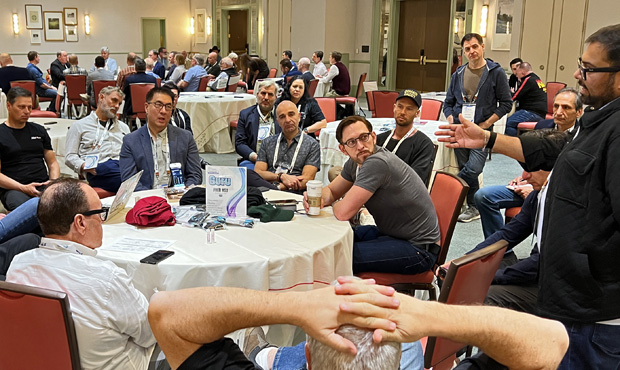
At the Internet Commerce Association’s January 2026 meeting in Las Vegas, Hsu sat at a Guru Table surrounded by domain industry attendees. The photograph has the texture of an industry doing business: coffee cups, name badges, people leaning into a discussion. D3’s proposition still has to survive questions asked across a table.
At Dominion in April, the company introduced Domain Asset Vehicles, designed to bring institutional domain portfolios into a tokenized structure, and the Doma Agentic Engine, aimed at helping owners assess how AI agents perceive their domains. Hsu’s subsequent account described Braden Pollock’s Alert.ai launching live on Doma during his keynote. The demonstration brought a specific owner and a specific address into the argument.
In July, Hsu took questions from NamePros members about monetization, liquidity and domain tokenization. He reiterated his preference for working with established DNS domains and explained that the seller sets a domain’s buy-it-now valuation; Doma does not endorse that figure. The distinction matters. A mechanism for trading an asset cannot settle every argument over its price.
Those appearances show the day-to-day shape of his ambition: demonstrations, explanations and conversations with people who already know this market. The idea has to earn its place among the tools they use.
The long route to the same question
Hsu’s career supplies a useful way to read that ambition. Oversee worked on the visitors reaching a domain. Manage worked on the advertising reaching a phone. Ember built games for the people holding those phones. D3 returns to the address, asking what more its owner should be able to do with it.
There is continuity in the kind of work, even as the vocabulary changes. Each business involves connecting something valuable with someone who can use it, then building enough machinery to repeat the exchange. The newest version requires domain industry experience, technical execution and the patience to explain an unfamiliar ownership model.
The question that follows Hsu is wonderfully concrete: what can an internet address do while its owner waits? Oversee supplied one answer with advertising. D3 is trying another with tradable interests and financial infrastructure. The outcome depends on people choosing to participate. After years of building around clicks, Hsu is once again asking the owner of a name to take a closer look.