Rob Monster once bought a collection of roughly 3,000 domain names from the market research company he had founded. The purchase sounds like an eccentric leaving present: a few thousand addresses, with no moving van required. It also offers a useful way into his career. He had built a business that helped companies find people online. Now he was becoming interested in the addresses people used to find businesses.
The company was Global Market Insite, usually shortened to GMI. Monster founded it in 1999 and left the chief executive’s job in 2007. Four years later, Kantar acquired it. His subsequent ventures would take him from internet investing to local commerce, then into an argument about who should be allowed to remain online. Eventually, they would take him into court.
There is a considerable distance between a consumer survey and a dispute over extremist websites. Monster’s route between them runs through a conviction that recurs throughout his business life: a useful internet platform can change the terms on which people participate. His record also shows how much depends on the person operating it.
A global business, before the domains
Monster grew up in Philadelphia in a Dutch-American family, attended Germantown Friends School, and earned a bachelor’s degree and an MBA at Cornell. Childhood summers included work on his grandparents’ farm in the Netherlands. He began investing at 12. The family farm and the stock market make an unusual pair of classrooms; both provide fairly brisk feedback on optimism.
His early corporate career was with Procter & Gamble, from 1991 to 1999, including work in Germany and Japan. He became a global product development manager for Pampers. This was a practical education in selling products across national borders, where understanding the customer meant understanding several customers, in several markets, at once.
GMI brought that international outlook to research. Its software and online consumer panels helped research firms gather responses across countries. The proposition had an obvious attraction: companies could coordinate research through the internet rather than treat every national study as an entirely separate undertaking. Monster was selling a way to organize the work as much as a way to collect the answers.
He also wrote about it. A 2001 article coauthored with Raymond Pettit examined how web technology could connect international research operations. Their book, Market Research in the Internet Age, followed in 2002. Behind the rather dutiful business-book title was a consequential question: how could researchers compare consumers around the world using consistent methods, while moving quickly enough to be useful?
Expansion was tangible. In September 2005, GMI announced acquisitions of NetReflector in Seattle, Insight in Shanghai, and MI Pro in Norway, alongside an alliance with Brazil’s ARO Sistemas. These deals added survey technology, analytics and local presence. Monster described an operation working across 50 countries and 32 languages. Geography was becoming part of the product.
That year, he received the Pacific Northwest Ernst & Young Entrepreneur Of The Year award in software and technology. By the February 2007 announcement of his departure as CEO, GMI reported around $55 million in sales, more than 300 employees and 1,400 customers in 60 countries. Those figures describe a substantial operating business, with obligations rather different from the exhilarating early task of getting one started.
The founder leaves; the company carries on
Monster’s departure was presented publicly as a move to other interests, with a continuing board role. In a later recorded account, he described being fired. Both belong in the history: the polished announcement and the founder’s less polished recollection. Neither requires pretending that leaving a company and selling it are the same event.
Michael Brochu became GMI’s CEO in June 2007. In September 2011, WPP announced that Kantar had bought GMI and would align it with Lightspeed Research. GMI had recorded $64 million in revenue for 2010. The announcement listed 230 employees and offices stretching from Bellevue to Tokyo. Its panels added 13 countries to Lightspeed’s footprint.
Monster retained an ownership interest and benefited from the acquisition. The purchase price was not disclosed. This distinction matters in a career easily reduced to a list of exits: he had stopped managing GMI years before its sale, while remaining financially connected to what he had built.
In between, he launched Monster Venture Partners. His stated ambition was unusually hands-on for an investor: work alongside entrepreneurs and take responsibility for helping their companies succeed. By August 2008, he had backed more than 20 early ventures and put about $7 million of his own money into the firm. Rest appears to have been a short-lived portfolio allocation.
A good address goes looking for a business
Domain names offered another starting point. In 2007, Monster’s Domain Strategies held thousands of names; he also joined Internet Real Estate Group as a partner. His approach could reverse the familiar startup sequence. Begin with a memorable address, then find the entrepreneur and business that could make use of it. A name became an invitation to build.
Epik, founded in 2009, developed this interest into a platform. Early on, Monster promoted building functioning sites on domains that otherwise sat parked with advertisements. He wanted a repeatable process for turning unused addresses into businesses. A 2010 developers’ conference in Seattle brought together people working on search, marketing, development and website sales.
The practical appeal was understandable. An address alone does little for a visitor who needs something useful when the page loads. Monster’s early pitch combined development tools with the economics of owning and eventually selling a working site. The business would later become more widely known for domain registration and hosting, services underneath the visible website.
DigitalTown gave him another field for the idea. Appointed CEO in May 2015, he pursued technology intended to help cities and local businesses retain more economic activity. By 2017, he was describing a SmartWeb combining descriptive domain extensions, websites and a shared sign-in and wallet. He wanted local commerce to have more of its own digital machinery.
When he left DigitalTown in September 2018, he described his strengths as leaning toward “vision, strategy and corporate development.” It was a candid piece of self-assessment from someone who repeatedly assembled companies and platforms. He said he wanted more time for Epik, Christian ministry and philanthropy. His family, he added, doubted that he would slow down.
“My family doubts that I will slow down.”
Rob Monster, on leaving DigitalTown, 2018
The address becomes an argument
Later that year, Epik took on Gab after GoDaddy dropped the social network following the Pittsburgh synagogue attack. The attacker had posted antisemitic material on Gab. Monster defended restoring its domain registration as a matter of speech and due process, and expressed confidence in Gab cofounder Andrew Torba. The decision moved a relatively specialized business into a much larger public dispute.
A registrar occupies an awkward position in that dispute. It does not write a customer’s posts, but it helps keep the address usable. A decision made below the level of the page can affect whether anyone reaches the page at all. Monster treated that power as a reason for restraint by providers. Critics saw a responsibility to stop helping platforms that enabled extremism.
Epik’s services placed business decisions beneath the websites people saw.
By 2021, Epik’s customers included other controversial platforms such as InfoWars, Parler and BitChute. Researchers tracking extremism argued that keeping such sites online could facilitate real harm. Monster defended a broadly accessible internet. Yet Epik had also stopped providing services to The Daily Stormer and 8chan. His business made boundaries, even while disputing the boundaries drawn by others.
His Christian faith was part of how he explained his choices. He spoke about engaging people whom others rejected, and about the possibility of their changing. That aspiration carried a difficult operational question: what should a provider do when engagement fails? The answer affects customers, people targeted by abuse, and everyone asked to trust the provider’s judgment.
Promises meet the operating ledger
In September 2021, a major breach exposed Epik data. Monster responded in part with a live online meeting lasting nearly four hours. The discussion ranged from security failures to religion. He acknowledged weaknesses in acquired code, and prayer became part of the conversation. The episode showed how closely his personal outlook and the company’s public response had become entwined.
Brian Royce succeeded him as Epik CEO in September 2022, with Monster moving to a non-executive chairman role. In 2023, the registrar and hosting platform were sold to a separate entity, Epik LLC. The distinction between that business and the old entities matters when reading the subsequent financial disputes.
In June 2025, a King County judge ordered Monster to pay more than $349,000 in a dispute arising from a failed domain transaction and settlement. On October 31, 2025, a federal court entered a separate default judgment against Monster, Epik Inc. and Masterbucks LLC, jointly and severally, for $1,368,217.76, plus interest, and the return of 5.18836095 bitcoin to Luigi Marruso.
The federal order granted relief on claims including fraudulent misrepresentation, conversion and violation of Washington’s Consumer Protection Act. It dismissed the contract, fiduciary-duty and RICO claims. These were civil proceedings, and the October order was a default judgment. Their precise terms are more useful than any sweeping label attached to them.
GMI had succeeded by making the internet useful to people trying to understand customers. Monster’s later businesses promised customers more control over their own place online. That history contains real enterprise, expansive ambitions and costly failures of responsibility. A domain can be transferred in a transaction. The trust attached to it takes rather longer to earn.
Continue the conversation
Interviews, public profiles and the business record.
- LinkedIn · Robert Monster
- X · @robmonster
- NamePros · public member profile
- Watch · DigitalTown interview, 2017
- Watch / read · DomainSherpa interview, 2011
- GMI · the 2011 acquisition announcement
- Epik · company website (under new ownership)
- NPR · the domain-registration debate, 2021
- Court order · October 31, 2025
- Read · June 2025 settlement judgment
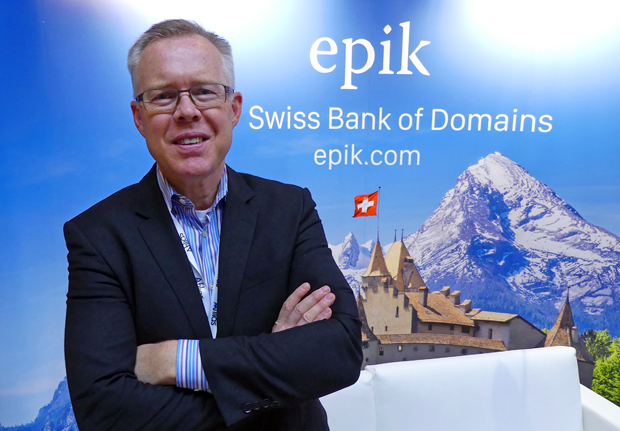
Event photograph: Ron Jackson / DNJournal.com, January 2017.