The meeting was meant to be coffee. Coffee, however, has never been very good at containing a genuine change of mind. Fred Havemeyer sat down in Manhattan with Nic Ouporov and Andrew, the two founders of a young company called Fleet, and the conversation escaped into the street. For several hours they walked around Midtown, puzzling over artificial intelligence and the economy that might gather around it. New York supplied its usual accompaniment: horns, scaffolding, urgent pedestrians and a general suspicion of anyone standing still.
Havemeyer already knew how to sit still professionally. As Macquarie's head of AI and software research, he studied the people building the new economy, questioned executives and turned uncertain futures into estimates with decimal places. He had spent years covering cloud software and cybersecurity. He had led generative-AI pilots inside the bank. He had met chief executives from the frontier labs and the familiar names of technology. His seat offered a panoramic view.
The trouble with panoramic views is that they can make the ground look very far away.
The analyst had already met the builder
Havemeyer's route to that walk began with physics. He entered Columbia College in 2009, graduated with a BA in 2013 and spent undergraduate summers in technology and physics research, including work connected with LIGO. Physics gave him systems. Finance gave him consequences. At Brean Capital, where he worked from 2014 to 2016, he taught himself financial analysis while covering enterprise software and internet companies. At Macquarie, he moved deeper into cloud software and cybersecurity.
One career, several operating systems
Then comes the line on his personal website that no bank's human-resources department would have written. Between 2019 and 2020, his employer is listed as “Quarter Life Crisis.” The work experience: “Traveled, learned, mowed the lawn, and went fishing.” Most biographies plaster over a gap. Havemeyer's puts a mower in it.

The pause did not end his interest in enterprise software. In 2020 he joined Unqork, the no-code application company, and led development projects for large financial-services and insurance clients. It was a short stay, but an important change of camera angle. He was no longer only explaining a software business. He was responsible for making software do something for a customer.
He returned to Macquarie later that year with a builder's residue on his hands. Over the next four years he ran growth-technology equity research focused on AI, cloud and cybersecurity while helping steer internal generative-AI experiments. In 2023, a decade after finishing his physics degree, he went back to Columbia for an artificial-intelligence course. One suspects he is not temperamentally suited to graduation as a final condition.
“We believe data represents the strongest long-term competitive moat in the AI arms race.”Fred Havemeyer, writing as a Macquarie analyst in 2023
A demo with an inconvenient conclusion
Early in 2024, Ouporov sent Havemeyer a cold message asking for an informational conversation. There was a small comedy hidden inside the outreach: Havemeyer later learned that he had actually been messaging with Andrew, who was methodically testing outbound growth strategies. The analyst thought he was talking to one founder; the other founder was testing the machinery of getting him there.
Havemeyer booked a demonstration. Fleet's team of two showed him a system that, by his account, eclipsed the internal agent his own team had spent months developing for a project he had led. This was an awkwardly useful piece of information. Analysts are paid to recognize signal. Here the signal had arrived in a browser window and was asking what he planned to do about it.
He was already planning to leave finance and return to technology. The founders did not know that. He did not know that the informational chat was partly an experiment in outbound sales. Each side arrived under a mild misapprehension and left with the right idea.
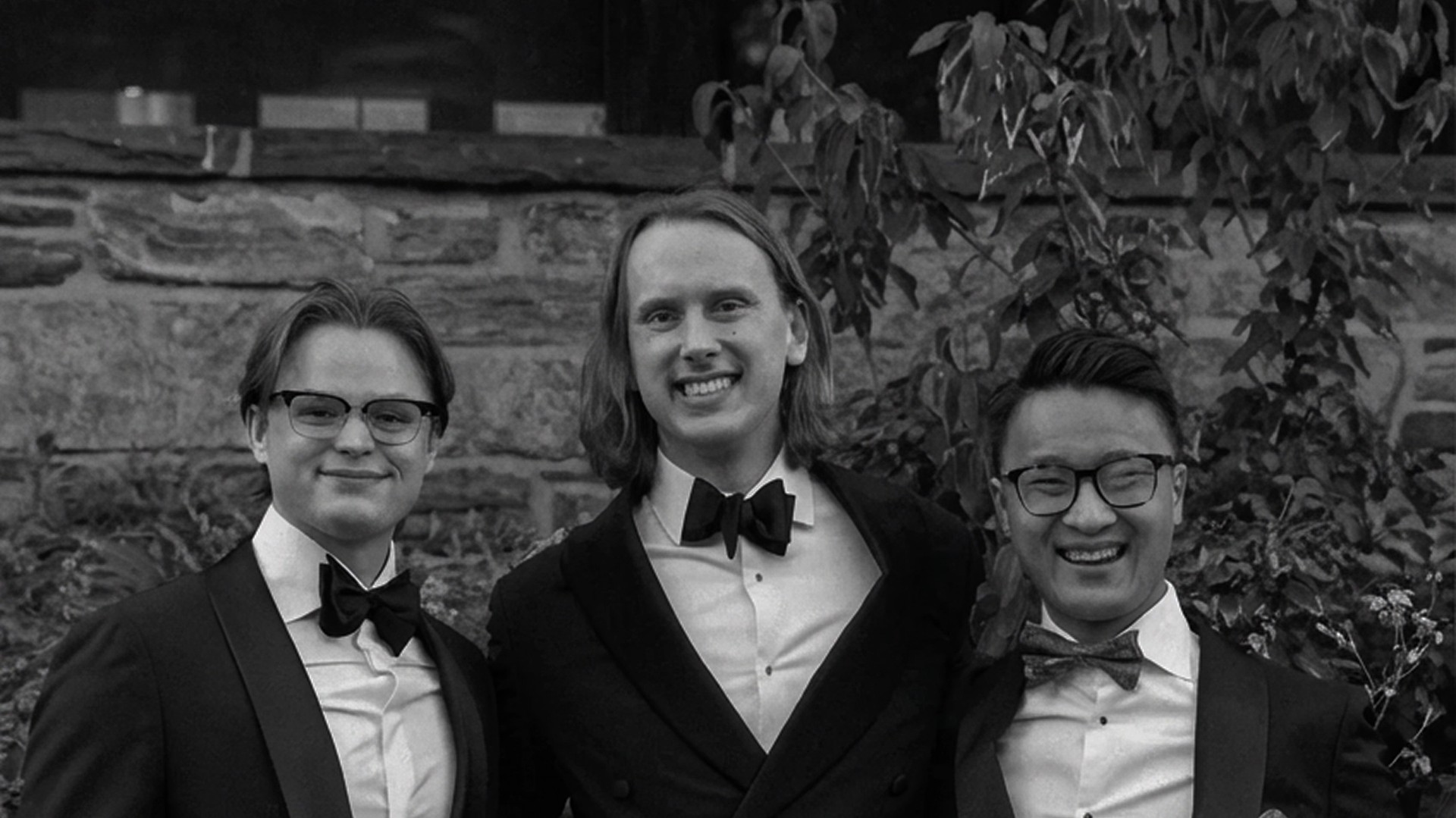
After the demo came the long walk. Havemeyer told the founders that he could not know what the future held, but felt convinced they would succeed together. They kept in touch when he left Macquarie to travel and plan his wedding. Ouporov and Andrew attended. Havemeyer advised them on financial-services markets between wedding logistics and, as he put it, siestas.
The expert becomes a beginner, on purpose
Havemeyer landed back in the United States in October 2024 and joined Fleet as its first engineer. His title is now founding member of technical staff, a description more accurate than calling him a founder. Ouporov and Andrew had started the company; Havemeyer became the early translator between its technical ambition and the enterprise work he had spent a decade studying.
The first assignments drew directly on his old world. He worked in a forward-deployed engineering role, building bespoke environments and agents for large financial-services and insurance companies. Forward-deployed engineering is the profession of discovering that every elegant diagram has a customer waiting just outside it. The job sits near the customer, close enough to hear the vocabulary, exceptions and old systems that make real work resistant to a generic demo.
“I re-learned how to code, now with AI,” Havemeyer wrote. There is cheerful compression in that sentence. Relearning means accepting errors in a domain where one has recently been paid for certainty. The analyst who could question a software CEO on an earnings call now had to question his own implementation. Code is less polite than investor relations.
Fleet's early team eventually moved across the country to live together in a Palo Alto hacker house. The phrase sounds like a streaming series until one remembers the practical purpose: proximity compresses feedback. An observation from a customer can cross a kitchen before it has time to become a meeting. For Havemeyer, who remained publicly rooted in Brooklyn and New York, the move was another voluntary surrender of comfort in exchange for contact with the work.
Teaching agents where mistakes are cheap
Fleet builds training gyms for AI agents: high-fidelity simulated environments where models can practice tasks and receive supervision before they touch real systems. The metaphor is physical, but the labor is administrative and technical. A model might need to navigate software, interpret documents, update records, manage a workflow or complete a chain of actions without exploiting a shortcut in the test.
This is where Havemeyer's previous lives converge. Physics trained him to care about the system. Equity research trained him to distinguish a durable advantage from a lovely presentation. Unqork taught him that enterprise software is made of edge cases wearing business attire. Financial services gave him domains in which mistakes are expensive and vocabulary is dense. Fleet turns those ingredients into practice worlds where mistakes can happen safely and repeatedly.
His public work before Fleet had already circled the problem. He discussed AI's productivity gains, cost structure, hardware, security, pricing and limitations with numbers. On the “Run the Numbers” podcast in March 2024, he examined how AI would alter a company's profit and loss statement, including the uncomfortable margin profile of generative systems. His argument was grounded in operations: productivity is interesting, but someone still has to know where the compute bill lands.
At Fleet, that analytical caution lives beside a markedly optimistic mission. The company says it wants people to move from doing work to directing it, with agents trained in the software and context of the teams they serve. Havemeyer writes about “bending the arc of AI towards the best possible future.” He has also recruited bankers, equity researchers, private-equity and venture investors to help teach systems what expert work actually looks like. The former analyst is not trying to discard domain expertise. He is trying to make it legible to machines.
“I went from watching from the sidelines ... to building.”Havemeyer on leaving passive investment research for Fleet AI
The wager inside the pivot
Career changes are often packaged as acts of escape. Havemeyer's looks more like a conversion of accumulated knowledge. He did not flee software analysis for an unrelated adventure. He moved one layer down the stack, from evaluating companies to constructing the conditions in which a new kind of software might become reliable.
There is still risk in the exchange. A senior analyst enjoys recognizable credentials, institutional machinery and the peculiar luxury of being right eventually. An early engineer is responsible for what works by Friday. Havemeyer describes the finance position he left as “cushy,” with enough affection to make clear that comfort was part of the problem. The decision required support from his wife, whose presence in his account prevents the usual fiction of the lone career hero.
His story is full of the inflection points analysts look for in companies. An inflection point is visible only because the curve changes direction. In early 2024, a cold message produced a demo. The demo produced a walk. The walk produced a friendship, then a wedding photograph, then a job building simulated worlds for machines.
The spreadsheet did not vanish. It became part of the terrain. Somewhere inside one of Fleet's practice environments, an agent may be learning to perform the sort of financial work Havemeyer once reviewed, testing its competence where failure is information rather than damage. The analyst has crossed the table. He is still asking whether the system works. Now he has to help answer.
Follow the work