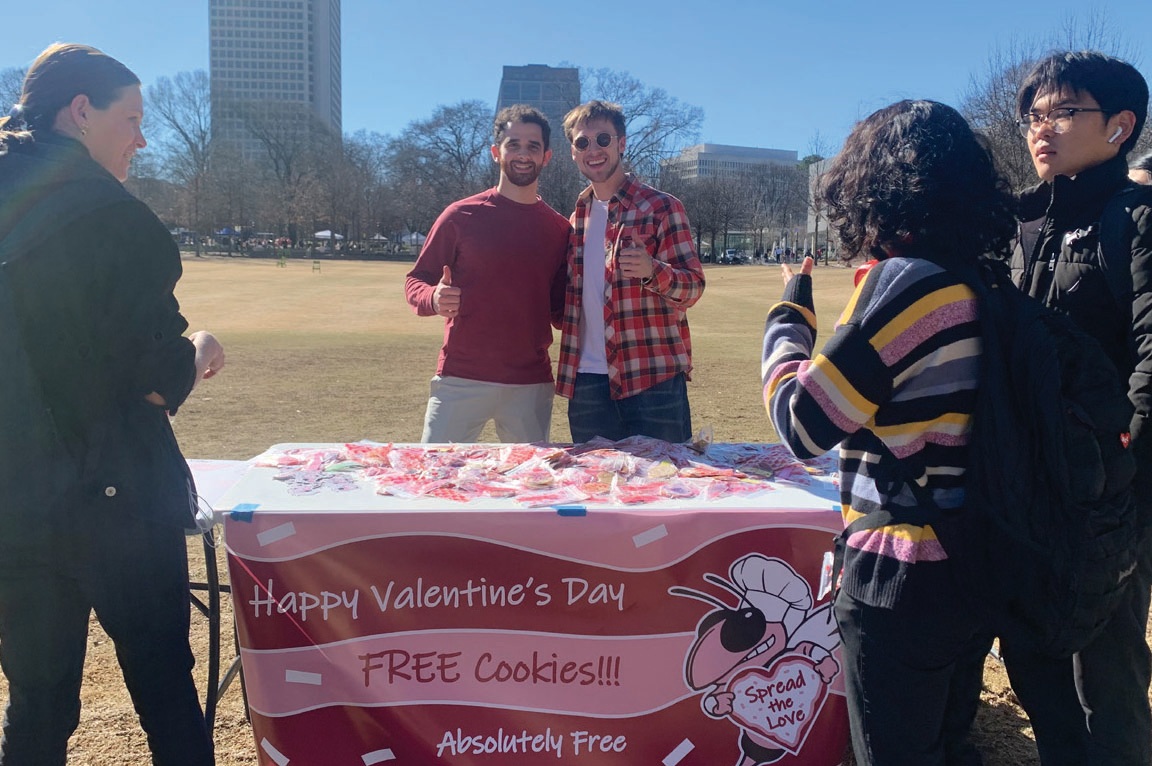
The stickers arrived thirty minutes before the cookies went out. This was fortunate, because Austin Rowland and his friends had already endured three sleepless nights, a thousand handwritten messages and the discovery that two ovens place rather firm limits on a person's charitable ambitions. The replacement shipment was the final crisis in a week of them. Then the table opened on Georgia Tech's lawn, and the crisis became a party.
Students came for homemade cookies, a Buzz sticker or simple curiosity. They signed a large banner. They left smiling. Within an hour and a half, the thousand cookies were gone. The operation had consumed more than 100 hours of work. It had also made its point with the brisk efficiency of a good demonstration: impact did not have to wait for a bigger budget, a distant title or some future version of oneself.
Rowland said as much at the time. The idea was to show that changing someone's day need not be “this huge grandiose thing” reserved for later. You could do it now. This is a useful thought to keep nearby when considering his present job in San Francisco, where the table has become an API platform and the arriving crowd may not be human at all.
The good sense to make fewer cookies
Spread the Love began on Valentine's Day in 2023, when Rowland and his friend Jared Abrahamian were both single and Abrahamian proposed what he called a crazy idea: bake an enormous number of cookies for other students. They first imagined 5,000. Reality, that stern but helpful project manager, negotiated them down to 500. The two made the batch themselves and gave every cookie away.
The following year they recruited four friends, doubled production and asked more than 100 students to contribute positive messages. Rowland's girlfriend, Bethanie Penna, and Abrahamian wrote most of the notes. Stickers went to the wrong address. Friends were called in. The ovens kept their own unhurried counsel. By the time students queued at the table, the disorder behind the event had been transformed into something that looked effortless.
There is an engineer's lesson hiding in the confectionery. Scope is not surrender. The retreat from 5,000 cookies saved the idea; the first 500 created evidence; the evidence attracted helpers; the helpers allowed the system to grow. Rowland's public profile now counts more than 4,000 cookies distributed since the project began, each paired with a handwritten message. It is difficult to imagine a less automated route to scale, which may be why the result felt personal.
A warning delivered from the stage
By then, Rowland had acquired several of the credentials that encourage a young professional to become unbearable at dinner. He was studying computer engineering at Georgia Tech. He had worked as a software engineering intern in Cisco's security engineering organization. He had led a campus chapter, built projects and documented his days online. Yet his 2023 TEDxGeorgiaTech talk was not a victory lap. Its title was “Ambition Might Be Your Achilles Heel.”
He had no prior public-speaking experience, he later wrote. Onstage, he separated ambition from discipline. The first expands the field of possibility; the second moves a person across it. He urged ambitious people to use gratitude as a way to recharge, to return to basic sources of happiness when the future became too loud, and to ask a corrective question: “Am I becoming the person I want to become?”
“You can do anything, but you can't do everything.”Austin Rowland, reflecting on his TEDxGeorgiaTech talk
The line has the neatness of a slogan and the inconvenience of good advice. It asks for selection. Rowland's early projects show him learning that selection in public: 500 cookies rather than 5,000; the right contribution rather than every contribution; a day described as it was rather than buffed into legend.
His Cisco internship video is revealing in this respect. The day starts at 7 a.m. in the gym, moves to remote engineering work in the Georgia Tech library, pauses for lunch bought with his resident-assistant dining allowance, detours to the Blue Donkey coffee shop and ends at Cisco's Atlanta office with project work and a mentor conversation. It is not an origin myth. It is a calendar.
The resident-assistant job deserves its place in that calendar. Rowland recommended it because it saved money, but also because it offered a direct way to affect other students' lives. The same day could contain code, a conversation with a resident, coffee-shop familiarity and an office mentor. Rather than trim those identities into one approved professional silhouette, he began to argue that their overlap was useful. A person who practiced making strangers feel welcome on a residence-hall floor might notice different things in a product meeting. A person who enjoyed making videos might explain an internship to the next student more clearly than a recruiting brochure could.
His internship reflection thanked co-interns, project leads, onboarding staff and mentors by name. The list was long enough to reveal how he understood the summer: not as a solo performance, but as a network of small investments. He urged people seeking mentors to consider what they could offer in return. Reciprocity, in his telling, was less a networking tactic than good maintenance. Relationships also fail when treated as one-way infrastructure.
Looking back on Cisco, Rowland wrote that the most important lesson was to make mentoring reciprocal and to “add value to everything” - not merely the assigned technical project. He also argued for lowering the wall between professional and personal interests. His content-making, once treated as outside work, became another way to contribute inside it.
That instinct matters in forward deployed engineering, a role designed around the messy region where a product meets a customer's actual system. It rewards translation. The engineer must understand what the software can do, notice what people are trying to do, and remain cheerful in the distance between those two facts.
The user who leaves without complaining
At Postman, Rowland spent nine months embedded with some of the world's largest API programs as they prepared for AI agents. On his walk to the office, he kept passing a company billboard that asked whether their APIs were ready for those agents. Field work supplied a sharper version of the question.
For decades, the expected API user was a developer. That person could read documentation, create an account and ask support for help. An agent behaves differently. It reads the available surface, attempts the integration and proceeds. When it encounters ambiguity, Rowland observed, it does not necessarily open a ticket. It may quietly choose a competitor it can use.
the API
become context
or exits silently
The response was an AI-ready API assessment that scores a public API surface and produces an evidence-backed report on where an agent gets stuck. It is a product shaped by proximity: observe the customer, name the friction, make the friction visible. Postman Governance, Workspaces and allied tools then address different parts of the route, from enforcing standards to giving partners and their agents usable context.
The assessment also turns an abstract executive concern into a sequence of inspectable failures. “Ready for AI” can otherwise mean almost anything, which is convenient for a slogan and useless for a repair list. A graded report forces the conversation toward particulars: what can the agent discover, what can it understand, what can it execute, and where does the path become uncertain? Rowland's field role sits inside that conversion from anxiety to evidence. It is less glamorous than declaring a revolution and considerably more useful.
The distance from a Valentine table to API governance is considerable. The operating pattern is not. Both begin by refusing to treat the user as an abstraction. The student needs the message to feel handwritten because it is. The developer needs an example that runs. The agent needs a surface clear enough to parse without the saving grace of a patient support engineer.
“When it gets stuck, it doesn't open a ticket. It silently switches to a competitor it can use.”Austin Rowland on AI agents as API consumers
The discipline after the ambition
Rowland's career is still early enough that any grand conclusion would be comic. The verified record is compact: Georgia Tech from 2020 to 2024; a Cisco internship; a TEDx stage; selection as one of nine finalists in a 2024 Mayo Clinic startup competition; a community project whose output can be counted in cookies; and a founding forward deployed engineering role at Postman.
What distinguishes the record is not its length but its recurrence. He makes the work visible. He speaks about the lesson while it is fresh. He treats communication as part of engineering and community as something built through logistics, not wished into being. Even the cookie project is less charming when described accurately: it required procurement, production, packaging, volunteer coordination, contingency planning and distribution. Charm was the user interface.
The AI era has produced no shortage of people announcing that everything has changed. Rowland's contribution is more grounded. A new user has arrived. It behaves differently. Go and watch where it fails. Then improve the route. This is not prophecy. It is field work.
And so the billboard question follows him into the office, while an older question follows beneath it: Am I becoming the person I want to become? One concerns the readiness of APIs. The other concerns the readiness of their builder. Neither is answered once. That may be why Rowland keeps choosing projects that answer in public - a stage, a post, a report, a table on the lawn. Ambition opens the horizon. Discipline, carrying a tray and checking the address on the sticker shipment, gets there.