A mother sent Frank C. Girardot a series of text messages about her son. Antonio “Tony” Ramirez had been killed at a party in 2002. Nearly a decade later, his family still had no answers. Margaret Gutierrez-Ramirez wanted the newspaper editor to look into it. He agreed. Then one unanswered case opened into a much larger question: how many other families were waiting?
The result was “Getting Away with Murder,” a Los Angeles News Group investigation examining homicides across the county between 2000 and 2010. The project encompassed 11,242 deaths. Behind the intimidating number was something quite small: a person contacting another person and asking him to pay attention.
That exchange is a useful place to meet Girardot. His résumé contains newspaper editorships, true-crime books, a public relations company and years explaining electric vehicles. Those jobs can look like separate careers. Follow the people asking questions, supplying answers or hoping a troublesome question will disappear, and the route becomes easier to understand.
A reporting project that grew from a mother’s request for answers.
The career adviser’s unfortunate forecast
Girardot was born in Detroit and grew up in Northern California. As a high-school sophomore, he read All the President’s Men and decided he wanted to become a reporter. Hunter S. Thompson helped confirm the choice. The books offered a persuasive prospectus. His career adviser supplied a less encouraging one.
Father Clemo told him journalism had no future after All the President’s Men. Girardot later recalled the exchange when explaining why he had never worked on his high-school newspaper. There is a certain administrative efficiency in declaring a profession finished just as a student discovers it. Fortunately for Girardot, the forecast did not settle the matter.
He began as a copyboy at the Los Angeles Herald-Examiner in the late 1980s. After that paper closed, his newspaper route included the Ontario Daily Report, San Gabriel Valley Tribune and Pasadena Star-News. His assignments ranged across disasters, courts, politics and sports, including the O.J. Simpson murder trial. It was an education conducted in public, with deadlines.
In 1994, he reported on the unsolved killing of Geneva Hilliker Ellroy, mother of novelist James Ellroy. The reporting helped lead to Ellroy’s My Dark Places. A newspaper story had become part of another writer’s return to a family mystery. Girardot’s own books would repeatedly inhabit that territory where the public record and a private life refuse to stay neatly apart.
The work brought recognition in more than one department: an investigative-journalism award in 1995, a first-place sportswriting award in 1998, and a place among the 2015 investigative data-journalism award finalists. The mix matters. His newspaper career had room for a game as well as a criminal case, and for a database as well as a single interview. The eventual move into several kinds of storytelling had precedents long before an agency appeared on his business card.
A famous surname, available for borrowing
The subject who brought Girardot a particularly durable book was Christian Gerhartsreiter, the impostor known as Clark Rockefeller. Name Dropper: Investigating the Clark Rockefeller Mystery appeared in 2013. A decade later came Becoming Clark Rockefeller, an updated account drawing on interviews, court documents and access to the impostor himself.
The underlying case reached back to the 1985 disappearance of John and Linda Sohus from San Marino. A backyard discovery of human remains in 1994 revived the investigation. Gerhartsreiter’s adopted identities and passage through affluent circles made the story travel far beyond Southern California. The name Rockefeller did a remarkable amount of introductory work.
In discussing the deception, Girardot pointed to a combination of charisma, social status and convincing lies. People responded to the standing they believed the surname conferred. It is an observation with uncomfortable implications for anyone who regards a polished introduction as a background check. The audience was helping the performance along.
By 2023, Girardot was also comparing the case with Anna Sorokin’s. He challenged an earlier assumption that abundant information on the internet would make elaborate invented identities impossible to sustain. More information had not abolished the attraction of a persuasive persona. For a reporter who also works in communications, that distinction between what sounds credible and what survives examination is rather close to home.
The investigator’s daughter takes the other chair
Another of Girardot’s subjects wore an occupational credential that ought to have been reassuring: arson investigator. John Orr was also a convicted arsonist. Girardot covered Orr’s trial, then returned to the case from a different direction when Orr’s daughter, Lori Orr Kovach, became his collaborator on Burned.
Kovach had testified on her father’s behalf in 1998. Years later, she approached WildBlue Press with a book, and the publisher connected her with Girardot. Their collaboration brought together someone who had encountered Orr through court proceedings and someone who had known him as a father. The same person occupied very different places in their lives.
The book’s public presentations made that partnership visible. In February 2019, the two appeared at South Pasadena’s library, in the community where the 1984 Ole’s Home Center fire had killed four people. Orr was convicted of those murders in 1998. The location gave the discussion a connection to the people and streets involved, beyond the book jacket.
Girardot’s other collaborations include A Taste for Murder, with Burl Barer, and Betrayal in Blue, with Barer and former New York police officer Ken Eurell. Different books bring different forms of access. A daughter’s account, a participant’s recollections and a reporter’s reconstruction each require their own questions. A shared cover does not make those perspectives interchangeable.
- 1980sThe copyboy
- 2013The book author
- 2015The agency founder
- 2026The next chapter
When the reporter starts taking the calls
In 2015, Girardot founded Pegasus Communications in Arcadia. The agency describes its work across corporate, government, marketing and outreach communications, and identifies him as CEO. After years spent deciding which claims deserved a newspaper reader’s attention, he was offering organizations help in reaching that reader.
The move changes the assignment. An editor can pursue a question because it needs answering. A communications adviser is retained to advance an organization’s interests. Girardot’s career puts both responsibilities in view. Experience with a skeptical newsroom is useful preparation for anyone who must explain a business to one.
His corporate chapter included more than seven years with BYD and its U.S. spinoff RIDE. By early 2026, he was serving as RIDE’s senior director of communications. His work put electric school buses, manufacturing and transportation into the foreground, a considerable change of subject from a borrowed Rockefeller identity.
In a May 2026 interview at ACT Expo, Girardot and Jason Shi discussed school-bus demand, charging, grants, vehicle-to-grid technology and American production. These are practical questions with practical audiences: school districts have routes to run and budgets to consider. A compelling account of a vehicle still has to explain how it will do the job.
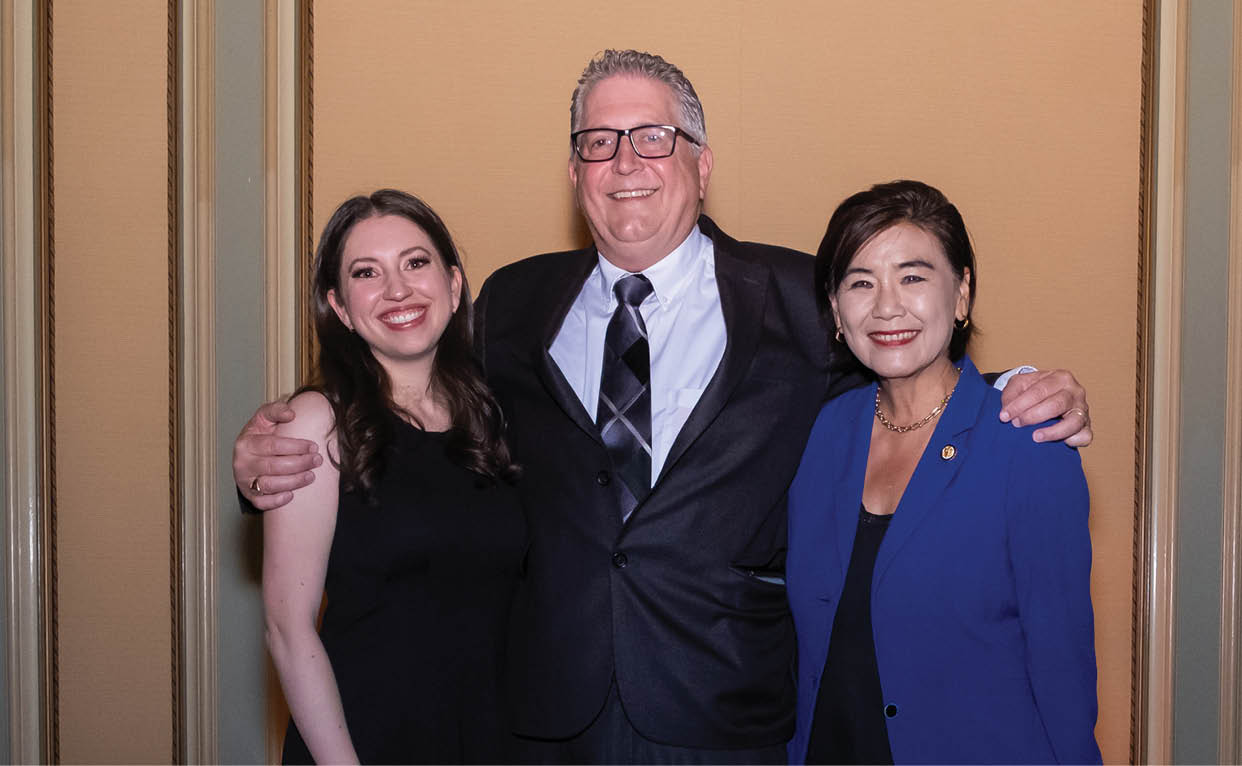
Pasadena, from the press table to the podium
On June 27, 2025, Girardot was installed as chair of the Pasadena Chamber of Commerce’s board for the 2025–26 term at the Langham Huntington Hotel. The former local editor now had an official role in the civic and business community he had helped cover.
The gala included scholarships for students leaving foster care and grants for businesses displaced by the Eaton Fire. The ceremonial handover shared the evening with tangible assistance. In his welcome to chamber members, Girardot emphasized networking, workshops and opportunities for businesses to become better known. The organization offered another setting for connecting people who might have reasons to talk.
By October 2026, he was scheduled to moderate a panel on Pasadena as an innovation hub at the chamber’s Business and Economic Summit. His work had taken him from asking questions for a newspaper to asking them in a room of business leaders. The microphone had changed hands; the local geography remained familiar.
There is always another message
Girardot’s newer work brings the reporting and communications strands alongside each other again. His public professional profile now lists Viewoak Strategies. After leaving BYD and RIDE in 2026, he shared crisis-communications advice that stressed early candor, consistent messages and relationships established before trouble arrives.
“Build the relationships before you need them.”
Advice shared by Frank C. Girardot, 2026
Meanwhile, his Area 51 publication continues across crime, politics, culture and current events. In September 2026, he described The Index, a podcast with J. Brian Charles whose discussions had ranged from the NFL to the Los Angeles mayoral race and 1990s rap. He invited suggestions for topics and guests. There was room, he said, for authors, advocates and people with expertise.
His continuing collaboration with Barer has also produced Where Murder Lies: Death and Deception in West Hollywood. The book reexamines a 2004 murder and the conviction of Jimmy Kitlas, arguing that the accepted account requires another look. The argument belongs to the authors; the decision to revisit a supposedly settled story is familiar Girardot ground.
Asked to name a favorite fictional journalist, he answered, “Hands down, Raoul Duke.” Thompson’s unruly alter ego is an entertaining choice for someone who has also had to speak for a corporation. It sits beside the career adviser anecdote as evidence of what Girardot finds memorable: the writer who made journalism attractive, and the adult who thought the attraction had arrived too late.
There is a guitar in this life, too. Girardot plays in Thunderheart, the band he formed in Temecula with actor Dean Norris. It is a welcome detail in a biography crowded with courtrooms and communications titles. He has room for both an amplifier and a byline.
The unanswered text messages offer a better ending than a list of positions. A family wanted someone to keep asking. Girardot answered, and the assignment grew. Years later, across books, agencies and a podcast open to suggestions, people still have ways to bring him a story. The next one may already be waiting.
Keep the conversation going
Read Area 51, explore Pegasus Communications, or find Girardot on LinkedIn, X, Instagram and Facebook.
Watch: Girardot and Jason Shi at ACT ExpoMore to explore: books and author biography · the career-adviser anecdote · The Index podcast announcement.