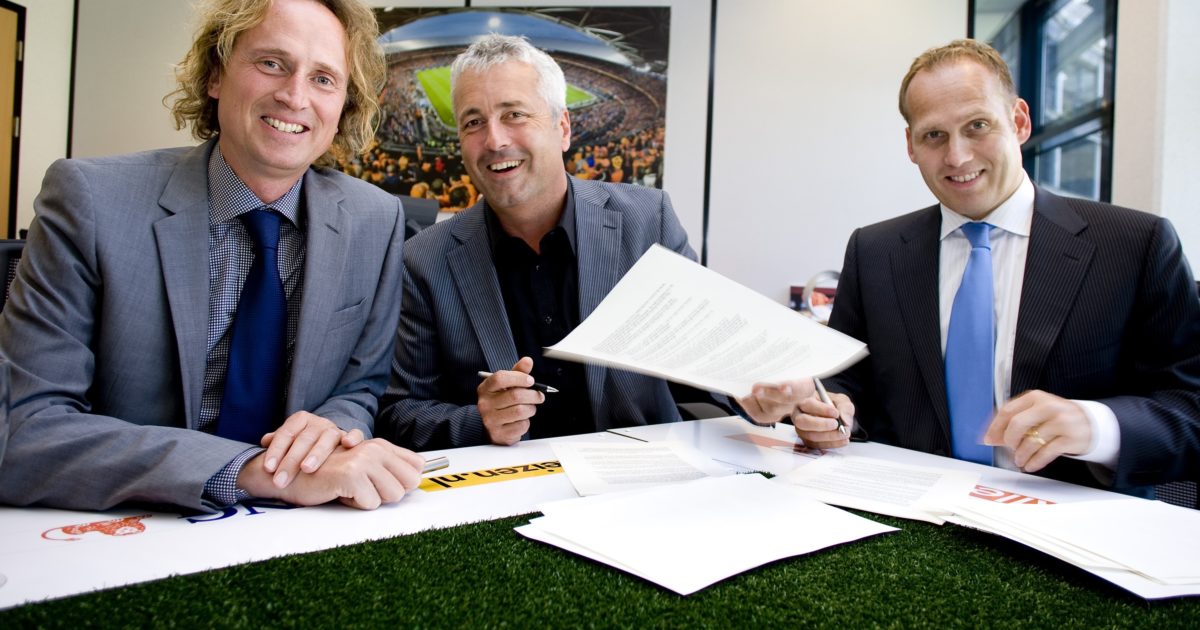
The picture was made for an older version of the internet. Three executives sit behind a conference table in Zeist, smiling over a freshly signed agreement. A sheet of artificial turf covers the table. Papers overlap. A stadium photograph fills the wall behind them. On the left is Frank Bijman, then commercial director of De Lotto, helping formalize Toto’s sponsorship of the KNVB Cup in September 2009.
It is an unusually literal image of marketing. The product is betting. The context is football. The prop is grass. Everyone in the frame can see the connection.
Bijman’s present-day work is harder to photograph. He is Chief Marketing Officer at Boyd Interactive in Toronto, a business built from Pala Interactive’s online-gaming technology. The company’s systems support real-money and social gaming for operators and consumers in regulated markets. The machinery includes player accounts, casino and poker products, content integrations and managed services. Much of it sits behind the experience rather than in front of a camera.
Between the turf-covered signing table and the software platform is a compact history of gaming’s digital turn. Bijman’s public record follows the industry as marketing expanded from television formats, sponsorship inventory and retail tickets into apps, partner platforms and a customer journey assembled in code.
Before the platform, there was the program
At De Lotto, Bijman’s job lived where gaming brands met popular culture. In January 2009 the lottery returned to television with Battle of the Stars, an RTL format in which Dutch celebrities competed in sports and selected a sports club to support. The daily Lucky Day draw was placed just before the finale of the word game Lingo. These were not isolated advertisements. They put the product inside programming that already had a rhythm and an audience.
The same logic appeared in sport. During 2009, Bijman spoke for De Lotto as it announced relationships with the national gymnastics union, the Judo Bond Nederland and the Dutch volleyball federation. The arrangements mixed elite competition with participation below it: national teams, championships, beach-volleyball circuits, sports schools and local clubs. A betting brand could be present at the top of the pyramid while explaining how revenue moved back toward its base.
“Toto is emotion; emotion is football.”
That was Bijman’s concise line when Toto became a KNVB Cup sponsor. It is a plain statement of fit. Football supplies uncertainty, loyalty and a calendar of shared moments. Toto supplies another way to participate in the outcome. The partnership did not need an elaborate metaphor because the two products already occupied adjacent emotional territory.
The commercial structure reached down to amateur football. Participating clubs could receive a one-time amount for a member who joined through Toto and a percentage linked to that member’s stakes. In 2011, a renewed KNVB agreement made Toto a principal sponsor of Dutch amateur football. The public announcement said Toto had donated more than €4 million to amateur football that year. Brand visibility, customer acquisition and club funding were presented as parts of the same loop.
A jackpot writes its own deadline
Lottery marketing has one advantage that most packaged goods do not: the product can generate a news event by itself. In June 2010, De Lotto’s jackpot had climbed to €27.5 million after going unclaimed week after week. One more rollover could have produced what was then described as the highest jackpot in Dutch history.
Bijman called the long run exceptional and described the mood at De Lotto’s headquarters as feverish. The useful detail is that nobody in the building controlled the ending. Either a player would win, or the amount would rise again. Rising ticket sales reflected suspense already present in the product.
The episode shows a particular kind of restraint. When a product contains genuine tension, the marketer’s job is to translate the stakes, not invent them. The number, the deadline and the unresolved outcome do the heavy lifting. A similar discipline appears in the sports deals: find the place where the product makes sense, then make the economic connection visible.
By 2012, Bijman was still identified as De Lotto’s commercial director during work around Eurojackpot, the newly launched European lottery. A testimonial from that period praises a brand-building process that used a clear sequence of models and questions. It is one of the few public glimpses of his preference as a working executive: start with identity, give the team a framework and make choices that can guide later marketing.
From buying attention to owning the rails
Pala Interactive represented a different layer of the business. Founded in 2013, it developed an online-gaming platform for real-money and social play. Its technology covered player account management, casino, poker and social products, with marketing integrations and optional support services. It could operate directly with consumers and supply other gaming businesses.
For a CMO, that combination changes the audience. Consumer marketing needs a clear reason to play and a smooth experience after the click. Business-to-business marketing needs evidence that the platform can integrate, operate and serve a regulated market. The buyer may be an operator, but the operator is evaluating what its own players will eventually experience.
accounts · games · integrations
brand · market · service
access · play · loyalty
Bijman’s public endorsement of a digital agency gives another small clue about the newer marketing mix. He cited campaigns across Facebook, Instagram and TikTok, along with the need to adjust creative and budgets quickly. Compared with a multi-season sponsorship agreement, social acquisition is measured and changed at a much faster tempo. The old question of audience fit remains, but the feedback arrives by the hour.
The product also keeps more of the promise than it did in a television spot. A viewer could enjoy a sponsored program without buying a ticket. In an app, the distance between message and experience collapses. Registration, navigation, game choice and support all become evidence for or against the campaign that brought the player there. Marketing cannot hand the customer to a separate digital department and declare the work finished. Its claims are tested screen by screen.
This is where his two chapters meet. De Lotto borrowed distribution from broadcasters, sports bodies and clubs. Pala built technology that could distribute through other gaming operators. One model places a brand beside an audience. The other gives partners the tools to serve one. Both ask marketing to understand the route between product and player, not merely the message at the end of it.
The acquisition and the longer game
On March 28, 2022, Boyd Gaming announced an agreement to acquire Pala Interactive for $170 million in cash. Boyd said the deal would give it control over technology, development and customer experience while supporting a regional online-casino strategy. At the time, Pala provided B2B services in eight US states and Canada and operated consumer offerings in New Jersey and Canada.
The transaction closed on November 1. Boyd’s subsequent reporting grouped Pala Interactive and Pala Canada under the Boyd Interactive name. The company described the acquired business as a provider of proprietary B2B and B2C solutions in regulated US and Canadian markets. Bijman remained in the marketing seat, now under an owner with a national portfolio of physical gaming properties and an explicit plan to grow online casino operations.
That continuity matters. Acquisitions often make the transaction the story, but the daily work begins after the announcement. A new parent brings its own customer relationships, properties and strategic expectations. The acquired company brings product knowledge and operating routines. Marketing has to connect the two without blurring what each side contributes.
Bijman’s career offers no tidy founder myth and little public autobiography. The documented work is more practical: a television format aligned with a lottery brand, sports agreements designed to reach federations and clubs, a record jackpot turned into a national moment, a European lottery given a clearer identity, and a platform company carried through a nine-figure acquisition.
Read together, those moments show an executive moving upstream. The early work made the wager culturally legible. The current work markets the infrastructure around it. What was once a ticket attached to a broadcast now sits inside an account, an interface, a content library and a regulated operating system. The customer still wants a simple experience. Producing that simplicity has become a much larger business.
The artificial turf in the 2009 photograph made the pitch obvious. Digital gaming removed the prop. Bijman’s job now sits in the gap between what the player sees and the complicated system required to make it work.