The Harlem Shake looked like a recipe for immortality: a simple format, endless variations, and an internet apparently willing to dance in almost any room. Gangnam Style had Psy. When Francesco D'Orazio and Jessica Owens followed the two phenomena through Twitter, the participatory hit proved the shorter-lived of the pair. Under their definition of sustained sharing, Gangnam Style lasted 172 days. Harlem Shake lasted 29. The crowd had made more versions. It had not bought itself more time.
For D'Orazio, this was a problem worth taking seriously. A video could be everywhere without travelling in the same way as another video that was everywhere. Counting views left much of the explanation untouched. Who passed it on? Which groups picked it up? What happened when the first audience had finished with it? His career has taken shape around those questions, often in places where everyone else was enjoying the spectacle.
A rumour finds a researcher
D'Orazio began university in 1997, as the web was becoming a conspicuous part of everyday culture. He studied how rumours moved through forums and blogs, then pursued doctoral research split between Italy and Canada. Alongside the academic work came an appetite for making things. Observing online behaviour offered one kind of satisfaction; building something people could use offered another.
His PhD in Sociology and New Media was awarded by Sapienza University of Rome. In 2005 and 2006, he studied within the McLuhan Program in Culture and Technology at the University of Toronto. By 2009, he and Stefano Mizzella were directing IULM University's Social Media Lab in Milan. London became his base, and the research and innovation agency Face became a place to put his thinking to work.
There is something pleasingly inconvenient about bringing that education into marketing. A campaign brief needs an answer by Friday. A social scientist is liable to ask what the question means. D'Orazio's subsequent work has repeatedly tried to make room for both demands: a usable product and a fuller account of the people behind its measurements.
Before the dashboards, there were avatars
His earlier ventures included ZZUB, a platform connecting brands and communities, and Myrl, a social network for avatars founded in 2007. Myrl belonged to an earlier wave of interest in virtual worlds. Long before the metaverse returned to corporate slide decks, D'Orazio was working on a gateway into it.
The detail matters because virtual worlds make the social part of technology hard to overlook. An avatar needs somewhere to go and someone to meet. A beautifully constructed environment can still be empty. The same distinction becomes useful when looking at a social platform, a brand community or a piece of content: technical availability tells you little about whether people will find a reason to stay.
His public work has also extended beyond one company. He co-founded the Visual Social Media Lab in 2014, followed by The Audiences Podcast and AudienceCON in 2023. The recurring subject is the audience, approached through software, research and conversation. The formats change; the interest in how people gather remains easy to recognise.
Avatars find a network
Audiences become the question
Following the stories
The office without the glamour
Pulsar launched in 2013. Its early setting was considerably smaller than the internet it hoped to understand. In a public recollection, James Cuthbertson described helping his friend start the company from a stationery cupboard off Tottenham Court Road. D'Orazio responded by crediting James and the original team for making Pulsar possible.
It is a useful correction to the smooth geometry of a founder biography. Company histories are usually drawn as straight lines between an idea and an outcome. A cupboard introduces a little perspective. Whatever the eventual sophistication of the software, someone still has to find room for the people making it.
At Face, D'Orazio helped develop Pulsar TRAC around questions of content, reach and audiences. Contemporary coverage described a platform that could track keywords, map groups and follow material through networks. The product reflected the research problem: a mention is more informative when you can see the company it keeps.
Two dances, two very different journeys
The Gangnam Style and Harlem Shake comparison gave that approach an unusually memorable demonstration. D'Orazio and Owens examined the five leading versions of each, tracing linked tweets and asking how attention moved. Gangnam Style centred on its original video; Harlem Shake spread through a proliferation of adaptations.
They defined a meme's active lifespan by a threshold of at least 500 Twitter URL shares a day. The 172-day and 29-day results describe that particular measure, rather than the entire cultural lives of the dances. It is a small qualification that makes the comparison more useful. A number becomes easier to understand when its boundaries are visible.
How long did the sharing last?
The finding resists a tidy instruction to make everything participatory. An invitation to join in can produce inventive local versions without sustaining the same breadth of attention. For a researcher, that complication is the interesting part. For anyone selling a universal formula for virality, it is rather awkward.
An astronaut, an advert, a bowl of cereal
A follow-up project with Twitter UK widened the cast. D'Orazio and Owens studied Chris Hadfield singing David Bowie's Space Oddity on the International Space Station, Dove's Real Beauty Sketches, Ryan Gosling Won't Eat His Cereal and footage of protests in Izmir. Few research programmes assemble quite such a dinner party.
Different patterns appeared. Some videos attracted a sudden rush of sharing; others built attention over more days. Hadfield's network had a substantial central hub. Other material travelled through constellations of smaller groups. The value of the exercise lay in making those differences legible, rather than filing every success under the same convenient word.
The distinction between watching and passing something on also became central. A view records an encounter. Sharing adds another decision, with a particular set of people in mind. The same clip can be entertainment for one viewer and something worth putting in front of friends for another. The audience helps determine the journey.
When a picture refuses to be a keyword
Working on images presented a related problem. A keyword search is an awkward instrument for a medium that can communicate without words. The Visual Social Media Lab brought Pulsar into collaboration with university researchers, including a community led by Farida Vis, to investigate how images circulate and acquire meaning.
At the lab's Picturing the Social gathering, the discussion included the structures hosting images, the people using them and the content itself. That combination made room for questions a simple recognition label would miss. Finding a car in a photograph tells you what is present; understanding why somebody posted it requires considerably more care.
D'Orazio's work on the visual identity of car brands asked whether consumer photographs reflected or distorted the image a brand had deliberately constructed. It is a wonderfully impolite question for corporate identity. A company may spend months specifying what it means. Its customers remain perfectly capable of having their own ideas.
A software founder asks for a better question
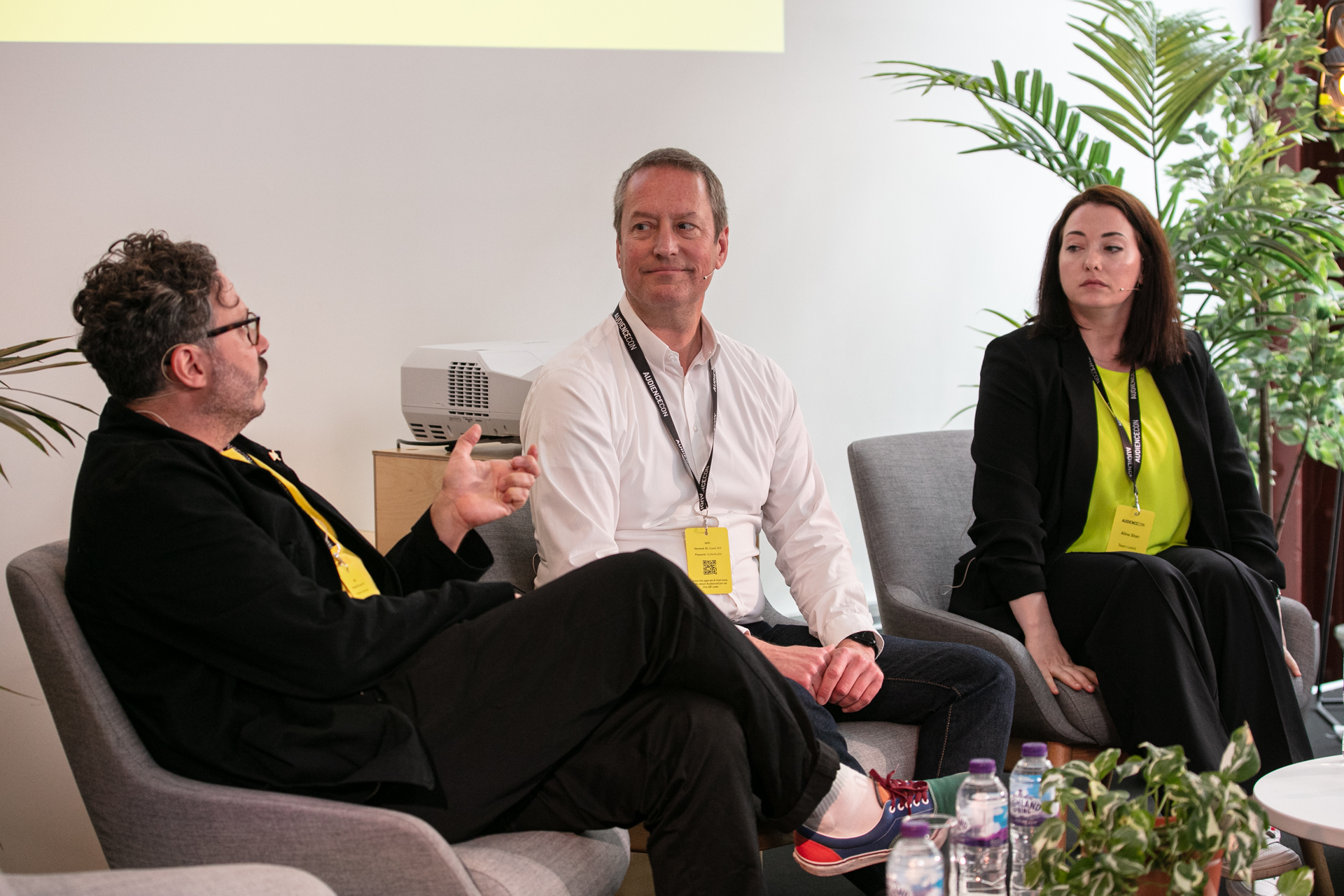
At AudienceCON, D'Orazio argued for combining research methods and beginning with a hypothesis. Even when data can be clustered and mapped, the researcher still needs an idea to test. The warning has particular force coming from someone who builds the tools that make those maps possible.
His formulation was modest: “it's about combining methodologies.” Surveys, observed behaviour and social conversation illuminate different parts of a problem. Putting them together requires decisions about what each can actually tell you. A dashboard may make an answer look finished before the thinking is done.
That practical concern also appears in his explanation of audiences: “Different communities look at the same topic and brand in very different ways.” For a communicator, the implication is demanding. A shared subject does not guarantee a shared interpretation. The message has to survive contact with the people receiving it, each bringing their own associations.
“Narratives AI combines quantitative precision with qualitative storytelling.”
Francesco D’Orazio / March 2025
Following the story beneath the conversation
In March 2025, Pulsar launched Narratives AI, a tool designed to group social and news material into the stories running through public discussion. D'Orazio, identified in the launch as Founder and President, presented it as a way to connect numerical analysis with the interpretation of stories.
The question had expanded from how a video travels to how a way of seeing the world takes hold. Later conversations with strategists Safaniya Stevenson and Michael Brito explored cultural interpretation and differences between media coverage and public discussion. A headline and the reaction beneath it may be discussing the same event while telling different stories about its significance.
His September 2026 Arctic report applies that approach beyond consumer brands. It examines three years of news and social narratives, including the growing prominence of sovereignty, security and economic questions. Analysts reviewed 313 leading Arctic narratives. The report distinguishes observation, inference and hypothesis, keeping the interpretation visible alongside the measurements.
The method makes an instructive distinction about attention. Its weekly series are normalised to each year’s own peak, so the shapes can be compared across years without treating them as equivalent volumes. That is the kind of detail a dramatic chart can easily obscure. Here, the caveat stays attached to the picture. Readers can inspect an argument about changing public conversation while keeping track of what the underlying measurements support.
That care returns the story to its starting point. Two dances could fill the internet and still follow different paths. An apparently shared conversation can contain different communities, motives and beliefs. D'Orazio keeps building ways to inspect those differences. The spreadsheet gets more interesting when the people are allowed back in.