At Hargraves McConnell & Costigan, a New York law firm, the trouble began after the paper had already become digital. Scanned documents were too large to move comfortably and lacked searchable text. The firm had an optical character recognition engine, or OCR, to fix that. But large files made it crash. A batch could take eight hours. The supposedly modern office had acquired a familiar problem: everybody waiting for a machine.
- Foxit sells tools to edit, search, sign, secure, and manage PDFs.
- Its customers include office workers, institutions, and developers embedding PDF features.
- The business case depends on the time around the document, as well as the software bill.
The firm licensed Foxit PDF Compressor with OCR for up to 75,000 scanned pages a month. In Foxit’s published account, batch processing fell to one hour. Files became smaller and searchable. The detail worth lingering over is the sequence: scanning had happened; useful digitization had not. Foxit sold the missing step.
A faster way into the file
Foxit began with a narrower irritation. Eugene Xiong started the company in 2001 because he disliked the available PDF software. Reader arrived in 2004. In a 2018 retrospective, he described the initial advantage with pleasing specificity: “less memory and rendered much faster.” A document reader could win by making the same document less annoying to open.
Then came a second route to customers. Foxit could sell the technology behind the application. Developers could incorporate PDF functionality into their own products. In December 2011, Amazon invested an undisclosed sum and announced a collaboration intended to improve PDF reading on Kindle devices and apps. The reader on somebody’s desktop and the component inside somebody else’s software were two ways to monetize the same expertise.
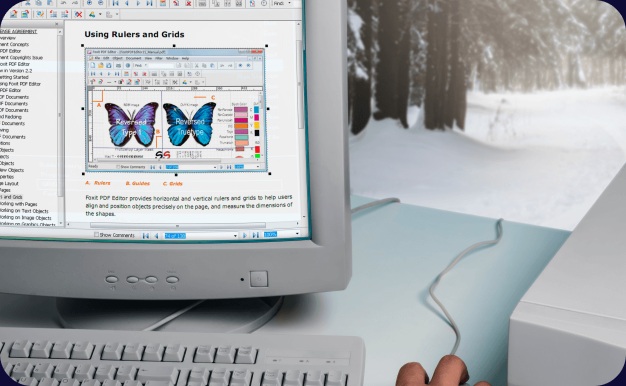
That expertise lives in unglamorous details: rendering pages correctly, handling fonts, converting formats, and making documents usable across operating systems. Foxit’s developer offering spans desktop, mobile, web, and server environments. A software team can license those capabilities rather than build its own PDF engine. The visible product might carry another company’s name.
Selling the next step
Today, free Reader is the easy entrance. PDF Editor supplies the workbench: create a document, change its contents, rearrange pages, recognize scanned text, or prepare forms. Editor+ bundles additional signing and redaction capabilities. Foxit eSign handles agreements as processes, with recipients, reusable templates, tracking, and audit trails. Its 2021 acquisition of eSign Genie expanded that signature business after the companies had already worked together.
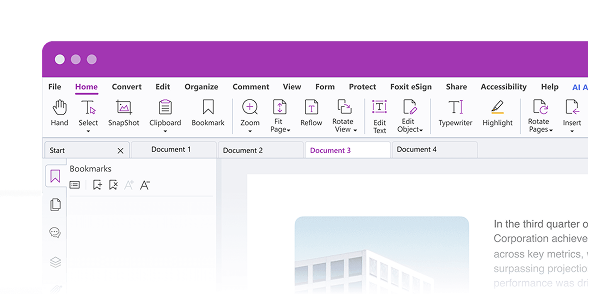
The product map makes sense if you follow a document. Someone creates it. Someone else corrects it. A third person needs to find a clause. Another person signs. A business needs a record of what happened. Each handoff creates another possible customer for Foxit, whether through an application, a cloud API, or server software processing an archive.
- 01Create
& edit - 02Search
& protect - 03Sign
& track - 04Store
& govern
That helps explain the customer mix. Published cases include Swansea University, air ambulance operator LifeMed Alaska, and Chase Bank. Lawyers need searchable evidence; universities need accessible editing tools; financial institutions handle document volumes that make storage and processing consequential. Foxit reports 700 million users and sales to more than 640,000 customers worldwide. Those figures describe its claimed reach, not a count of current paying subscribers.
The bill has two columns
Adobe Acrobat is the obvious comparison in editing. Nitro and PDF-XChange offer other routes; Docusign competes for signature workflows. Foxit’s pitch combines familiar PDF tasks with a wider bundle and different licensing choices. Its US product page lists Editor+ at $159.99 per user annually in a comparison dated July 2026. It also lists a $209.99 perpetual Editor license. The packages have different entitlements, so the cheaper-looking number needs context.
The buying decision starts with a distinction that software bundles can obscure: reading a file and changing a file are different jobs. Someone who only reads and annotates may be served by free Reader. A team sending agreements needs to inspect signature allowances and tracking. Developers need an SDK agreement suited to their application. Buying the broadest package before mapping those requirements can erase the savings that made switching attractive. A sensible evaluation assigns each group the work it actually performs.
There is a second bill: support, migration, and time. A Foxit-commissioned Forrester study, announced in 2022, modeled a 7,000-employee organization using interviews with four customers. It estimated $6.8 million in benefits against $1.8 million in costs over three years. That is a composite calculation, not an observed customer’s bank statement.
The useful unit of comparison is a completed document.
Most of the modeled benefit came from productivity: $5.4 million. That makes the study’s assumptions more interesting than its headline return. Savings change if employees seldom edit PDFs, migration is expensive, or existing integrations require extra work. A lower license price cannot tell you how much time a particular organization will recover.
The document gets a memory
Foxit’s recent expansion addresses what happens between sessions. In May 2026, it announced a document management system integrated with paid Editor and eSign subscriptions, initially rolling out in North America and Europe. Version history, permissions, metadata, retention rules, and check-in/check-out controls give a file an organizational memory. Someone can determine which version matters and who may change it.
September’s Editor 2026.2 announcement added Workspace, Local AI, and bring-your-own-model support. Foxit describes Workspace as an environment for projects involving multiple documents. Its Local AI mode handles text tasks on a Windows or macOS device, working offline after a model download. That distinction matters when the location of a document’s processing is part of the purchasing decision.
Bring your worst files
The lesson readers can copy is practical. Test a stubborn scan, a complicated layout, and an agreement that passes through several people. Time the whole task. Check the resulting document, the permissions, and the handoff. Price the plan that actually covers that work. Foxit’s opportunity appears wherever an apparently finished file still leaves people waiting. The PDF opens. Whether the job moves forward is the test.