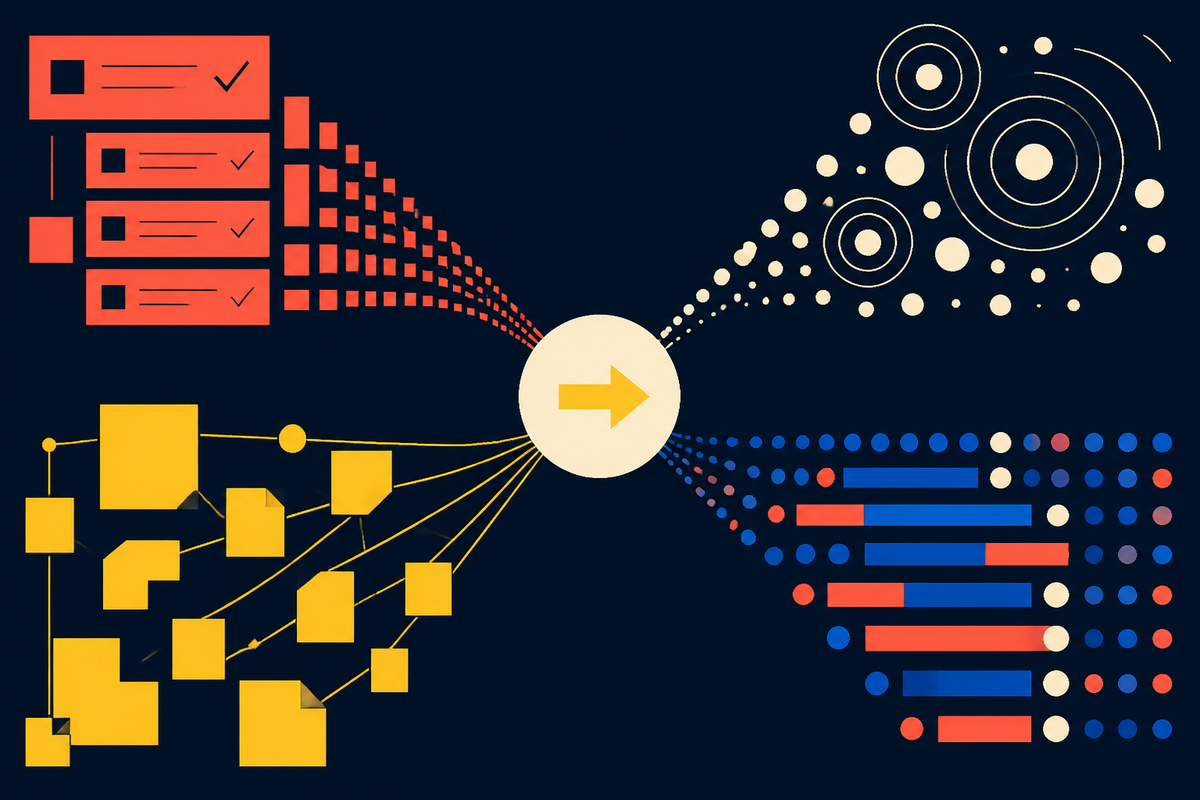
A bad software comparison starts with a spreadsheet. Rows become features, columns become vendors, and a roomful of sensible people slowly forgets the problem they came to solve. Feathery, InMoment, Dovetail, and QuestionPro make this especially easy. Each talks about customer data. Each uses AI. Each can place a chart on a screen. From thirty feet away, they begin to resemble one another.
Move closer and the resemblance falls apart. Feathery is built around the moment information must enter an operational workflow. InMoment is built around an enterprise trying to understand and improve experiences across many channels. Dovetail is built around scattered customer evidence that needs to become searchable, traceable knowledge. QuestionPro is built around designing research, gathering responses, and analyzing them at scale. They overlap, but their centers of gravity live in different rooms.
The practical lesson is simple: do not rank them in the abstract. Ask where the chain from customer signal to company action keeps breaking. The answer gives you a much better shortlist than a feature matrix ever will.
Feathery begins where a form becomes work
Feathery still has the bones of a form builder: visual design, conditional logic, embeddable forms, APIs, integrations, and analytics. But its current positioning is more operational and more specific. The company now emphasizes financial-services workflows such as client onboarding, underwriting intake, advisor transitions, document extraction, approvals, identity checks, and e-signatures.
That changes the buying question. A simple survey asks for an opinion. An operational intake flow may need to prefill records, validate identity, route different fields to different collaborators, pull data from an internal system, generate a PDF, wait for approval, collect a signature, and write the result back to a CRM. Feathery is designed for that sequence. Its public materials say it has processed more than 10 million workflows and connects forms to custom APIs and more than 100 standard integrations.
The useful mental model is not “Typeform with more controls.” It is a lightweight process layer with a strong front door. In 2026, Feathery added an AI Workflow Builder beta, Data Hubs, and more financial-services automation. Its assistant, Robin, is intended to build forms, logic, integrations, and document flows from plain-language instructions. The human still reviews and approves the result.
Choose it when the response itself must set work in motion. If your main problem is analyzing fifty customer interviews or monitoring thousands of public reviews, start elsewhere.
A customer signal is not yet an insight. An insight is not yet a decision. Good software makes one transition reliable.YesPress analysis
InMoment watches the whole experience
InMoment operates at a broader enterprise layer. Its integrated customer-experience approach brings together surveys, social reviews, conversational chat logs, call transcripts, and other journey data. The job is less about one study and more about a continuing program: detect a pattern, connect it to an account or location, open a case, assign action, and see whether the experience improves.
This makes InMoment a fit for organizations with many locations, channels, service interactions, and internal owners. Contact-center leaders may care about conversation themes and agent performance. A restaurant or retailer may care about reputation across hundreds of locations. A CX team may need to connect feedback with operational data, track cases, and show program value to executives.
InMoment announced generative AI in its Conversational Intelligence product in 2024, combining contact-center conversations with surveys, reviews, and social feedback. The company was acquired by Press Ganey Forsta in 2025 and now identifies itself as a Press Ganey Forsta company. That ownership is relevant for procurement and roadmap diligence, even though InMoment continues to present its own platform and CX identity.
Choose InMoment when the unit of analysis is the enterprise experience rather than a single research project. Expect a program, not merely a login: governance, taxonomy, integrations, closed-loop operating habits, and executive sponsorship will matter as much as the interface.
Dovetail keeps the evidence attached
Research has a memory problem. Interviews end up in video folders, support tickets in a service desk, sales calls in a recorder, and insights in slides whose source links no longer work. Six months later, another team asks the same customers the same questions.
Dovetail is built for this mess. It centralizes interviews, transcripts, documents, surveys, tickets, reviews, and other customer signals; lets teams tag and highlight evidence; and turns that material into findings, reports, searches, and conversations with the data. Its distinctive promise is traceability alongside speed. Dovetail says every AI-generated insight links back to its source, giving a reader somewhere to look before treating a pattern as fact.
The product has expanded beyond a traditional research repository. Its 2026 Summer Launch brought AI Agents into general availability and introduced Channels 2.0 in closed beta. Channels pulls from connected feedback sources and can rank evidence-backed opportunities; APIs, CLI tools, and MCP connectors move those insights into other working systems. That pushes Dovetail toward customer intelligence for product, support, sales, and customer-success teams, not only researchers.
Choose it when qualitative evidence is abundant but organizational memory is weak. It can help a product manager inspect why a theme exists, compare signals across projects, and carry customer context into a brief or ticket. It will not repair a poor interview guide, and automation does not absolve researchers from checking contradictory evidence. A fast synthesis can still be a shallow one.
QuestionPro owns the instrument
QuestionPro is the traditional research suite in this group. It covers surveys, market research, customer experience, employee experience, research communities, audience services, academic use cases, and reporting. Its platform supports advanced survey logic, many question types, offline collection, real-time dashboards, and AI-assisted survey creation and analysis.
Breadth is useful when the research instrument is the work. A university may need multi-admin governance across departments. A market researcher may need sophisticated logic, a respondent audience, and exportable analysis. A field team may need to collect responses without a connection. An employee-experience group may need recurring studies and segmented reporting. QuestionPro reports more than 5.3 million users, eight regional data centers, and 10 billion questions answered; its academic offering says it serves more than 5,000 universities and colleges.
Its AI can generate survey questions and summarize open-ended answers, but the old research rules remain intact. A polished questionnaire can still lead respondents. A large sample can still answer the wrong question precisely. QuestionPro gives teams substantial machinery; study design determines whether that machinery produces knowledge.
Choose it when you need to create and govern structured research at scale. If the answers already live in support calls, interview recordings, and sales notes, a new survey may add noise rather than clarity.
Buy the bottleneck, not the category
A clear selection process begins on a whiteboard without a vendor name. Draw one real path from customer interaction to business action. Mark every system, handoff, owner, and delay. Then circle the failure with the highest cost.
Some organizations will use more than one. A company could collect onboarding data through Feathery, monitor the ongoing experience in InMoment, synthesize interviews and support evidence in Dovetail, and run a market study in QuestionPro. The architecture can work if identifiers, consent, retention, ownership, and handoffs are explicit. Without that discipline, a four-tool stack becomes four partial versions of the customer.
For demos, bring one awkward workflow and one messy dataset. Ask the vendor to show what happens when data is incomplete, a source contradicts the summary, permissions change, or an integration fails. Ask how an AI answer cites evidence, how data can be exported, and which features remain beta. The graceful path is easy to stage. The exceptions reveal the product.
Finally, define success before signing. Measure fewer abandoned workflows, faster case closure, less duplicate research, higher evidence reuse, shorter analysis time, or better response quality. “More insights” is not a metric. A decision made sooner, with evidence others can inspect, is.
Questions buyers ask
Are these four products direct competitors?
Only partly. They overlap around feedback, analytics, and AI, but their centers of gravity differ: operational workflows, enterprise CX, evidence synthesis, and survey research.
Which product fits interview analysis?
Dovetail. It is designed to store, tag, search, synthesize, and share qualitative research while linking conclusions back to source material.
Which product fits complex surveys?
QuestionPro. It offers a dedicated survey and research suite with advanced logic, reporting, offline collection, and audience options.
When should a team shortlist Feathery?
When collecting information is part of an operational flow involving APIs, approvals, documents, identity checks, e-signatures, or regulated onboarding.
When should a team shortlist InMoment?
When an enterprise CX program must connect many feedback channels, locations, conversations, cases, and business outcomes.