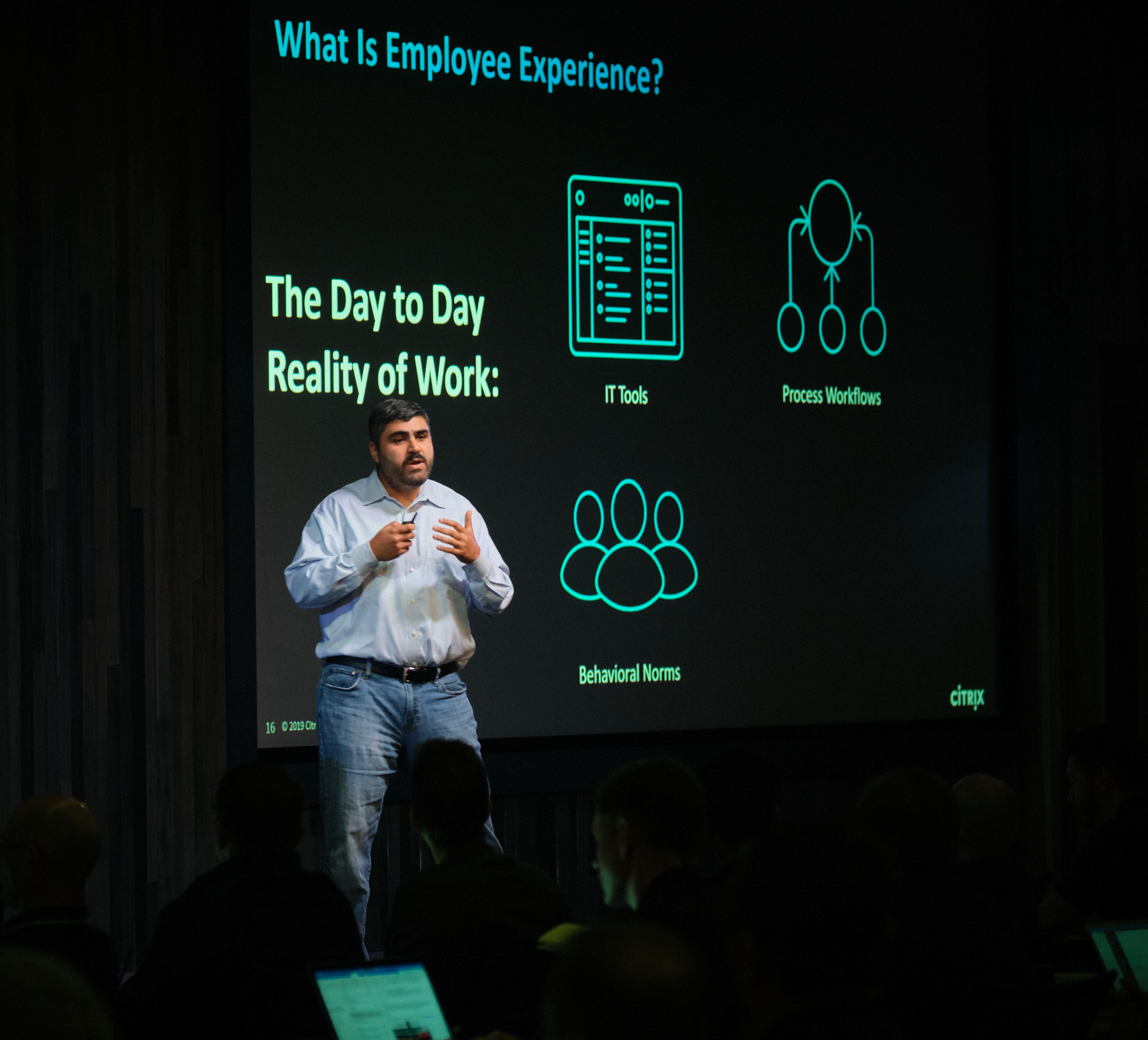
In a photograph from Citrix’s 2019 developer conference, Fouad ElNaggar stands in front of a screen that asks a disarmingly ordinary question: What Is Employee Experience? Beneath it are three ingredients: IT tools, process workflows, behavioral norms. He is holding a presentation remote. Someone in the audience has a laptop open. There are no robots in sight. The future of work appears to have arrived wearing a pale blue shirt and carrying a list of things that make Tuesday difficult.
That modest scene is a useful entrance to his career. ElNaggar has founded businesses, invested in them, helped run a media company, and sold an enterprise software startup. Yet his recurring subject is the distance between what a person could accomplish and what an organization actually lets that person accomplish. A job description can be expansive. The approval system can be a small prison.
At Citrix Converge, his opening argument concerned excessive applications, complicated tools, and the cost of switching between them. It was an argument addressed to developers, who could build the connections needed to make those tools work together. The ambition was practical: take some of the administrative obstacle course out of an employee’s day. It is easy to admire a new application. It takes a different sort of attention to notice the ninth application somebody must open before lunch.
A career with several points of view
ElNaggar studied economics and government at Dartmouth, graduating in 1998, and later earned an MBA at UCLA Anderson. There was an earlier plan to become an international lawyer, followed by a consideration of investment banking. He instead joined a home textiles business, reporting to its CEO and learning the work of running a company. The setting sounds wonderfully unglamorous beside the technology jobs that followed. It also puts customers, stock, employees, and decisions in the same room.
His career subsequently crossed the boundary between building companies and financing them. At Redpoint Ventures he oversaw the Los Angeles office and helped establish a dedicated fund in Brazil. His investment work included businesses such as BlueKai, Machinima, Clicker, and Scribd. Each placed technology against a different commercial problem. An investor gets to compare the attempts; an operator has to live inside one.
At CBS Interactive, his responsibilities encompassed strategy, operations, partnerships, and acquisitions. Deals involved Yahoo, IAC, and Twitch; acquisitions included TV Guide and Giant Bomb. That portfolio put him close to the practical business of moving familiar media brands into new digital habits. Viewers were changing how they watched. Media companies had to change how they worked.
He had also co-founded Hark with David Aronchick in 2007, a service for discovering and sharing audio clips. It is a telling contrast with the software he would later build. A memorable sound bite travels because people want to pass it along. An expense approval travels because somebody needs it finished. Both ask a designer to understand what a person is trying to do, though only one is likely to be amusing.
- 2005-2011RedpointCompare businesses
- 2012CBS InteractiveOperate at scale
- 2014-2018SaphoBuild the connection
- 2020 onwardArrayConnect work to outcomes
The art investment on the way
In May 2012, TurningArt announced a $1.5 million funding round and ElNaggar’s arrival on its board alongside NextView’s David Beisel. He was then an SVP at CBS Interactive and a former Redpoint investor. TurningArt’s founder and CEO was Jason Gracilieri. The business let customers try artwork in their homes before committing to a purchase.
It offered a neat answer to a familiar hesitation. People could like art and still struggle to choose something for a wall. Artists could make work and still struggle to reach buyers. TurningArt put a service between those two uncertainties. ElNaggar’s documented place in that story is as an investor and board member, bringing a career in technology and business to a company selling a rather more tangible experience.
The connection broadens the picture. A career can look tidy when reduced to industry labels. Here, the objects range from audio clips to paintings to workplace software. What connects them, at least as a way of reading his choices, is an interest in improving the route between a thing people value and the people who might use it.
Two different centuries inside CBS
The idea for Sapho came out of CBS Interactive, where ElNaggar worked with CTO and CIO Peter Yared. Employees were developing modern consumer experiences while contending with internal technology that felt decades older. The contradiction was close enough to see every day. A company could stream its future to customers while making its own staff navigate the past.
ElNaggar and Yared co-founded Sapho in 2014. Their response was to let people complete small, relevant tasks through a more coherent experience across existing applications. The attraction was that an employer could improve the experience without first replacing every underlying system. The expensive machinery could stay; the person using it could encounter something more manageable.
In another 2018 interview, ElNaggar described a financial-services customer where 41 percent of employees began their first day without a computer ready. That number was his reported example, rather than a claim about every employer. But it supplies a sharp little scene: a new recruit has accepted the offer, arrived with enthusiasm, and found that the company has forgotten the instrument required to begin.
His point was that recruiting and retention cannot be detached from daily working conditions. Hiring costs money. Learning a business takes time. When an experienced employee leaves, colleagues absorb the work and the employer starts the process again. A poor tool or a clumsy first day belongs in that calculation. The welcome speech may be excellent; the missing computer will have the last word.
New employees starting without a computer ready at one financial-services customer, as described by ElNaggar.
An office with a little Arrakis in it
Sapho’s name came from Frank Herbert’s Dune: a substance associated with the mentats, the novel’s human computers. ElNaggar’s public Twitter handle, ThufirHawat, also comes from the book. Science fiction gave an enterprise software business a language for thinking faster. It is an unusually literary starting point for a product that might help someone approve a routine request.
In a 2018 podcast conversation, ElNaggar described welcome boxes containing Dune, its film adaptation, company clothing, and a written introduction to Sapho’s culture. He also credited mentor and board member Bill Coleman with helping him think through the stages of building a business. The reading material was imaginative; the management work was deliberate.
His humor extended to calling himself “super cheap.” His parents were scientists who immigrated from Egypt and Mexico. He connected that background with care over money, particularly other people’s money. He also talked about raising four young children and coaching boys’ soccer. These were details he offered in 2018, and they helped explain his respect for experienced colleagues whose lives included responsibilities beyond the office.
The same conversation questioned hiring an impressive résumé simply to signal that a startup had arrived. The concern is recognizable: a title from a famous company can become an expensive substitute for deciding what the job requires. For ElNaggar, developing existing employees and bringing in outside expertise both had a place. Judgment lay in choosing when to do each.
“super cheap”
Fouad ElNaggar’s own description, 2018
A sale, and an audience beyond the startup
In November 2018, Citrix acquired Sapho. The transaction was reported at about $200 million. The product joined a much larger workplace technology business, and the acquisition connected a Bay Area founding team with development work in Prague. A significant part of Sapho’s engineering had been done there. The geography is a reminder that a company’s mailing address rarely describes all the people who made its product.
The event photograph comes from the following year, when ElNaggar was a Citrix vice president and the company gathered more than 100 developers at its Santa Clara campus for Converge. His argument now had a different audience and a larger platform. The problem of complicated workplace software survived the sale perfectly well. It was waiting for everybody on Monday.
Another media connection followed. In June 2022, Yahoo appointed him to its board, in a group that included Jessica Alba, Aryeh Bourkoff, Cynthia Marshall, Michael Kives, and Katie Stanton. Yahoo’s announcement described a range of experience across media, technology, consumer businesses, and finance. For ElNaggar, the appointment also linked back to the partnership work he had done at CBS. Careers sometimes move forward by returning to a familiar table with a different seat.
What the clock leaves out
Array, which ElNaggar co-founded in 2020 and leads as CEO, takes the productivity question into frontline work. Its business combines staffing, software, and services. The company describes a three-part system: identify suitable talent, amplify performance through support and rewards, and coordinate execution. The vocabulary has moved beyond the office portal. The concern with what helps a person perform remains recognizable.
Array reports more than 100,000 people hired through its platform and over 4,000 customers across North America. Those are company-reported figures. They describe a business with an operating layer as well as a software layer: people doing work, local teams helping deliver it, and technology intended to connect performance with outcomes.
Its acquisitions help explain that construction. Array’s own timeline starts with Hire One in 2020, continues through staffing businesses in subsequent years, and includes recruitment technology company GoToro in 2024 and rewards platform Onaroll in 2025. The timeline also reports operations across all 50 states. Building a system around physical work requires proximity to the places where that work happens.
The distinction between an hour and its output is central to his current argument. An hour measures duration with admirable reliability. It tells an employer much less about the work completed within it. As a thought experiment, consider two equally long shifts with different amounts of useful production. A time record makes them look alike. A manager responsible for the result knows that they differ. Array’s proposition begins in that gap.
Find suitable talent
Support performance
Connect execution
The question has become more human
In September 2026, ElNaggar discussed that proposition with Todd Zipper on An Educated Guest. The conversation explored rewarding individual contribution, the relationship between education and employment, and the difference between knowledge work and what he calls the essential economy. His argument was that work involving the physical world may meet AI differently from work conducted mainly through screens.
He presented greater productivity as a possible route to better business results and higher wages. That is an aspiration, and its appeal is straightforward. A person would like getting better at a job to improve what the job returns. An employer would like better performance to be visible and repeatable. Aligning the two is a substantial management task, even when the software is willing.
Seen across these episodes, ElNaggar’s career invites a particular reading: he keeps changing the size of the frame. At CBS, the frame held an employee and outdated software. At Sapho, it held a task and the systems surrounding it. At Array, it holds a worker, an employer, a way of measuring performance, and a possible path to advancement.
The pale blue shirt in the conference photograph belongs to an earlier chapter. The question on the screen still fits. What does an employee experience, hour by hour, while trying to do a useful job? ElNaggar has made a career of treating that question as something a business can act on. The clock, meanwhile, continues to offer its immaculate answer: sixty minutes. He is asking what happened inside them.
Follow the conversation
Profiles, interviews, and the businesses in the story.