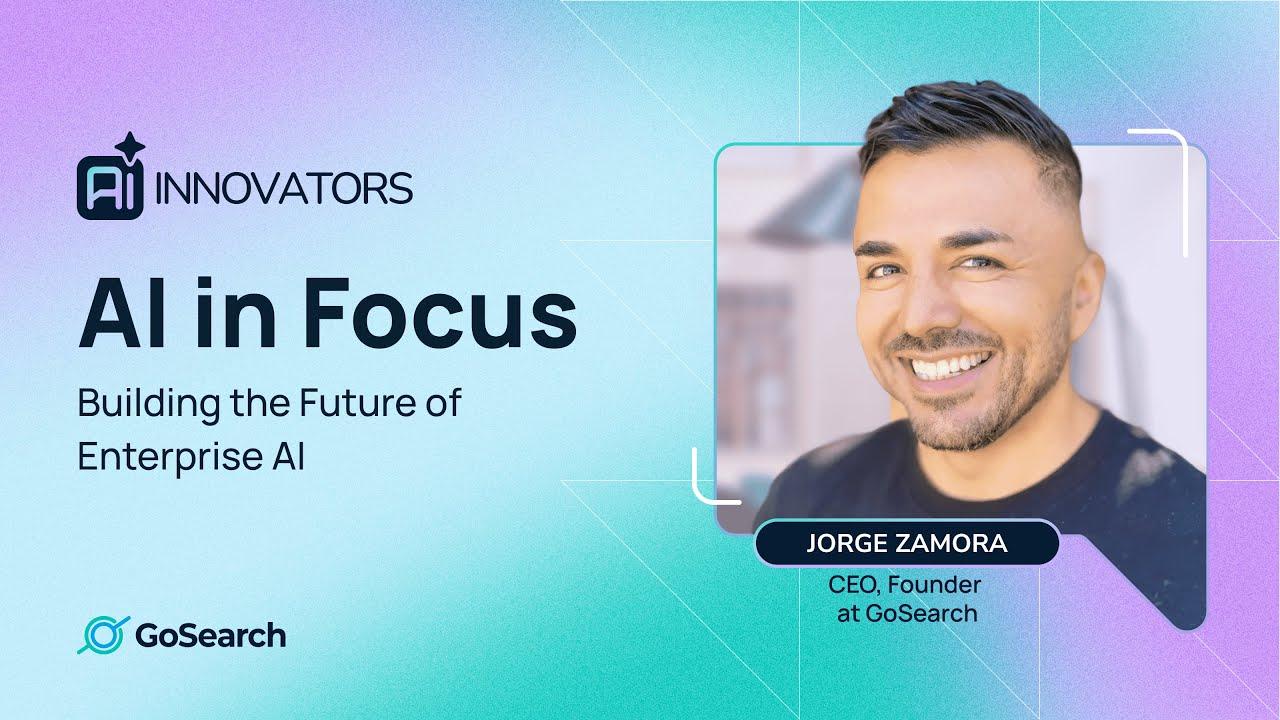
Jorge Zamora used to draw plans for things that were difficult to move. Railroads. Freeways. Piers. His early work in computer-aided drafting belonged to the physical world, where a revision could mean a lengthy approval process. Then he started building a social network, taught himself to make it function, and discovered the peculiar satisfaction of changing something that people could use immediately. A button could move before Monday. The freeway, quite reasonably, could not.
That change of pace is a useful place to begin with the founder of GoLinks. His business grew around an apparently modest piece of workplace infrastructure: a short, memorable route to a resource. Type a name, reach a page. The proposition is almost suspiciously easy to explain. The career behind it includes design, engineering, Yahoo, a startup accelerator and the expanding complications of enterprise AI.
A book before a business
Zamora’s early project, Amigoster, was a social network for the Hispanic community. He had designed the experience; an engineer friend was going to build it. When that arrangement fell through, he bought a web-development book approaching a thousand pages and worked through it. Login and photo-upload features followed. Software offered a welcome combination: creative control and quick feedback from people using what he made.
He later earned a master’s in computer science at the University of Southern California. His education also includes a civil engineering bachelor’s degree from UC Irvine. The two disciplines make an interesting pair. Both concern connections and dependencies, although only one lets a customer request a different color scheme without involving a planning authority.
His professional record stretches across several early ventures, including VidSocially and the founding team of hell0world.org. Yahoo became the consequential next setting. He joined in 2014, worked on internal software and progressed into engineering management. The place offered a close view of tools whose audience was largely the people arriving for work each morning.
The idea was already in the hallway
Inside Yahoo, shortcuts were part of the furniture of work. Zamora noticed comparable systems when visiting other technology companies: short links on signs, in shared spaces, in the ordinary circulation of office information. Engineers had built services that redirected familiar names to longer web addresses. The same useful idea kept reappearing inside different walls.
The opportunity he pursued was to turn that practice into a service other organizations could adopt. He brought together old college friends and worked on a commercial version. On August 29, 2016, the team released its SaaS product. GoLinks lists 2017 as its company founding year. The release came first; the corporate milestone belongs on its own line.
A name colleagues can remember.
A destination they can reach.
There is a distinction here between inventing an office habit and making it available. Zamora’s opening was the second. A large technology company can assign an engineer to a recurring internal problem. A smaller organization may encounter the same problem without having that engineer available. Packaging the tool changes who can use it and who must maintain it.
Consider the everyday social burden of a difficult link. Someone knows where the resource lives. Everyone else must ask. Over time, the person with the answer becomes a small, involuntary help desk. A memorable name gives colleagues another route. In that sense, the shortcut is also a way to release a person from being the shortcut.
A customer on the other side of the table
GoLinks entered Y Combinator’s Winter 2019 batch. Zamora’s recollection of the interview contains a pleasingly economical sales demonstration. He told the panel that one of their companies had already bought the product. The customer relationship existed before the pitch had finished explaining it. He recalls receiving the acceptance ten minutes later.
“Someone on this panel already bought our product”
Jorge Zamora, recalling his YC interview
The anecdote illustrates the difficulty of selling something familiar to one audience and unfamiliar to another. A tool can seem obvious to a former user while requiring explanation for everyone else. Existing use supplies evidence that an elegant slide cannot. In Zamora’s telling, the room contained that evidence, even before everyone knew it.
His engineering work had already brought recognition. His public professional profile lists a 2012 Young Engineer Award from the Orange County Engineering Council and an Individual Yahoo Superstar Award in 2015. These belong to an earlier chapter, before the startup funding announcements. They give the career a useful shape: an engineer recognized within organizations, then a founder trying to serve organizations himself.
- 2016First SaaS release
August 29 - 2017Company founding
Company founding - 2019Y Combinator
Winter batch - 2022$27M Series A
February 1
In February 2022, GoLinks announced a $27 million Series A led by Anthos Capital, with Mayfield and FundersClub participating. The plans attached to the money were concrete: invest in the product, expand distribution and grow the team. The announcement described an office increasingly spread across cloud storage, shared documents, messages and other applications.
Funding made the modest shortcut a larger operational commitment. Once other companies depend on a service, the responsibility continues long after the delight of the first demonstration. The original inconvenience may be small. Supporting its solution across different organizations creates a substantially longer to-do list. A founder acquires a business precisely where an employee once wanted one fewer chore.
Three doors into the same company
By December 2023, the product family had expanded to include GoSearch and GoProfiles. Each addressed a different way of getting oriented at work. GoLinks supplied the memorable route. GoSearch addressed questions spread across workplace applications. GoProfiles helped employees discover colleagues, understand organizational relationships and recognize one another’s work.
Zamora described GoProfiles as “employee data for employees.” That phrasing places the person looking for a colleague at the center of the directory. The product included profiles, organizational charts, maps and peer recognition called Bravos. A name in a database becomes more useful when it helps someone work out whom to approach.
- GoLinks
- Where’s the resource?
- GoSearch
- What’s the answer?
- GoProfiles
- Who should I ask?
Editorial shorthand for the products’ distinct roles.
The suite’s practical attraction is the relationship between those questions. A project document may identify a decision without explaining its history. A search may find the history without revealing who can authorize the next step. A directory may locate that person. Work regularly travels through all three. Zamora’s product family follows those handoffs.
He was also taking the subject into public discussion. At KMWorld in November 2023, he appeared on a panel about digital workplace transformations. His speaker biography emphasized full-stack engineering, SaaS development and user experience. Those interests help explain why this story keeps returning to the distance between having information somewhere and making it useful to someone.
The shortcut acquires responsibilities
By January 2026, Zamora was describing an ambition for AI that could operate across everyday tools, carrying useful context with it. His emphasis included permissions: the system should work with the information the individual user is entitled to access. The convenience of a single answer creates an obligation to preserve the boundaries around its ingredients.
That concern fits the earlier internal-tools problem. A company contains many audiences, even when it shares one name. The same question from two colleagues can legitimately lead to different information. An assistant that ignores that distinction would create a fresh problem while appearing to solve an old one. Speed needs a sense of whose work is being done.
Meanwhile, the original links still needed tending. In March 2026, GoLinks introduced verification, a tags dashboard and centralized user management. Creators could confirm that links remained current and set review intervals. Colleagues could request a check. Administrators gained ways to tidy tags and manage access in bulk.
These are revealing additions. The first appeal of a shortcut is immediate access. Later comes the less glamorous question of whether it leads somewhere dependable. A beautifully labeled door is of limited assistance if the room behind it has moved. Verification gives the company’s shared vocabulary a maintenance routine.
In June, GoLinks announced an MCP server for searching and managing short links within compatible AI tools, including Claude and Cursor. The library could be reached from an existing conversation or coding session. The product was following employees into another working environment, carrying its original purpose along with it.
There is a risk of letting the AI chapter swallow the person who arrived there. Zamora’s record has a more particular texture: civil engineering studies, early web ventures, Yahoo recognition and a company built around a repeated internal chore. His colleagues supplied a lighter detail in a 2025 action-figure depiction of their founder. One thought it needed a LaCroix. Even enterprise software can have accessories.
The work also changes the meaning of simplicity. For an employee, simplicity can mean one name to remember or one place to ask a question. For the team supplying that experience, it requires decisions about ownership, organization and access. Zamora has moved from using internal infrastructure to running a company accountable for it. The clean interface is where the user meets the accumulated decisions behind it.
Zamora has described himself as unafraid to begin. His career suggests a useful companion to that attitude: pay attention to what people already use. The GoLinks opportunity was visible in ordinary offices before it became a pitch. He noticed the recurring shortcut, gathered a team and began making it available elsewhere. Years later, the question has grown to include AI, access controls and shared company memory. It still begins with a colleague trying to get somewhere.