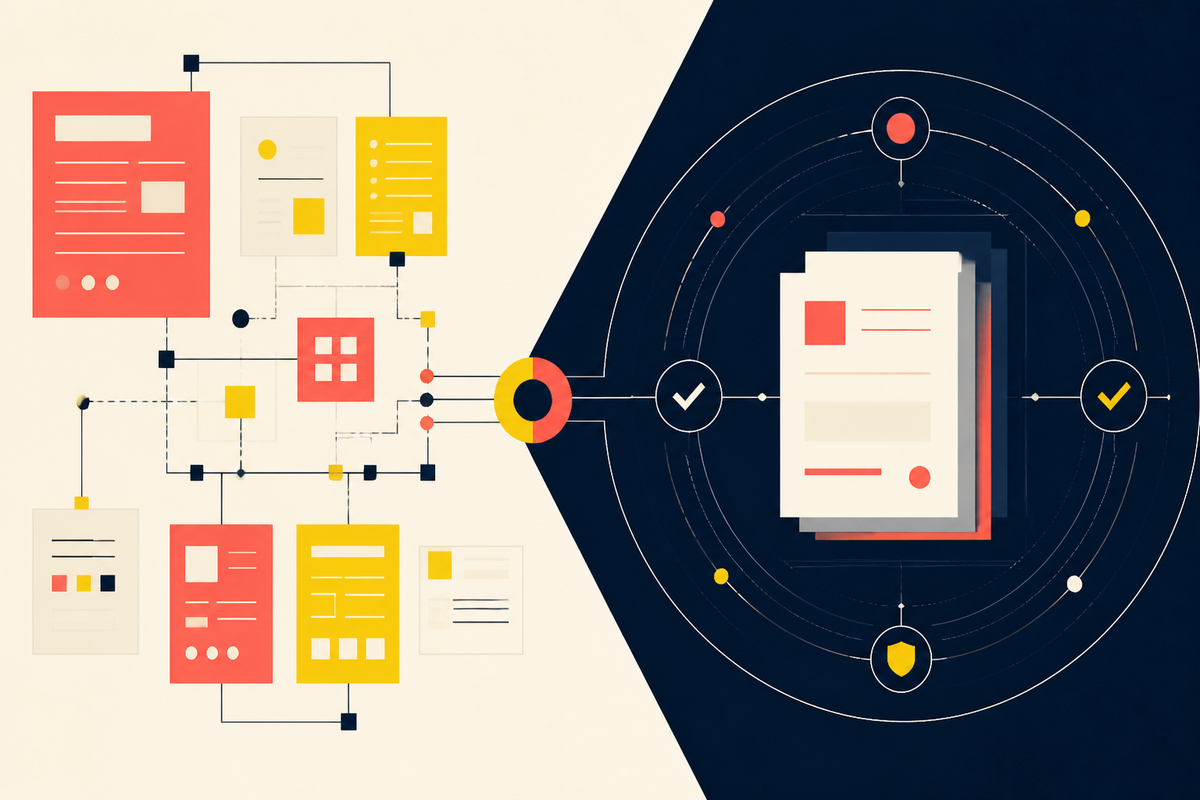
A document automation demo usually ends with a small magic trick. Someone clicks a button, a polished PDF appears, and the room relaxes. But the generated file is the least revealing part of the system. The important action happened earlier: data arrived, rules fired, language changed, permissions were checked, and a person or system decided where the document should go. Later, someone will need to revise a clause, trace an approval, replace a data source, or explain why a customer received one version instead of another.
That is the right frame for comparing Formstack and GhostDraft. Both can help organizations turn data into personalized documents. Both talk about giving business users more control and reducing repetitive work. Yet they arrive at those promises from different directions. Formstack is a general-purpose product family for online forms, document generation, e-signatures, and connected workflows. GhostDraft is a customer communications and document automation platform built around insurance, with content, integrations, and governance shaped by that industry.
This is not a horse race. A procurement team can make either platform look stronger by choosing a checklist that favors it. Count the range of intake and signature functions, and Formstack's breadth becomes the story. Count insurance content libraries and forms-lifecycle concerns, and GhostDraft's specialization becomes the story. The better question is simpler: which platform begins where your hardest work begins?
Start at the front door
Formstack's natural front door is data collection. Its suite connects online forms, document generation, e-signatures, and a visual workflow builder. A team might collect a university application, generate an acceptance package, route it for approval, capture a signature, and return the result to a system of record. The same building blocks can serve healthcare intake, sales proposals, employee onboarding, or a local government's permit process. Its value is reuse across departments.
Formstack Documents can also stand on its own. The company says users can upload templates or build them, populate them from CRMs, databases, form builders, and other systems, then deliver the result through Sign, a CRM, or a document repository. Conditional sections adapt output to the underlying data. The product supports common business formats, including Word, PDF, PowerPoint, and CSV. For an operations team trying to replace copy-and-paste work across many functions, that is a legible proposition.
There is a naming wrinkle worth understanding. In June 2025, the parent company rebranded from Formstack to Intellistack and launched Streamline, an AI-driven no-code process automation platform. The Formstack products did not disappear. Intellistack says they remain actively sold and supported. A buyer should therefore distinguish the familiar Formstack product family from the broader direction of the company that owns it.
Workflow first
Collect data, assemble a document, request a signature, and connect the steps across common business systems.
Content first
Control regulated language, versions, forms, personalization, approvals, and delivery across an insurance document lifecycle.
Then inspect the document's burden
GhostDraft's starting point is narrower and deeper. The company traces its history to 1984, when Mark Todes and Mendel Karpul launched an early document composition engine. Today it describes GhostDraft 360 as a platform for the full insurance communications lifecycle, from authoring and management to personalized delivery. Its audience includes product, compliance, IT, and business teams that need to work on the same body of customer-facing content.
Insurance documents carry a peculiar burden. A policy form may be reused across products, brands, jurisdictions, and channels. Language changes can have effective dates. Regulators and industry bodies can introduce new versions. A small edit may affect many outputs, but not all of them. The difficult job is not simply putting a policyholder's name in the correct field. It is preserving controlled reuse while proving that the approved language reached the right customer in the right context.
GhostDraft's bureau-content offering makes that specialization concrete. The company offers preconfigured ISO, AAIS, and workers' compensation form libraries and says it continuously monitors circulars, updating affected forms ahead of their effective dates. It also promotes integrations with insurance core systems, template authoring for business users, omnichannel delivery, and forms management across jurisdictions. Those capabilities matter when regulatory content maintenance is a recurring operating function rather than an occasional document task.
The best platform is the one that makes your riskiest change boring.YesPress analysis
Specialization has a cost of its own. A focused system may demand a more deliberate implementation, a stronger content model, and close coordination among domain experts. Breadth also has a cost: a general tool can leave teams designing the insurance-specific governance themselves. Neither cost is inherently bad. The mistake is paying for one while assuming you bought the other.
Who gets to change the words?
The most revealing question in a buying process is not “Does it have conditional logic?” Most modern document systems do. Ask who can safely change a clause on Tuesday afternoon. Can a business owner make the edit without filing a development ticket? Can compliance approve it without passing attachments through email? Can IT see what changed? Can the system identify every template and output touched by the revision? Can the team reverse the change?
Both vendors emphasize business-user control, but buyers should test the claim with their own roles and constraints. “No-code” is useful only when governance travels with the control. Moving work away from developers can shorten a queue. Moving it into an ungoverned template library simply creates a quieter queue that will become visible during an audit or incident.
Integration deserves the same skepticism. A logo wall proves that two systems can connect; it does not prove that they exchange the data shape, volume, timing, errors, or credentials your workflow requires. Formstack lists connections to widely used tools such as Salesforce, HubSpot, and SharePoint. GhostDraft promotes more than 20 core-system integrations. In either case, the buyer should ask what is native, what uses an API, what requires services, and who owns the connection after launch.
Run the ugly-template test
A proof of concept should not use the sample template that made the sales engineer's calendar. Bring the ugliest document your team still depends on: nested tables, conditional clauses, repeating data, multiple brands, jurisdictional variants, accessibility needs, and a delivery rule nobody remembers writing. Connect it to a representative source. Then change it.
- Map one real journeyMark where data enters, where language is owned, who approves changes, and where the final artifact lands.
- Build the difficult variantUse real conditional content, repeated records, formatting requirements, and permissions rather than a clean one-page example.
- Trigger a controlled changeAlter one shared clause and trace its effect across brands, products, channels, and effective dates.
- Break an integrationTest missing data, expired credentials, duplicate submissions, retries, and the alerts an operator actually receives.
- Price the second yearInclude template maintenance, content updates, integration ownership, support, training, and the people needed to govern it.
This exercise exposes the real difference between “can generate” and “can operate.” It also gives both vendors a fairer hearing. Formstack can demonstrate how its components simplify the entire intake-to-signature journey. GhostDraft can demonstrate how its insurance model handles the lifecycle and dependencies of regulated content. A team may discover that one platform cleanly owns the whole job. It may also discover that its architecture needs more than one system, with an explicit boundary between intake, content, signature, and recordkeeping.
Ask about day 400
Implementation timelines are easy to celebrate and hard to compare. GhostDraft says its customers can go live in less than 90 days and reports a 100 percent implementation success rate. Those are company claims, useful as prompts for due diligence rather than universal promises. Formstack presents a range of products and plans that can let teams begin with one component, then connect more of the suite. In both cases, the calendar depends on template cleanup, data readiness, integrations, security review, training, and the number of people allowed to disagree.
The sharper reference call is about day 400, not launch day. Ask a customer how many templates it maintains, how often people work outside the platform, and how long a routine change takes. Ask who investigates a failed merge at 4 p.m. on a Friday. Ask whether the original services team left behind a content model that new employees can understand. A fast launch can be valuable, but maintainability compounds for every year the system remains in production.
Pricing should follow the same lifecycle. License comparisons rarely capture migration labor, template rebuilding, new integration work, bureau subscriptions, implementation services, or the internal cost of approving and testing changes. Model a stable year and a turbulent one. The turbulent version, with a new product line or a cluster of regulatory updates, will show whether the platform absorbs complexity or merely invoices around it.
The answer is inside your process
Choose Formstack when the recurring problem is broad workflow assembly: collect information, populate documents, route work, obtain signatures, and connect common business tools across several departments. Its attraction is a coherent set of no-code components that can be applied to many processes. Evaluate how the current Formstack products and the newer Intellistack platform fit the roadmap you are actually buying.
Choose GhostDraft when insurance communications themselves are the hard system: controlled authoring, reusable language, bureau forms, jurisdictional updates, core-system integration, and personalized delivery. Its attraction is not that insurance companies also make PDFs. It is that the platform has been shaped around the reasons insurance documents become difficult to govern.
And resist choosing either by brand recognition, feature volume, or a single successful demo. Follow one customer communication from raw data to approved language to delivered artifact, then follow it again when a rule changes six months later. The platform that makes both journeys understandable is the platform worth carrying into procurement.