Before Foo Fighters were a band, they were a piece of misdirection. In 1994, Dave Grohl booked six days at Robert Lang Studios near Seattle and moved quickly. He played nearly everything. The songs had accumulated quietly while he sat behind the drums in Nirvana, carrying a guitar on tour and keeping much of his writing to himself. Now there was a tape, a deliberately plural name borrowed from wartime slang for unexplained lights in the sky, and a modest hope that the music might circulate without becoming a referendum on its maker.
That plan lasted about as long as a secret played through an amplifier. Copies travelled. Record labels called. Grohl recruited bassist Nate Mendel and drummer William Goldsmith from Sunny Day Real Estate, with Pat Smear on guitar. The first public show came in February 1995; the self-titled album followed in July. A recording made mostly by one person had acquired the inconvenient, exhilarating obligations of a band.
Thirty-one years later, the disguise has become an institution. Foo Fighters have released twelve studio albums, won 15 Grammys and entered the Rock & Roll Hall of Fame. Their current lineup puts Grohl beside Mendel, Smear, Chris Shiflett, Rami Jaffee and drummer Ilan Rubin. The scale changed beyond recognition. The animating gesture did not: enter a room, find the song, hit it hard enough that other people want in.
A plural name learns to behave like a band
The second record is where the story stops being a clever origin and becomes a difficult career. The Colour and the Shape, released in 1997, put friction into the machinery. Grohl re-recorded most of the drums, Goldsmith left, and the group had to decide what kind of collective could survive its founder's exacting ear. The finished album made that tension useful. “Monkey Wrench,” “My Hero” and “Everlong” pushed quiet and loud against each other until contrast became propulsion.
“Everlong” in particular escaped the boundaries of an ordinary single. It can arrive as a full electric surge or as one voice and an acoustic guitar, and both versions feel complete. This became a Foo Fighters specialty: write a chorus strong enough to survive changes in voltage. The songs sound engineered for mass participation, but their most persuasive moments often begin with a private admission.
It's not about being perfect, it's not about sounding absolutely correct. It's about what goes on in here - your heart - and what goes on in here - your head.Dave Grohl
Taylor Hawkins joined during that era and became, for a quarter-century, the kinetic foil at the kit: a drummer with the presence of a frontman and the confidence to tease the actual frontman. Shiflett arrived around the turn of the millennium. Smear eventually returned full-time; Jaffee moved from touring and session work into official membership. The personnel history is not a straight line. It is closer to a well-used patch cable, bent and rerouted, still carrying signal.
The garage door opens onto America
Success gave the band options, and they repeatedly used those options to invent constraints. In Your Honor split itself between a heavy disc and an acoustic one. For Wasting Light, the band worked with producer Butch Vig in Grohl's garage, recording to analogue tape. No endless digital repair kit waited behind the screen. The method forced decisions, preserved small imperfections and returned a stadium-sized group to the domestic dimensions of its first impulse.
The gamble paid in the currency institutions understand. Wasting Light won the Grammy for Best Rock Album, one of five Foo Fighters records to take that category. Yet the garage matters less as nostalgia than as a reminder: a mature act can still rearrange the conditions of work. Longevity gets dull when it protects the routine. Foo Fighters have been most interesting when they make the routine answer to a room, a rule or a dare.
Sonic Highways expanded that idea until the room became a map. Eight songs were recorded in eight American cities, while Grohl directed a television series about the local histories surrounding each studio. The premise could have become cultural tourism with expensive microphones. At its best, it showed a band submitting its familiar methods to unfamiliar context - geography as an additional instrument.
They were never above making the solemn business of rock look silly. In 2014 they played tiny British shows as The Holy Shits. In 2021 they made a Bee Gees tribute record as the Dee Gees. At Glastonbury in 2023, they appeared on the bill as the ChurnUps. And when breakup rumors swelled in 2016, they answered with a seven-minute comedy sketch: Grohl contemplated a solo career while the others auditioned Nick Lachey. The punchline was printed without ambiguity: “For the millionth time, we're not breaking up!”
The joke works because the band understands the mild absurdity of band mythology. Everything is always the final show, the brave return, the definitive lineup, the statement album - until the next rehearsal. Foo Fighters puncture that theater, then walk onstage and give the performance its full dramatic weight anyway. Irony lives in the announcement. Sincerity starts on the count-in.
The catalogue kept finding another floor
Cumulative studio albums at selected milestones. The graph counts releases, not decibels; no instrument has yet been built for the latter.
The art of returning without pretending
The band that made But Here We Are in 2023 had lost its longtime drummer and friend. It did not treat continuation as erasure. The record held memory and forward motion in the same frame, with Grohl handling the studio drums. Josh Freese then joined the touring lineup through 2025. Ilan Rubin came next. By the time Foo Fighters reached their twelfth album, the current formation was again new, though several of its relationships stretched back decades.
Your Favorite Toy, released April 24, 2026, credits the band and Oliver Roman as co-producers. Grohl has said its title track unlocked the album after more than a year of experiments. That is a revealing description from a group with a large catalogue and an instantly recognizable silhouette. The path was not a grand strategy meeting. It was a song that suddenly told the other songs how to stand.
“Your Favorite Toy” really was the key that unlocked the tone and energetic direction of the new album. It was the fuse to the powder keg of songs we wound up recording for this record.Dave Grohl, 2026
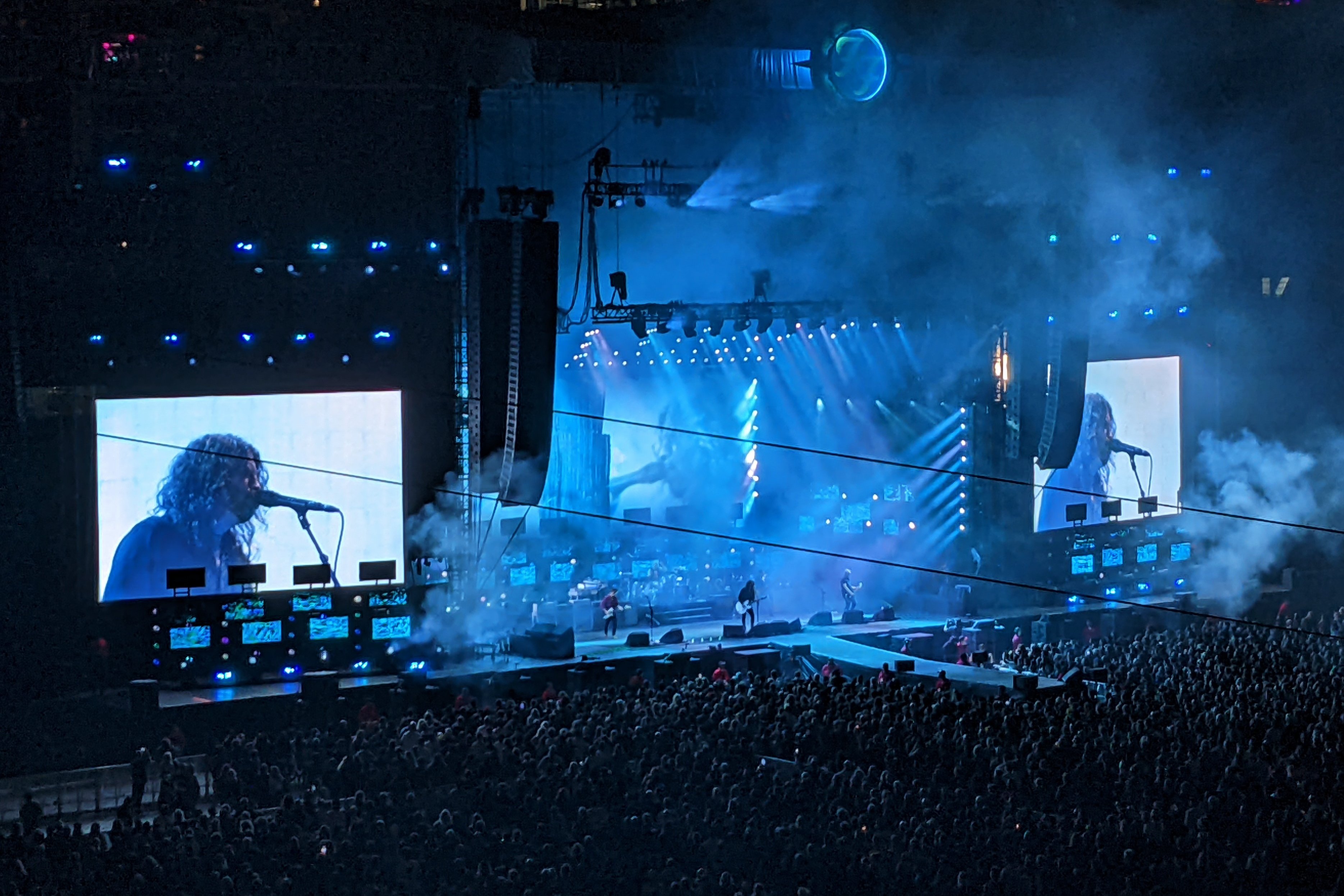
Rubin's drums sit beside three guitars - Grohl, Smear and Shiflett - Mendel's bass and Jaffee's keyboards. On paper, that is enough machinery to start a small municipal dispute. In practice, the arrangement explains the band's scale. Foo Fighters do not make minimal music. They make legible music with many hands, leaving enough air around a riff for an arena to recognize its entrance.
The trophies accumulate neatly: 15 Grammy wins from 34 nominations, five Best Rock Album awards, the first MTV Global Icon Award, Rock Hall induction in the first year of eligibility. But careers are not lived in trophy cases. They are lived in the transitions between versions: solo project to band, drummer to frontman, tape to garage, city to city, one lineup to the next. Foo Fighters' real subject has always been continuity under pressure.
The 2021 Hall of Fame ceremony made that continuity almost comically visible. Paul McCartney, himself familiar with the strange afterlife of a world-sized band, delivered the induction. On the plaque were Grohl, Hawkins, Mendel, Shiflett, Smear and Jaffee. The honor fixed one lineup in bronze, as halls of fame must, while the working band kept moving. An institution wants a clean caption. Music insists on verbs: write, rehearse, replace, return. Foo Fighters accepted the monument, then carried on behaving like a workshop.
Even the name now reads differently. What began as camouflage became a promise of plurality. No matter how strongly the band bears its founder's character, Foo Fighters only became durable by letting other people change the sound, complicate the plan and share the risk. Mendel's bass, Smear's grin and attack, Shiflett's precision, Jaffee's color, the succession of drummers - these are not decorations around an origin story. They are the reason the origin survived.
There is an appealing lack of elegance to all this. A mysterious name. A debut made in a rush. A career interrupted and resumed, sometimes with a gag. Songs that favor the huge human pleasure of shouting the same words at once. The Foo Fighters story is not tidy enough to be a fable, which is why it is useful. Begin alone if necessary. Form the band when the work asks for company. Change the room. Keep the chorus. Then count in again.