The first Coldplay rehearsal room was a bathroom in a University College London residence hall. The acoustics were good. The ambitions, at least in retrospect, were suspiciously well dressed. Chris Martin had heard Jonny Buckland playing guitar through a dormitory door during their first week at university in 1996 and immediately proposed that they make something together. Guy Berryman joined months later. Then the expected drummer failed to appear at a recording session, so Will Champion sat at the available kit. A personnel crisis became a line-up.
They had the usual young-band problem of wanting a future before possessing a name. Big Fat Noises came first. Their debut concert, at the Laurel Tree in Camden on 16 January 1998, was billed to Starfish. Coldplay arrived shortly afterward, borrowed from another student's abandoned band-name list. Phil Harvey, Martin's school friend, financed the 500-copy Safety EP. Only 150 copies reached the public. The rest went to record companies, friends and the sort of people who might turn hope into a meeting.
The meeting happened. Parlophone signed them in April 1999, one month before final exams. Martin studied Ancient World Studies. Buckland left with a mathematics and astronomy degree; Champion with one in anthropology. Berryman had moved from mechanical engineering to architecture before leaving university. This is an unusually useful spread of training for a rock band: myths, numbers, people, machines and unfinished buildings.
A song simple enough to carry
Parachutes arrived in 2000 with "Yellow," a song whose opening instruction - look at the stars - would become an accidental blueprint. The arrangement was roomy. Buckland's guitar glowed rather than snarled. Martin sang as if the feeling had reached him seconds before the microphone did. The song made vulnerability portable, and the band's career followed it through the door.
What followed was not a straight line, although the chart positions can make it appear so. A Rush of Blood to the Head sharpened the emotional machinery. X&Y enlarged it. Brian Eno helped roughen the walls on Viva la Vida or Death and All His Friends, where strings, church bells and a fallen king displaced the familiar piano confession. The title track gave the band a number-one single on both sides of the Atlantic and a Grammy for Song of the Year.
The statistics describe reach, not method. Martin brings a relentless stream of ideas, but Coldplay has long operated as a democracy. Songs pass through Buckland's restraint, Berryman's taste and Champion's editorial ear. Harvey returned after an early spell as manager and became a creative director, sounding board and officially acknowledged fifth member. The arrangement is less romantic than the lone-genius myth and far more practical. Four people can save a song from its author. A fifth can remind them what the song is for.
Their roles are audible even when the credits are shared. Buckland often plays around a melody, leaving bright pockets of air where another guitarist might stack chords. Berryman gives the songs their forward motion without demanding the spotlight. Champion, who could already play piano, guitar and bass before taking up drums for the group, became the utility player and internal editor. Martin supplies the abundance: melodies, titles, fragments and new schemes, sometimes emailed to his bandmates immediately after a tour leg. This is an ecosystem built around unequal temperaments rather than interchangeable parts. The restraint is as important as the supply. Coldplay sounds like Coldplay because three people know when to prune the fourth person's enthusiasm, and because the fourth returns the next morning with another idea.
“Our great joy is when you look out at the audience and there are five-year-old kids and pensioners.”Will Champion
The argument with cool
Coldplay's chosen material - wonder, regret, devotion, repair - has always left the doors unlocked. Critics noticed. So did comedians, record-store clerks and anyone who considered a falsetto an invitation. The band became a remarkably safe target. Martin's reply was not to develop a leather-jacket personality. He joked that he hoped to make the group “a bit more sufferable.” It was a shrewd surrender. Self-awareness let Coldplay remain earnest without becoming pompous about the earnestness.
That openness also made the music unusually migratory. Mylo Xyloto wrapped pop in graffiti colour. Ghost Stories reduced the room after a period of personal upheaval. A Head Full of Dreams opened it again. Everyday Life moved through gospel, Arabic-language vocals and field-recording texture. Music of the Spheres brought BTS into "My Universe," which debuted at number one in the United States. On Moon Music, Little Simz, Burna Boy, Elyanna, TINI and Ayra Starr widened the circle further.
There is an easy accusation here: Coldplay borrow whatever can travel. There is also a more generous reading. A band preoccupied with connection will keep testing new cables. The constant is not genre. It is the upward movement of the chorus, Buckland's economy and Martin's conviction that a simple phrase, repeated with enough people, may briefly improve the room.
The crowd gets a part
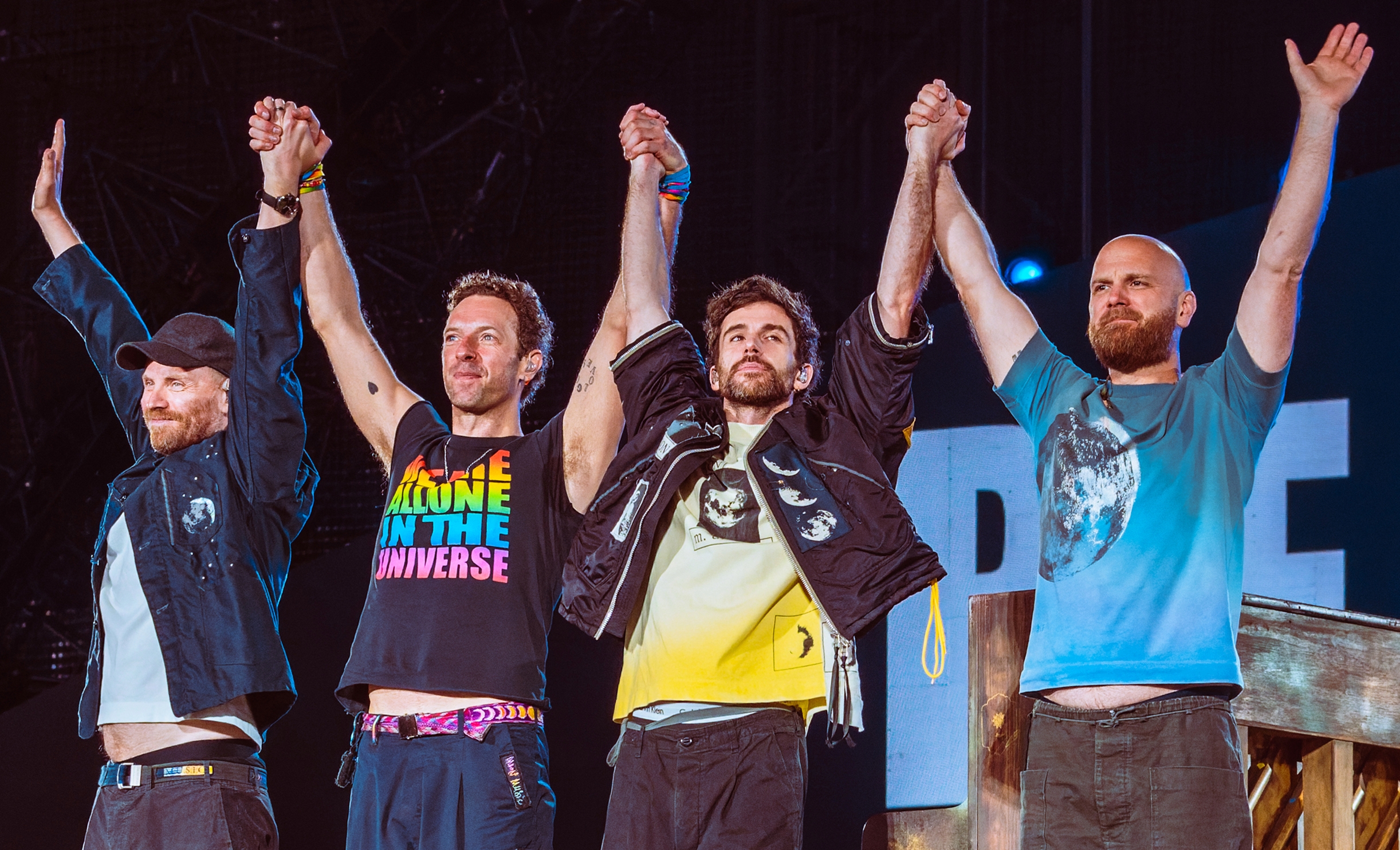
Coldplay's stadium era solved an old arena problem: how do you prevent 80,000 people from becoming wallpaper? The answer was to put light on their wrists. Radio-controlled LED bands turned separate spectators into pixels, then waves, hearts and galaxies. The trick worked because it granted everyone a visible role. One wristband is a trinket. A stadium of them is weather.
The same instinct shaped the Music of the Spheres tour, which ran from 2022 to 2025. Kinetic dance floors and power bikes invited fans to help charge show batteries. A mobile rechargeable system, assembled from repurposed BMW i3 batteries, stored energy from renewable sources. Refillable water points, reusable cups, lower-impact freight choices and an emphasis on public transport made backstage logistics part of the creative brief.
2016-17 baseline = 100
The band reported that those first two years produced 59 percent less direct CO2-equivalent emissions per show than its 2016-17 stadium tour. The figures were independently reviewed. Seven million trees had been planted, one for each attendee at that point. The average LED-wristband return rate reached 86 percent. Eighteen shows in 2023 ran entirely on the mobile battery system.
None of this makes a stadium tour weightless, and Coldplay does not claim that it does. The valuable part is the public experiment: measurement instead of mood music, and visible systems that make the audience complicit in improvement. Even the physical Moon Music LP entered the argument. Each standard EcoRecord copy used material from nine recycled PET bottles and, according to its manufacturing assessment, substantially reduced production emissions compared with conventional vinyl.
A crowd is the fifth instrument: choir, light show, electrical source and occasionally a very large tambourine.
A small history of getting larger
First show as Starfish in Camden; the self-financed Safety EP follows.
Parachutes turns "Yellow" into the band's passport.
"Viva la Vida" reaches number one in the UK and United States.
A Super Bowl halftime show and a fourth Glastonbury headline set put the group firmly in stadium scale.
"My Universe" with BTS debuts at number one on the Billboard Hot 100.
A fifth Glastonbury headline set; Moon Music becomes album ten.
The tour closes at Wembley; the band crosses 100 million monthly Spotify listeners.
By the close of the tour at Wembley in September 2025, Coldplay had travelled an absurd distance from the Laurel Tree. The tour was the first by a band to pass $1 billion in reported gross revenue. The group had played Glastonbury as headliner five times, accumulated seven Grammys and nine Brit Awards, and become the first group to cross 100 million monthly Spotify listeners. The numbers are impressive chiefly because four people have had nearly 30 years to annoy one another and still turn up for the bow.
There are plans, naturally. Martin has said Coldplay intends to stop the studio album count at twelve. Such declarations in pop have the legal force of a note left on a refrigerator, but the limit suits a band fascinated by arcs, planets and endings that lead back to beginnings. Touring may continue. Collaborations certainly will. The committee remains in session.
Even the pause has produced more rooms. In January 2025, the band released A Film for the Future, a 44-minute visual companion to Moon Music assembled from work by more than 150 artists in 45 countries. Later that year came an announcement that the Wembley concert would return as an immersive VR experience, accompanied by a game pack and workouts. The formats are new; the impulse is familiar. Coldplay keeps looking for another way to place a stranger inside the song. A record becomes a film, a concert becomes a headset, and a listener is gently promoted to participant.
The useful size of a feeling
Longevity often makes musicians guarded. Coldplay went the other way. Their shows became more colourful, their collaborations more porous, their choruses less embarrassed by their own size. This can tip into excess. It can also produce the peculiar hush before thousands of people sing the first line of "Fix You," each carrying a private reason into a public sound.
That is the Coldplay proposition. A feeling need not become more sophisticated to become more widely shared. It needs a melody with room in it, a band willing to argue over the furniture and an audience invited across the threshold. The bathroom acoustics were good. The stadium acoustics, it turns out, depend on everybody.