Tapped AI has spent most of its life trying to delete the tab called “VENUES FINAL v7” from an independent musician's laptop. The New York company wants a performer to open a phone, find rooms that fit the act, apply for a slot, compare booking signals and sketch a tour. It is a modest workflow wrapped around an immodest ambition: build the data layer for live music outside the industry's most powerful gates.
That description is cleaner than the route the company took to reach it. Founded in 2021 by Johannes Naylor and Ilias Anwar, Tapped first wore the costume of an AI record label. A 2023 offer charged $50 a month for a suite of artist services - marketing, design, management and related help - while promising not to take a percentage of an artist's music. The idea was software scale applied to work normally rationed by labels. A promotional profile said 130 artists were willing to pay and 15 were in an early beta.
There was energy in the pitch, plus a Times Square billboard and the kind of founder-made theater that travels well on social feeds. One April Fools announcement claimed DDG had bought Tapped for $28.28 million. The number was invented. The attention was real. It helped pull people toward Tapped-branded mixers in New York, where music, technology and a lightly chaotic founder community occupied the same room.
“Does this get a performer more bookings?”Tapped AI's stated north-star test for a feature
The first thing that brokeEverybody wants the gig. Fewer people want another booking inbox.
The earliest structural failure was not a lack of artists. It was marketplace physics. Tapped originally tried to connect performers and venues directly, including the transaction. Performers were willing to join. Venues and promoters had to be recruited one by one, then persuaded to keep another system current. Without enough quality opportunities, artists had little reason to return; without credible artist demand, venues had little reason to change their habits. The company had found the cold start problem wearing a backstage pass.
Naylor later wrote that gig marketplaces tend to carve out a narrow niche just to reach liquidity. Tapped's verdict was admirably unromantic: there were easier ways to reach the goal. It also considered ticketing, which would have generated beautiful data tying fans, venues and performers together. But owning ticketing would not immediately fix a customer problem. The company chose to partner where possible and collect data itself where necessary.
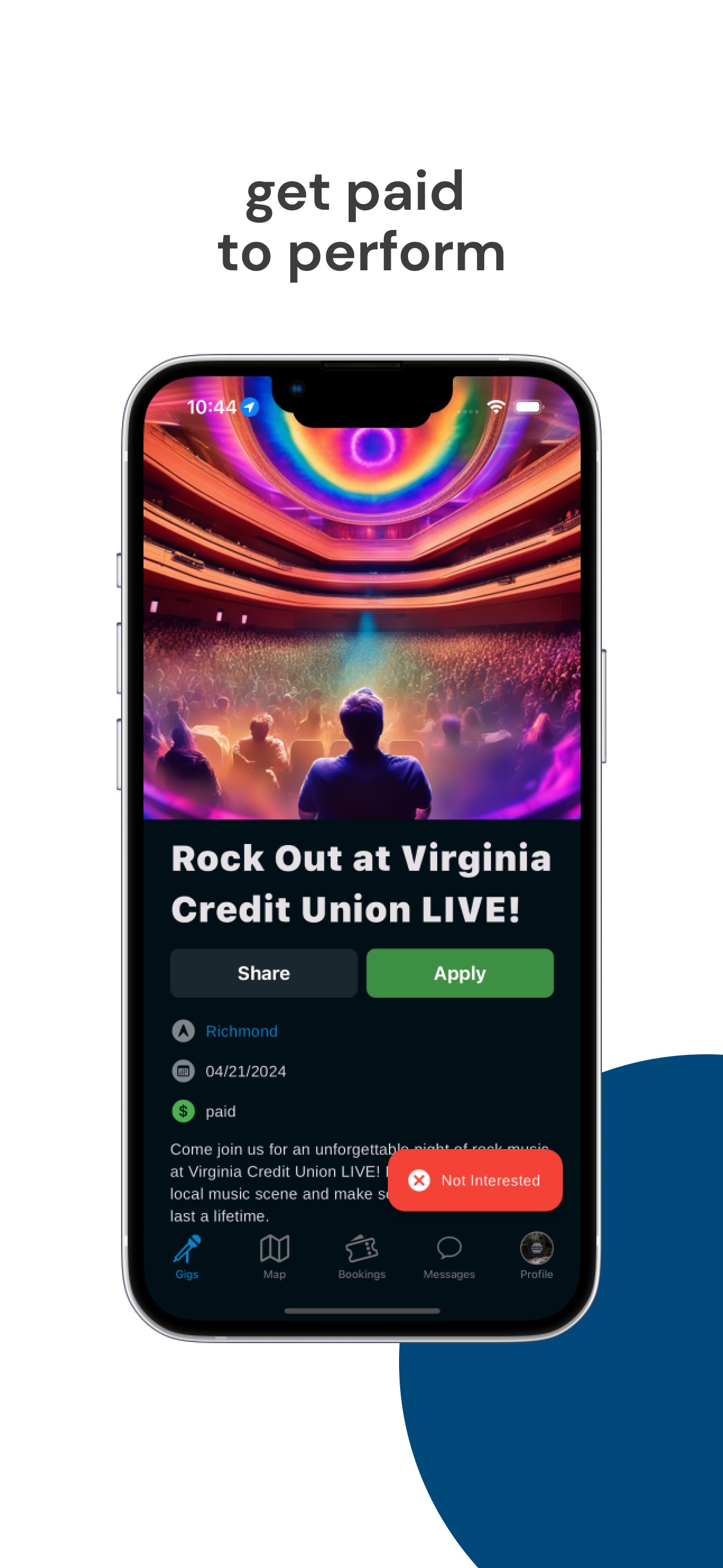
The pivot preserved the mission while shrinking the first job. In April 2024, Tapped released a product aimed at performers. It offered venue information and mass outreach, later presented as smart venue discovery, direct applications, booking management and analytics. A performer could filter rooms by capacity, genre and location, then use those choices to route a tour with more evidence than a chain of Google searches.
What the customer buysLess romance, fewer cold emails
Tapped's first customers are independent performers, especially those too early for a large agency but active enough to need better booking operations. The app also serves venues looking for acts. The planned second act goes deeper into the industry: labels, A&R teams, agencies, marketers, promoters and venue owners who may pay more for scouting and performance intelligence.
For artists, the problem is fragmented labor. Venue research lives in one place, contact details in another, applications in email, dates in a calendar and proof of demand in screenshots from social platforms. Tapped compresses that into a booking workflow. Its site now describes venue matching, applications, negotiation, confirmations and analytics. The App Store lists the app as free with a $12.99 Premium purchase. That is a different, narrower proposition from the earlier $50 artist-services package.
For industry customers, the eventual value is not another inbox. It is a database of where artists play, what comparable rooms look like, which bills may sell, how a route should move and where a performer is gaining traction. Tapped's 2024 roadmap included related-artist calculations, performer scores, ticket-price and attendance estimates, tour generation and smarter bill recommendations. Those are ambitions, not proof that each prediction is available or reliable today. The current public product is best understood as booking software with analytics, not an oracle.
The clever bitThe app is bait for a better dataset - in the useful sense
Most music-data businesses start by selling a dashboard to professionals. Tapped's model runs in the opposite direction. Give performers a tool that works with a smaller initial dataset. As they search, apply, report payouts and add overlooked venues, the information becomes richer. Use that growing dataset to make the performer tool better. Then package deeper intelligence for customers with larger budgets. Repeat.
The data flywheel Tapped is trying to build
This is where Tapped differs from a plain gig board. GigFinesse, Gigmit and Gigmor attack booking from marketplace angles. DICE and Eventbrite own ticketing and consumer discovery. Chartmetric analyzes audience and artist signals for professionals. The durable version of Tapped would sit between them: an operating tool for the artist whose activity produces a proprietary view of the live circuit.
The catch is quality. A data flywheel does not turn because somebody drew arrows in a pitch deck. Venue records decay. Booking contacts change. Artists may use the search without reporting outcomes. Promoters can ignore mass outreach. Predictions trained on thin, biased activity can send musicians toward the wrong rooms with greater confidence. Tapped works only if the first utility is good enough to create repeat behavior and if that behavior yields cleaner data than public scraping alone.
The second thing that hurtOne small team, two codebases, one impatient app store
By July 2024, engineering had become its own market test. Tapped built features for web, then rebuilt them for mobile. The web stack could push a fix almost immediately. Mobile required separate interface decisions, payment plumbing and app-store review. The company said the duplication roughly doubled development time, created bugs and depended heavily on one contributor.
So Tapped made a choice that founders often postpone: web became the sandbox, mobile became a paid perk. Curious users could explore on the web. Paying users, presumed to have higher-intent feedback, kept the native app. The move reduced the number of surfaces that needed simultaneous experimentation while turning the preferred surface into something customers funded.
A mobile app can be the thing users love and still be the wrong place for a tiny team to learn.The operating lesson behind Tapped's web-first shift
The trade is not free. Musicians live on their phones, often while traveling, and a worse or gated mobile experience can interrupt adoption. App Store reviews capture both sides: praise for access to venues and support, but also reports of onboarding failures and beta-level bugs. The iOS listing showed a 4.0 rating from 12 ratings when reviewed, too small a sample for triumph or disaster. It does show the exact pressure the company described.
What to stealBuild the wedge that feeds the asset
The copyable move is not “add AI to touring.” It is choosing a first product that solves a narrow problem and improves a strategic asset as a side effect. Tapped did not need every venue and promoter to adopt a new marketplace before an artist could get value. It could begin with discovery and workflow, observe what performers actually needed, and improve coverage over time.
The napkin version
Pick one user with urgent pain. Give that user a tool that works before the network is complete. Make normal usage produce information that improves the next session. Sell the mature intelligence to the customer who can price its economic value.
There are four useful constraints in Tapped's version. First, measure the customer outcome, not feature usage. “More bookings” is better than “more taps.” Second, resist adjacent businesses that mainly serve your hunger for data. Ticketing was strategically tempting and operationally distracting. Third, price the costly surface. If native mobile slows the learning loop, premium access can filter for serious users and pay for maintenance. Fourth, keep the long-term buyer in view without forcing an enterprise product onto incomplete data.
It will not work everywhere. The loop breaks when user activity is too sparse, when customers will not share outcomes, when scraped records become stale faster than usage corrects them, or when incumbents control critical inventory and refuse access. It also fails if automated outreach makes venues less responsive, poisoning the very signal the product needs. In small local scenes, a trusted human booker may outperform a database because taste and relationships carry more weight than matching scores.
Tapped's public history remains untidy. A September 2024 article announced a shutdown without a clear explanation; the iOS app then received another update in December, and the web map and product pages are accessible today. The sensible reading is not a neat death-and-rebirth fable. It is that a tiny music startup has repeatedly changed shape while the central wager survives: live performance is badly mapped, and whoever makes the map useful to artists may earn the right to sell the map to everyone else.