On a July night in 2025, the long road from Aston became a short trip across Birmingham. Ozzy Osbourne appeared at Villa Park before roughly 42,000 people, played a compact solo set, then joined Tony Iommi, Geezer Butler and Bill Ward. The original Black Sabbath lineup had not performed together in public for twenty years. Now the four men were a few miles from the streets where their improbable business had begun.
The occasion was called Back to the Beginning, a name so neat it could have been distrusted. Ozzy had spent most of his career making neatness impossible. He was a heavy-metal frontman who worshipped the Beatles, a professional menace with excellent comic timing, an arena figure routinely defeated by household appliances on television. Yet the final concert offered a clean piece of geometry. The Birmingham boy left, changed the sound of rock, and came home to thank the people who had listened.
Seventeen days later, Ozzy died at 76. The performance became his last act, and Birmingham became more than a birthplace in the biography. It was the frame.
Act I · Aston, before the smoke
The voice above the machinery
John Michael Osbourne was born in 1948 and raised in Aston, one of six children in a working-class household. School did not suit him. A sequence of ordinary jobs followed, including work tuning car horns and in a slaughterhouse. He also tried burglary, without distinction. In later interviews he could turn these facts into a routine, usually at his own expense.
Music supplied the imaginative exit. The Beatles mattered enormously. “She Loves You” suggested that a boy with a regional accent might travel farther than the factory gates. The influence is easy to miss if Ozzy is filed only under doom. His solo records, especially, depended on melody as much as menace. He wanted darkness with a chorus.
In 1968 he joined Iommi, Butler and Ward in the group that became Black Sabbath. The sound carried the pressure of its surroundings: Iommi’s lowered, grinding guitar; Butler’s anxious words; Ward’s restless drums. Ozzy did not sing like another gear in that machine. His voice was high, plain and oddly exposed, floating over the riffs like a warning from someone trapped on the roof.
The first two albums, Black Sabbath and Paranoid, both arrived in 1970. Songs such as “War Pigs,” “Iron Man” and “Paranoid” supplied a grammar that later musicians could develop, reject or exaggerate. The band did not need to call the result heavy metal for audiences to recognise a new weight.
Act II · The firing that opened a door
Starting over, louder and catchier
Black Sabbath dismissed Ozzy in 1979. In the tidy version of a music career, this is the cautionary ending. In his version, it is the hinge. Sharon Arden, the daughter of the band’s former manager Don Arden, became his manager and partner. They assembled a new group around guitarist Randy Rhoads, bassist Bob Daisley and drummer Lee Kerslake. The restart had talent, discipline and a useful disregard for the obituary already being drafted.
Blizzard of Ozz appeared in 1980. “Crazy Train” made the new formula audible within seconds: Rhoads’s exact, exuberant guitar, Ozzy’s keening melody, a lyric worried about the world, and a chorus designed for a crowd. Diary of a Madman followed in 1981. Rhoads died in a plane crash the next year, at 25, leaving the partnership painfully brief and musically permanent.
Ozzy continued with a succession of notable guitarists, including Jake E. Lee and Zakk Wylde. He learned how to make the instability of a solo band feel like a feature: the voice and persona stayed fixed while new players altered the voltage around them. “Mama, I’m Coming Home,” from 1991’s No More Tears, proved he could take a ballad into the mainstream without tidying away the cracked edges.
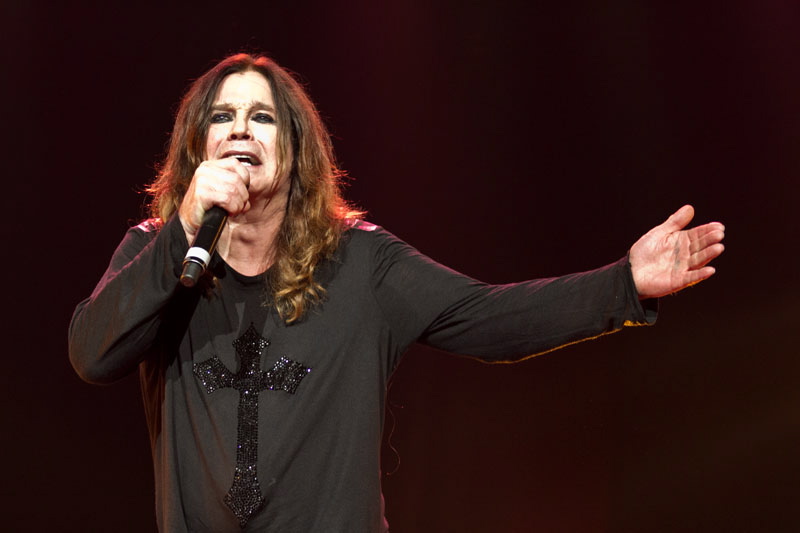
Act III · If the gate stays shut, build a field
Ozzfest turns rejection into infrastructure
By the middle of the 1990s, the culture industry had decided what a contemporary festival looked like, and Ozzy was not invited. Lollapalooza rejected him. Sharon’s reply was Ozzfest, launched in 1996 with dates in Phoenix and San Bernardino. It put Ozzy, Slayer and Sepultura beside developing acts and gave hard rock and metal an ecosystem of their own.
The durable idea was not simply that Ozzy could still sell tickets. Ozzfest worked as a ladder. Established names drew the audience; younger bands met that audience in daylight and returned later with better slots. Across successive bills, acts including System of a Down, Slipknot, Linkin Park, Disturbed and Queens of the Stone Age passed through. A rejection had become a distribution network.
It also clarified Sharon and Ozzy’s partnership. She could read the business insult and design the counterattack. He remained the magnet and the peculiar host, generous enough to share the field while unmistakably owning the name over its gate.
Act IV · Darkness meets the dog door
The household comedy hiding inside the spectacle
Then came a reinvention nobody could hear. The Osbournes premiered on MTV in March 2002, placing cameras inside the Los Angeles home Ozzy shared with Sharon and their children Kelly and Jack. Aimee, their eldest daughter, chose not to participate. The show became MTV’s highest-rated series of its era and won the first Primetime Emmy for Outstanding Reality Program.
Its joke was the gap between costume and circumstance. Onstage, Ozzy could summon thousands with two raised hands. At home, he muttered at remotes, worried about pets and wandered through family arguments with the expression of a tenant who had entered the wrong flat. The profanity was plentiful, but so was affection.
Celebrity reality television already existed. The Osbournes made domestic anti-glamour into a format. It did not destroy Ozzy’s mystique because the stage persona had always contained a wink. The series simply moved the wink closer to the camera. A generation that had never bought Master of Reality learned his name from bins, dogs and an exasperated “Sharon!”
The contradictions were not a branding exercise. Ozzy could play the Prince of Darkness and become bashful around Paul McCartney. He could cultivate menace, then use an awards speech to marvel at his own luck. When the Rock & Roll Hall of Fame inducted him as a solo performer in 2024, eighteen years after Black Sabbath entered, his response was brisk: “Not bad for a guy who was fired from his last band.”
Final act · Villa Park, July 2025
The route home was hiding in the title
The last phase of Ozzy’s recording career still had forward motion. Ordinary Man arrived in 2020, his first solo studio album in a decade. Patient Number 9 followed in 2022 and won the Grammy for Best Rock Album; “Degradation Rules,” a reunion with Iommi, won Best Metal Performance. Even the late work preferred collaborators to monuments, with musicians from Jeff Beck to Andrew Watt entering Ozzy’s orbit.
For the final concert, that orbit widened. Metallica, Slayer, Pantera, Tool, Guns N’ Roses, Gojira, Alice in Chains and others came to Villa Park for an all-day charity bill. Ozzy performed solo before the original Black Sabbath four played “War Pigs,” “N.I.B.,” “Iron Man” and “Paranoid.” There were no deep cuts and no need for them. The songs carried fifty years of other bands inside them.
“You have no idea how I feel,” he told the crowd. “Thank you from the bottom of my heart.” For once, the professional showman did not need a better line. Gratitude had become the plot.
After his death, Birmingham’s farewell procession traveled along Broad Street, past the bench and bridge named for Black Sabbath. Fans filled the route. The family stopped to view flowers at the bridge. The city that once offered factories, a prison cell and a narrow horizon now held the public memory of what four local musicians had made.
Ozzy’s career is often reduced to survival or shock. Both are present, but neither explains the affection. The more revealing pattern is reinvention without polish. He changed bands, guitarists, business models and media, while keeping the accent, the laugh and the sense that he was as surprised by the outcome as anyone watching.
The darkness was theatre. The gratitude was not. At Villa Park, the two finally shared the same stage, a short drive from Aston, with the old band waiting in the wings.
Listen, watch and read