The message that changed Ayra Starr's life arrived through the same little rectangle where everybody else's messages arrive. In December 2019, a 17-year-old singer posted an original song called “Damage” on Instagram. Don Jazzy, the founder of Mavin Records, saw a powerful voice attached to a remarkably young face and sent a direct message. He invited her to the studio with a guardian. Three days after they met, she had a record deal.
This is the sort of beginning that the internet loves to flatten into luck: upload, refresh, become famous. But a door opening is not the same as knowing what to carry through it. By then, Oyinkansola Sarah Aderibigbe had spent years gathering material. She had moved between Cotonou, where she was born to Nigerian parents, and cities including Lagos. She joined choirs when the family moved. She watched a brother learn guitar. She wrote, sang, modeled, posted covers and learned how a camera could translate presence. Her mother had been urging the children to show their gifts to the world. The Instagram post was a spark landing on a house already wired for light.
Audacity is her favorite renewable resource. At a strict school, when teachers declared that girls should not wear trousers, she asked why and was punished for the question. In mathematics class, a teacher predicted she would one day sign with Mavin Records. The forecast was improbable enough to be funny, then precise enough to become family lore. By 2018, she was modeling professionally in Lagos. A year later she began posting covers of artists including 2Baba and Andra Day, then risked the far more revealing act of sharing something she had written herself.
The childhood kept moving. The voice kept collecting.
Movement gave her ears a passport before the industry did. Cotonou brought Beninese textures and French. Lagos brought the pulse and argument of Nigerian pop. Home offered Yoruba, Nigerian Pidgin and a crowded creative laboratory of four siblings, a mother and an aunt. Nearly everyone in the family made something. One brother became a video director; another wrote songs with her. Their mother's support reversed the familiar tale of a young artist hiding a creative ambition from practical parents.
The result is often called Afrobeats because categories need somewhere to sit. Starr's music is less well-behaved. R&B softness can share a room with amapiano percussion, pop choruses, alt-rock grit, dancehall movement and classic West African references. A fuji praise chant arranged by her brother opens The Year I Turned 21. On the cover of Starrgirl, she wears a gele. The local details do not obstruct the global journey. They give it luggage.
Age first became armor
Her 2021 debut, 19 & Dangerous, put the number on the door. Starr has said she wanted listeners to know her age and understand that youth was not permission to dismiss her. “Bloody Samaritan” became the first solo track by a woman to reach number one on Nigeria's TurnTable Top 50. The song traveled because it offered a useful emotional service: a way to dance while refusing bad energy.
Then “Rush” escaped every sensible container. Released in 2022, it crossed European charts, became the most-streamed solo song by a Nigerian woman on Spotify and pushed its video beyond 100 million YouTube views. It also earned Starr a nomination in the Grammys' inaugural Best African Music Performance category. A song about blessings arriving began to accumulate them with suspicious efficiency.
The post
An original Instagram upload reaches Don Jazzy and leads to Mavin's studio.
The introduction
A self-titled EP and 19 & Dangerous establish the voice, vocabulary and nerve.
The crossing
“Rush” becomes an international hit; a world tour and first Grammy nomination follow.
The ownership
BET and MOBO wins, a second Grammy nomination, a Yale keynote and Starrgirl.
Success made the calendar strange. Starr spent the end of her teens and the start of her twenties touring, recording and learning adulthood in airports. On her 21st birthday, a rare pause in Barbados with family and friends made the scale of the change suddenly legible. That realization became the emotional architecture of The Year I Turned 21: pleasure beside homesickness, bravado beside grief, a person attempting to experience life while her professional self kept sprinting ahead.
The album made history in 2024 as the first by a Nigerian woman to debut on the Billboard 200. Its collaborations were chosen like entries in a private fan diary: Giveon, whose voice had once made her cry; Coco Jones, whom she remembered first seeing onscreen; Asake and Anitta, each invited into a world Starr describes herself as creatively directing. She does not merely sing the songs. She hears the pieces, assembles the room and decides what kind of weather belongs inside it.
Three titles, one changing posture
The superstar returns to the bed
For all the scale, one of Starr's recurring creative locations is wonderfully unglamorous. She writes on her bed. It is where the stage name can loosen its grip and Oyinkan can reappear: daughter, sister, private citizen, person in socks. The safety matters. Her most intimate work draws power from the temporary disappearance of the performer. An arena can magnify a song, but it cannot give the song a pulse.
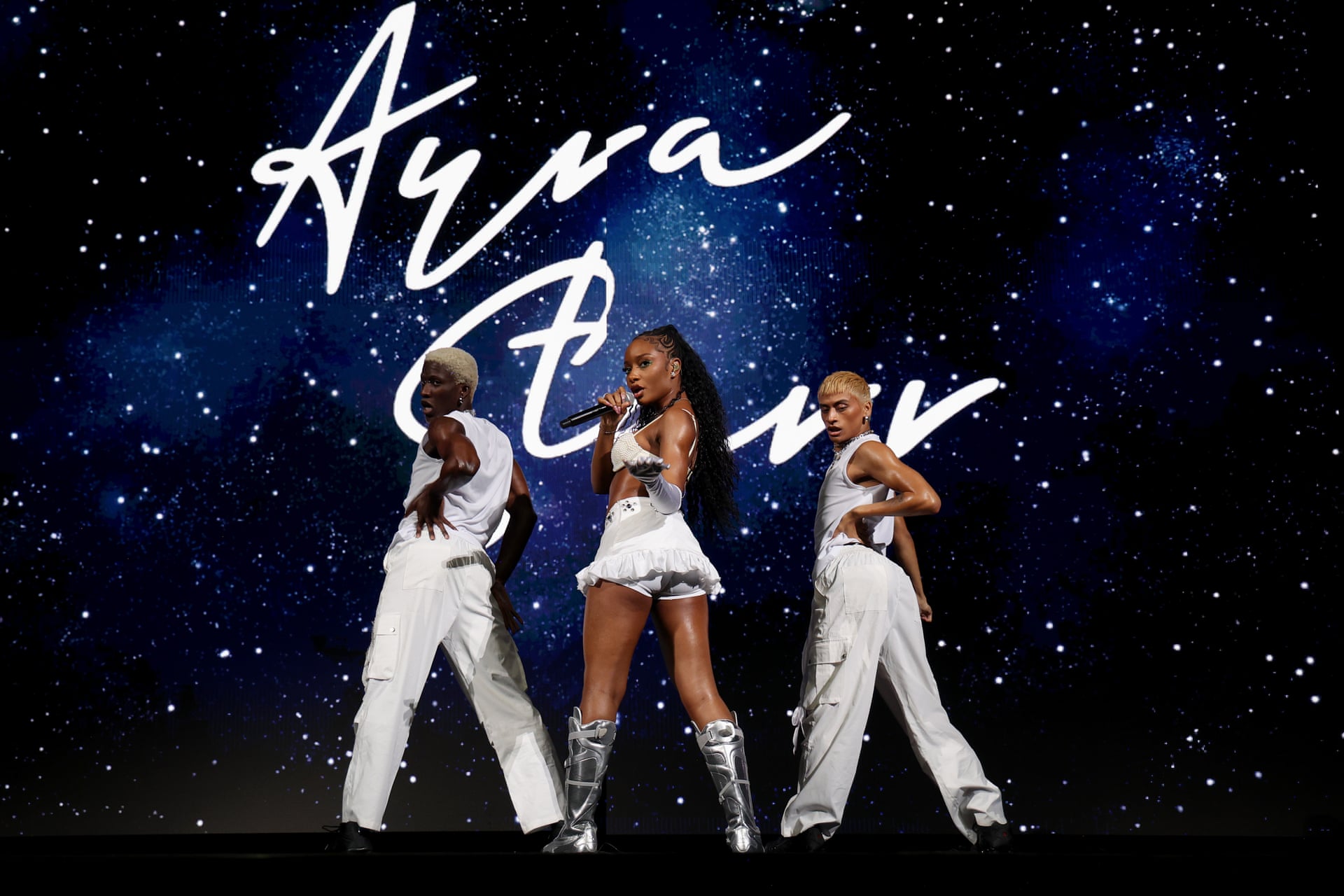
That tension between private room and public sky explains much of her appeal. Onstage, she enjoys spectacle, tiny skirts, long boots, sharp choreography and the comic grandeur of calling herself a celestial being. Offstage, the material returns to family voice notes, childhood notebooks and the people who knew her before the extra “r” in Starr became a profession. Her confidence never sounds solitary for long. A mother pushed her to post. Siblings write and direct. Don Jazzy opened a studio door. Kelly Rowland became a mentor. The star may be singular; the constellation is crowded.
She has been rehearsing that mixture of authorship and mischief for years. At 13, she published stories on Wattpad under a username she still refuses to surrender. At school, she altered uniforms by shortening skirts and tightening tops, earning brisk trips to the principal's office. The impulse was consistent: given a supplied form, revise it. Fashion later became another sentence in the same language. The tomboy who once preferred oversized clothes learned that femininity did not have to be an apology, then embraced pink, nails and the long theater of getting ready. Clothes, like genre, became material rather than a rule.
Her humor keeps all this self-construction from becoming solemn. She has called a cold New York apartment her “walk-in freezer.” She talks about the studio microphone as a toy and tries to approach a session as a visit with friends. Even the fan name, Mobstarrs, puts a wink beside the celestial branding. The ambition is enormous; the person carrying it is allowed to laugh.
The public milestones continued. In 2025 she won Best International Act at the BET Awards and collected both Best International Act and Best African Music Act at the MOBOs. She performed at Global Citizen Festival in Central Park, where she spoke about children needing reliable electricity to study, practice and dream. She joined Roc Nation's management roster while remaining a Mavin recording artist. “Gimme Dat,” her collaboration with Wizkid, brought a second Grammy nomination in 2026. At Yale that spring, she addressed more than 350 students, entrepreneurs and policymakers about her journey and Africa's creative economy. Instagram's teenage vocalist had become the keynote.
No more counting birthdays
Starrgirl, released in August 2026, breaks the numerical naming pattern. Starr understood that listeners expected another age and chose the more interesting answer. The 16-track album brings together Wizkid, Rema, ZAYN, Leon Thomas, kwn, Danny Ocean and Theodora without sounding like a guest list in search of a host. Its title turns the persona from a destination into a residence.
The distinction is small enough for a lyric and large enough for a life. Earlier, she moved with the pressure of “I have to be.” Now she describes the position as “I am.” Becoming can be thrilling, but it keeps the future in charge. Being lets an artist work from the ground she has already earned.
She is still ambitious. Acting interests her. So does a version of global pop capacious enough to contain Yoruba rhythms, a traditional headwrap, R&B confession and a One Direction fan's duet with ZAYN. What has changed is the grammar of arrival. At 24, with three albums and stages across several continents behind her, Ayra Starr no longer needs the next room to confirm that she belongs in this one.
The phone screen remains part of the story. It is where discovery happened, where fans gather, where a young person can still watch her and imagine a door. But the lasting lesson is not algorithmic. Post the work, certainly. Then build a self sturdy enough to survive being seen.
Keep listening