The useful thing about a loud career is that it makes the quiet beginnings sound almost comic. Before the arenas, before five Grammy nominations, before his name became a compact synonym for Nigerian pop, Davido was a business student at Oakwood University in Alabama, distracted by a noise upstairs. A neighbor called Jaymo had built a studio in his dorm room. Davido knocked, announced that he wanted to make music too, and proposed an equipment budget of $2,000. Jaymo told him he was overspending. They went to Guitar Center with $500.
It is a lovely origin because it contains the career in miniature: money is present, certainly, but so are curiosity, other people and the corrective power of someone saying, relax, you do not need all that. Davido began making beats and recording vocal references for a cousin back in Lagos. The business degree receded. The upstairs room became the real classroom.
A family argument with a bass line
David Adedeji Adeleke was born in Atlanta in 1992 and raised in Lagos, the youngest of five children. His father, Adedeji Adeleke, was a businessman who expected education to come before improvisation. His mother, Vero, was a university lecturer. The family plan made sense on paper. Davido was meant to learn business in America. Instead, after three semesters, he left Oakwood, went to Atlanta and then disappeared to London to concentrate on music. He had shifted from making beats to using his own voice.
When he returned to Lagos in 2011, the disagreement with his father became spectacular enough to enter Davido folklore. Yet the ending was not rebellion for rebellion's sake. Father and son negotiated. Davido would go back to university. Music could continue, but the degree had to be finished. He enrolled at Babcock University and graduated in 2015 with a degree in music. It was a compromise with excellent comic timing: by graduation, the supposed distraction was already a profession.
His first singles appeared while he was still a student. Then came “Dami Duro,” a record with a title that translates roughly as “stop me” or “try to stop me.” It was less a request than a grin. The song drove his 2012 debut album, Omo Baba Olowo, and spread through clubs and radio across Nigeria. Within months, bookings were arriving from around Africa.
“People always say, ‘Oh, he’s just some rich kid.’ And he is. But they don’t realize that this music stuff - at first he did it alone.”Kamal Ajiboye, Davido’s manager, in 2016
The line matters because Davido has never been separable from the fact of his privilege. One of his nicknames, OBO, abbreviates Omo Baba Olowo, Yoruba for “son of a wealthy man.” He put the accusation on the album cover before anyone else could whisper it. Access bought equipment and time. It did not write “Dami Duro,” persuade a nightclub or make a chorus travel. In pop, a famous surname may get a meeting. The crowd still decides whether to answer back.
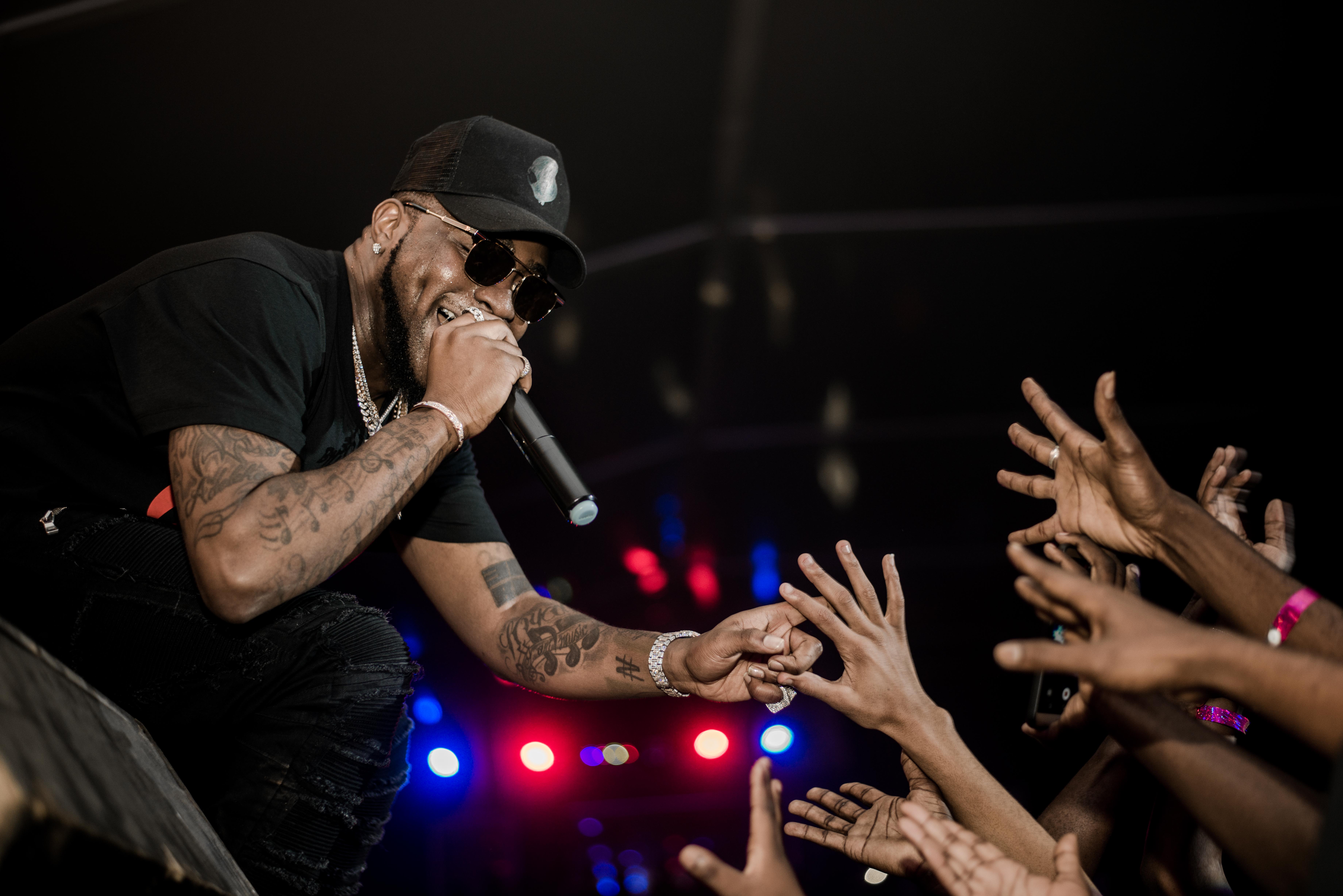
The hit that took its own flight
By 2017, Davido had learned that a song could be both unmistakably Nigerian and casually international. “If” was nimble, romantic and patient. “Fall” was even more patient. It became a hit in Nigeria first, then drifted into American ears on a delay, helped along by parties, diaspora networks, Shazam searches and a video people kept replaying. In 2019, it became the longest-charting Nigerian pop song in Billboard history at that time. Its video had already become the first by a Nigerian artist to pass 100 million YouTube views.
That slow second life was more revealing than an engineered launch. American radio had not discovered an empty continent. It had arrived late to a song that was already busy. Davido's career kept making that point. In January 2019 he sold out London's O2 Arena. Later that year, A Good Time assembled the route map in album form, placing Nigerian producers and singers beside American guests without asking either side to surrender its accent.
2012 to 2026
through 2026
to Oriadé
The word “global” is often used as though it were a solvent, something that washes the address off music. Davido treats it more like an extension cord. The power still begins somewhere. He has argued that Afrobeats will last only if its artists remember home: African audiences, African cities, African producers. He welcomes exchange, but with credit attached. Joking with his frequent collaborator Chris Brown, he put the boundary neatly: Davido cannot sing R&B like Brown, and Brown cannot sing Afrobeats like Davido.
One voice becomes an address book
The career also grew sideways. Davido signed with Sony Music in 2016 and founded Davido Music Worldwide that year. DMW turned the frontman into a label builder, with artists and producers moving through a network that included Mayorkun, Peruzzi, Morravey, Logos Olori, Fresh VDM and others. This was not a retirement plan. It was the recognition that a durable scene needs more than stars; it needs rooms, introductions and working machinery.
His own albums kept changing the guest list. A Better Time arrived in 2020. Timeless followed in 2023 and set streaming records for an African album on Apple Music. It also brought his first three Grammy nominations. The title sounded serene, but the music remained social, made to occupy weddings, cars and the hour when a sensible evening loses its argument. “Unavailable,” with Musa Keys, supplied a dance as well as a refrain. Davido has always understood that choreography can be distribution.
Those Grammy nominations placed a formal American institution at the end of a route Davido had been walking without it for years. Timeless was nominated for Global Music Album; “Feel” for Global Music Performance; and “Unavailable” for the newly created African Music Performance category. He did not win. The useful fact was the shape of the ballot itself. A sound once treated abroad as a visiting curiosity now had a category, and an artist once told to finish the sensible degree was seated inside the ceremony with three reasons to listen for his name.
Awards have followed him from closer to home, too. The Headies named him Next Rated in 2012, when the question was what he might become. In 2025, the same awards named him Artiste of the Year and Digital Artiste of the Year, when the question had changed to how long he might continue. Nigeria appointed him an Officer of the Order of the Niger in 2023. These honors are snapshots, not the film. Still, placed together, they show the unusual span of the career: newcomer, national figure, global nominee, all before his mid-thirties.
Six records, one widening circle
5ive, released in 2025, was edited out of abundance. Davido began with roughly 80 songs, then asked family and friends to rank them. Seventeen survived. The method is revealing. For all the scale around him, his quality-control department resembled a busy group chat. The finished album joined Chris Brown, Victoria Monét, Becky G, Omah Lay, Victony and others. A 42-date tour followed, crossing 12 countries and four continents.
By spring 2026, that road reached Coachella. The appearance was described as a debut, though Davido arrived with the ease of someone for whom California was another pin on a familiar map. Festival billing can make international music look newly imported. His set carried fifteen years of prior travel into the desert. Soon after, “No Place Like Home,” recorded with Major Lazer and Nelly Furtado for the official World Cup album, made the title of his central idea explicit. Home was not the place left behind. It was the thing the touring machine kept carrying.
“The most important thing that will make us last longer is if we don’t forget where we came from.”Davido, 2025
The crown looks backward
In July 2026, Davido released his sixth album, Oriadé. The Yoruba title joins ori, the head or destiny, with adé, the crown. Fifteen years after his first professional recordings, he had chosen a title that looked less like a victory lap than a conversation with everything that had happened on the road.
The album is his shortest, thirteen songs in 37 minutes. Brevity suits the moment. Where earlier Davido projects sometimes showed their generosity by filling every chair, Oriadé makes its argument and leaves the party with its coat. Black Sherif, Mayorkun, FOLA, Leon Thomas, Aya Nakamura and Llona appear; newer voices sit beside old allies. The sounds move through Afrobeats, amapiano, R&B and pop. The center of gravity remains Davido's warm, slightly raspy insistence.
A decade earlier, he had spoken about Afrobeats as a field where it sometimes felt as if only one person could win. In 2026, his phrasing had changed: the sky was big enough for everyone. That may be the more interesting achievement. Competition helped him enter the room. Time taught him to widen it.
Davido is still easy to describe through motion: Atlanta to Lagos, producer to singer, student to founder, local sensation to touring act. But motion is not the same as escape. His best work keeps doubling back, collecting the language and people that made the trip possible. The upstairs dorm studio mattered because he heard it through the floor and went looking. Fifteen years later, the instinct is the same. Follow the noise. Find the room. Bring more people inside.