Before the stadiums, the Grammy and the audacious nickname, there was an old computer in a cupboard. A schoolmate had given Damini Ogulu a copy of FruityLoops, and the boy who would become Burna Boy shut himself away to learn what the buttons could do. The room was cramped. The imagination was not. He made beats, absorbed the music around his family and began assembling a private grammar from sounds that were already travelling: Nigerian pop, Afrobeat, dancehall, reggae, American rap and the patois he heard during time in London.
This is a useful place to begin because Burna Boy's later career can look preordained. He was born in Port Harcourt in 1991. His maternal grandfather, the broadcaster and critic Benson Idonije, had managed Fela Kuti. His mother, Bose Ogulu, would eventually manage him. Musicians had passed through the family home. Yet lineage is not a record deal, and proximity to history is not the same as making some of your own. The cupboard matters because it shows the first ingredient was appetite.
The family inheritance was musical but not narrowly so. Bose worked as a translator, and the household prized education. School holidays took young Damini beyond Nigeria, including language programmes elsewhere in West Africa and Europe. His ears were being trained in difference before his records began collapsing borders. At the time, he was not dutifully studying Fela's archive. He wanted the hard immediacy of DMX and the bright transmission of MTV. The older Nigerian music his grandfather offered became useful later, when experience gave him a reason to hear it properly.
A reluctant student finds the serious subject
Ogulu went to Britain to study, first media technology at the University of Sussex and then media communications and culture at Oxford Brookes. Formal education did not take. London did. Brixton supplied grime, slang and a sharper feel for the affinities between Nigerian pidgin and Jamaican patois. He spent two wandering years discovering, with admirable inefficiency, what he did not want. Then he went home.
Back in Port Harcourt, an internship at Rhythm 93.7 FM placed him close to the machinery of radio. His mother later recalled that within two days he was helping anchor a morning drive show. He played the station's programme director a track called “Freedom Freestyle”; it went on air the next day. Soon he moved to Lagos and signed with Aristokrat Records. “Like to Party,” released in 2012 and produced by LeriQ, was the proper break: languid, melodic and instantly social. His debut album, L.I.F.E, followed in 2013.
Those early records did not arrive as immaculate declarations. They arrived as experiments from a young artist testing how much could coexist in one voice. There was a little rasp, a little croon, an instinct for melodic understatement and the useful confidence to leave a rhythm some space. The name Burna Boy came from an even earlier private mythology: as a child drawing comic-book heroes, he wanted to invent one of his own. The cape did not survive. The scale of self-invention did.
“I care about crossing over, but in the opposite way.”Burna Boy, 2019
That sentence contains the operating system. Conventional crossover asks an artist from elsewhere to approach a presumed centre, sanding away whatever might slow the trip. Burna Boy imagined the traffic reversed. The listener could come to the sound. The accent need not acquire a visa. The history lesson could keep its drums.
A genre with an open door and a firm address
Burna Boy calls his music Afro-fusion. The term is elastic enough to admit dancehall's bounce, hip-hop's stance, R&B's warmth and rock's appetite for spectacle. But elasticity is not vagueness. The centre is African, and the connections are historical rather than decorative. When he hears pidgin, creole and patois, he hears related solutions to the same colonial language. A groove can therefore be pleasure and evidence at once.
This explains why his political songs rarely feel stapled to the party records as a separate, respectable department. Education travels inside entertainment. A listener may come for the hook and leave wondering how Nigeria was assembled, why Black identities across oceans rhyme, or what Fela's long shadow asks of a pop star. Burna Boy has never sounded eager to become a lecturer. He prefers the sneakier achievement of putting a syllabus on a bass line. The body accepts the lesson before the mind notices the homework.
The albums widened that proposition. On a Spaceship arrived in 2015. Outside, his 2018 major-label debut after signing with Atlantic and Warner, carried “Ye,” the record that moved him decisively into wider view. Then a festival poster handed him a title. Annoyed that his name appeared in small type on the 2019 Coachella bill, he complained that he was an African giant. It was a magnificent piece of wounded typography. More usefully, it became the name of his next album.
African Giant could party, argue and remember. On “Another Story,” Nigeria's colonial formation entered a song sturdy enough for a festival crowd. Bose Ogulu's BET acceptance speech closed the album, reminding an American audience of the African identity that precedes the hyphen. The record earned a Grammy nomination. Its 2020 successor, Twice as Tall, recorded largely at home and executive-produced with Sean “Diddy” Combs and Bose, won Best Global Music Album.
The loss before the win also matters. African Giant was nominated and did not take the Grammy. Angélique Kidjo won and used her acceptance to praise a younger generation of African artists represented by Burna Boy. A year later, Twice as Tall completed the step. The sequence was almost too neat: acknowledgement from an elder, then the institution's trophy. But the music did not treat recognition as an arrival gate. The next records kept changing the balance between autobiography, history, pop instinct and braggadocio.
The victory was personal, but its surrounding machinery was familial. Bose is both mother and manager. Burna Boy's sister Ronami is a co-manager and the operating chief of Spaceship Collective. The organisation expanded from a label imprint into records and publishing with an explicit concern: build the structure the family lacked and keep more African catalogue ownership in Africa. The romance of inheritance - grandfather to mother to son - is easy to tell. The more consequential inheritance is a suspicion of bad deals.
The rooms keep getting larger
The audience grows; the particulars survive
Stadium achievements are usually served as dry arithmetic. Burna Boy's are better read as changes in permission. In 2022 he became the first Nigerian artist to headline Madison Square Garden. In 2023, he headlined London Stadium, then sold out Citi Field in New York, becoming the first African artist to headline and sell out a United States stadium. In 2025 he became the first African artist to sell out Stade de France. Each booking made the next ambitious African tour slightly easier to imagine.
The geography is part of the achievement. London was not merely a foreign market; it had been an unruly classroom and a home to African and Caribbean communities that heard the music early. New York carried its own symbolic freight, a Black Atlantic city receiving a performer who had long argued that diaspora connections were living facts. Paris, with its deep African audience, offered a different kind of recognition. These were not anonymous pins on a global tour map. Each city returned some part of the musical conversation.
Scale suits him because his records have always contained a bandstand. The voice is the anchor: low, grainy and surprisingly supple, capable of sounding amused before the line has finished. Around it sit live drums, horns, guitars and bass with enough air between them to move a crowd. The spectacle is large, but the songs retain the conversational pleasures of someone turning a phrase at the edge of a party.
Watch the transitions in a full show and the architecture becomes plain. A recorded hit is not simply replayed louder. The band stretches introductions, thickens breaks and lets percussion carry the handoff from one song to another. Burna Boy can stalk the runway, pause for a choir of tens of thousands, then drop back into the arrangement without making the scale feel mechanical. The audience is not decoration around the performance. It becomes another instrument, unruly but rehearsed by years of knowing the hooks.
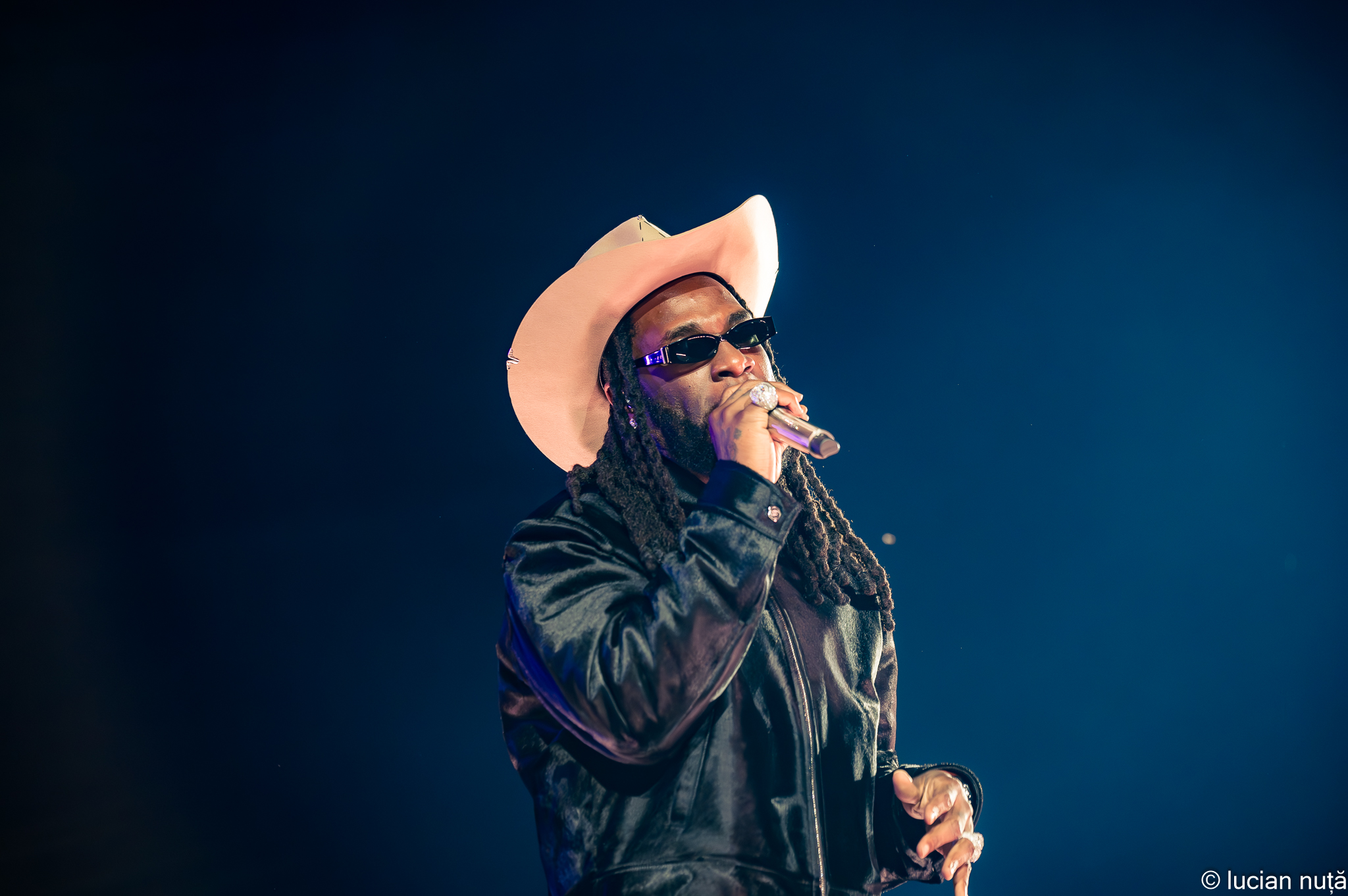
There is also a comic tension in the public persona. He has the grandeur to name an album African Giant and the candour to admit that, when a teacher asked what he wanted to be, he wrote “rock star” without knowing what rock stars did. Decades later, the answer includes cowboy hats, pyro, a live band and Mick Jagger replying on WhatsApp.
Watch “Tested, Approved & Trusted”Official music video · Burna Boy on YouTubeRock star was the childhood answer. Longevity is the adult one.
Love, Damini in 2022 made the writing more personal without abandoning the wide frame. I Told Them… followed in 2023, wearing hip-hop influence openly. The eighth album, No Sign of Weakness, arrived in 2025 with guests from several different maps: Travis Scott, Stromae, Shaboozey and Mick Jagger. The guest list looks chaotic until one remembers the door has always been open. Afro-fusion is not a purity test. It is a host with excellent house rules.
Burna Boy's method is less theatrical than the finished records. He records constantly, gathers songs in a vault and, once a theme becomes clear, selects and shapes the album around it. Accumulation comes before explanation. The process has room for accident, but the ambition is exact. Speaking about working with Jagger, he described a future of music built to last, songs one might still perform at 81. The boy who could not define a rock star now defines one by endurance.
That ambition also extends beyond one catalogue. He has spoken about organisation as the recurring missing ingredient across African and Black creative life. Spaceship's publishing purpose, his insistence on naming his own genre and the reverse-crossover idea all answer the same problem: who sets the terms when culture travels? It is possible to enjoy “Last Last” without conducting a seminar. The scholarship has a chorus.
There is a practical sharpness beneath the grand language. Catalogue ownership decides who benefits after the applause. Management decides whether a first invitation becomes a durable route. Naming a sound helps prevent other people from reducing it to whichever category is easiest to sell that season. Burna Boy's career is full of flamboyant gestures, but its continuity depends on unglamorous things: contracts, touring systems, publishing administration and a family team able to argue over the long term.
In 2026, No Sign of Weakness and its song “Love” added two more Grammy nominations to a career total of thirteen. Later in the year, the NFL chose him to headline halftime at its first regular-season game in Paris, citing his history in the stadium and the city's appetite for African music. Another institution, another enormous room, another invitation that makes perfect sense only after someone has done the supposedly improbable work.
The Burna Boy story is not an escape from home. It is an expansion of what home can hold.
Return, then, to the cupboard. A small room can teach useful habits: make your own tools work, listen without asking permission and do not confuse available space with possible scale. Burna Boy carried those habits from Port Harcourt to Lagos, from Brixton back into pidgin, from an undersized festival billing to a title nobody could print timidly. The stages became vast. The point of view did not become smaller. That is why the journey feels less like crossover than gravity.