Before Wizkid became a passport stamp for Nigerian pop, he was a boy watching other people work. At OJB Jezreel’s Point Beat studio in Lagos, he observed recording sessions and absorbed the unglamorous grammar of making songs: waiting, listening, trying again. He had already sung in church and made music with friends as the Glorious Five. He had already called himself Lil Prinz. The apprenticeship mattered because the career that followed can look, from a distance, suspiciously effortless. Wizkid sings as if he has just remembered a melody and might forget it again if he presses too hard.
That ease is a marvelous bit of stagecraft. Ayodeji Ibrahim Balogun, born in Lagos in 1990 and raised in the Surulere area, began working in music while still a child. By 2009 he had signed to Empire Mates Entertainment. “Holla at Your Boy” arrived the next year with the cheerful nerve of a teenager already introducing himself as a fixture. His debut album, Superstar, followed in 2011. The title was immodest; the delivery rarely was.
The interesting contradiction has endured. His songs move with social confidence, but the person behind them has spoken about wanting an ordinary life and disliking cameras in his face. Onstage, reserve turns kinetic. Offstage, he has described “Wizkid” as a business distinct from Ayo Balogun. Most pop stars construct a persona and ask us to believe it. He built one and calmly explained the paperwork.
“Everything I’ve learned, I learned from Lagos.”Wizkid, 2021
A place-name that became a route
The hinge of the story is “Ojuelegba,” from his 2014 album Ayo. Ojuelegba is a place before it is a metaphor: a busy Lagos district and transport junction, close to the streets that formed him. In the song, Wizkid folds struggle, gratitude and forward motion into a beat too supple to carry a lecture. He has said the record is about where he was, where he is and where he hopes to go. That is an enormous itinerary for four minutes, but the song never appears to hurry.
Drake and Skepta joined a remix in 2015. Their presence expanded the audience, but it did not relocate the song. Listeners had to meet it where it lived. This is one reason “Ojuelegba” remains more revealing than a generic anthem about success. It has traffic, memory and an address. Ambition is usually marketed as escape. Wizkid made origin the chorus.
A year later, Wizkid appeared on Drake’s “One Dance.” The single reached number one in the United States and the United Kingdom, introducing his voice to listeners who might not yet have known the name. His own 2017 album, Sounds from the Other Side, tested how far the bridge could stretch, moving among Afrobeats, R&B, dancehall and pop. The collaborations multiplied: Chris Brown, Ty Dolla $ign and Major Lazer on that project; Beyoncé and Saint Jhn on “Brown Skin Girl” in 2019; artists from Nigeria, Britain, Jamaica and the United States on what came next.
The album that refused to leave home
Made in Lagos appeared in October 2020 after an unusually long gestation. Wizkid said he made several versions and sometimes woke up ready to discard one that had sounded complete the night before. He has a neat test for when a record is finished: when it is out. The line is funny because it is also a confession. Calm music can come from an agitated editor.
The album’s guest list works like a diagram of the Black Atlantic: Burna Boy and Tems from Nigeria, Skepta from Britain, Damian Marley from Jamaica, H.E.R. from the United States. Yet the title makes its position plain. This is not Lagos exported in a sealed container. It is Lagos as meeting place. Wizkid’s voice, light and conversational, gives everyone room. He does not dominate a collaboration so much as alter its weather.
The release was delayed again during the End SARS protests against police brutality in Nigeria. Wizkid joined a London demonstration and used his platform to criticize the Nigerian government. He has resisted making overtly political music, preferring songs that create pleasure and connection. Still, timing carries meaning. Pausing an album called Made in Lagos while young Nigerians demanded accountability tied the record more tightly to the place named on its cover.
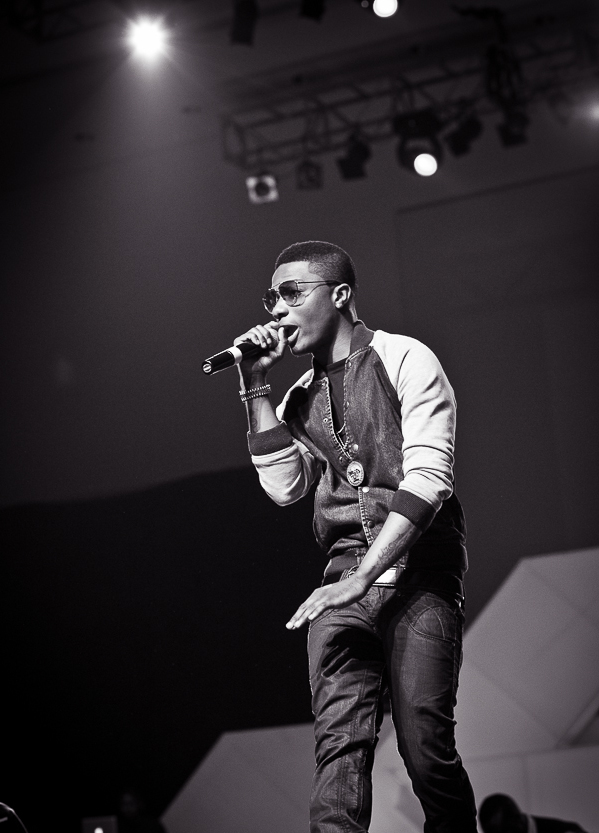
“Essence” and the virtue of not shouting
Then came “Essence,” the duet with Tems that behaved less like a campaign than a climate. Released on Made in Lagos, it gathered momentum across 2021, becoming the first Nigerian song to enter the Billboard Hot 100. A remix added Justin Bieber. The achievement is easy to reduce to a chart fact, but the song’s character makes the fact more interesting. “Essence” does not arrive carrying a battering ram. It glides. Tems’s rich vocal line and Wizkid’s feather-light responses leave open space where a less confident record might add noise.
The song did not invent Afrobeats, a broad and evolving family of contemporary West African pop sounds with many architects. Nor did one artist move it around the world alone. What “Essence” supplied was sustained American radio presence for a Nigerian record and a highly visible door through which more listeners could walk. Wizkid’s part in the genre’s expansion is significant partly because he has treated collaboration as infrastructure, not decoration.
That distinction matters. Pop history is fond of the lone genius because a single silhouette fits neatly on a poster. Records are less obedient. “Essence” depends on Tems’s writing and unmistakable voice; Made in Lagos bears the fingerprints of producers including P2J and a cast of guests; “Brown Skin Girl” belongs to a wider creative company. Wizkid’s gift is often curatorial as much as vocal. He understands who can make a song larger without making it busier. In his best collaborations, nobody sounds like hired furniture. Each artist changes the architecture. The approach also resists a tired idea of international success in which an African musician needs a guest from elsewhere to certify the work. By the time Bieber entered the “Essence” remix, the original had already found its own gravity. The visitor joined the address everyone else was learning.
At the 2021 Grammys, Wizkid earned his first win as a featured artist in Beyoncé’s “Brown Skin Girl” video. His official tally reached six nominations through the 2026 awards, including nods for Made in Lagos, “Essence,” Asake’s “MMS” and Ayra Starr’s “Gimme Dat.” Awards are useful punctuation. His more persuasive argument is the normality that followed: Nigerian pop in stadiums, on major radio and in international collaborations without the anxious label of novelty.
Starboy, family man, reluctant exhibit
Wizkid’s reserve can be mistaken for detachment. Interviews suggest something more deliberate. He says he does not watch numbers or think of music as competition. He speaks instead about family, feeling and the responsibility carried by African creative work. He has called himself a fan of old Nollywood comedies and talked about possibly producing films. The taste is telling: even his future curiosity points home.
There is play in the clothes, too. He has mixed global streetwear with Nigerian textiles and work by local tailors, wearing tradition without turning it into costume. His sound follows a similar rule. Yoruba, English and Nigerian Pidgin pass through melodies influenced by R&B, reggae, dancehall and older African music. The pieces are cosmopolitan; the arrangement belongs to him.
“The sky is big enough for everybody to shine.”Wizkid on competition
In July 2023, he headlined Tottenham Hotspur Stadium in London. The months before that show became the spine of Karam Gill’s 2025 documentary Wizkid: Long Live Lagos. A stadium in north London might appear a curious destination for a film with Lagos in the title. It is actually the perfect one. The distance supplies the scale; the title supplies the meaning.
Joy, after the victory lap
His sixth studio album, Morayo, arrived in November 2024 through Starboy, Sony Music International and RCA Records. The title is a Yoruba expression his label translates as “I see joy.” Across 16 tracks, guests including Brent Faiyaz, Asake, Jazmine Sullivan, Tiakola and Anaïs Cardot enter the familiar orbit. P2J, a central producer on Made in Lagos, returns as part of a long creative relationship. Wizkid’s method has matured without becoming stiff: find the pocket, lower the temperature, let another voice change the room.
In January 2026, Wizkid and Asake made that collaborative instinct the whole proposition. Their four-track EP REAL, Vol. 1 placed two Lagos generations side by side, with Magicsticks leading the production and both singers sharing the foreground. It is a compact project - ten minutes rather than a monument - and the scale suits him. After a stadium documentary and an album freighted with personal meaning, Wizkid’s next move was to trade melodies with a younger peer. The circle widened again without losing its center.
By this point, the career contains several possible endings: the international remix, the number-one feature, the Grammy, the Hot 100 breakthrough, the stadium. Wizkid treats each as another verse. That may be why his trajectory feels less like crossover than accumulation. He did not cross from one fixed culture into another. He kept adding rooms to the house.
And the front door still opens onto Lagos. “Ojuelegba” named the beginning. Made in Lagos named the method. Long Live Lagos named the argument. The global story is real, but the local story gives it shape. Wizkid’s great trick is not that he escaped the specificity of home. It is that he made millions of strangers hear home as an invitation.