The first sound on Back in Black is not a guitar. It is a bell, tolled slowly enough to let the air around it become part of the music. Then Malcolm Young enters with a riff so spare it seems less written than uncovered. A second guitar answers. The drums wait. When the full band finally arrives, the song has already made its argument: leave room, make every entrance count, never confuse clutter with force.
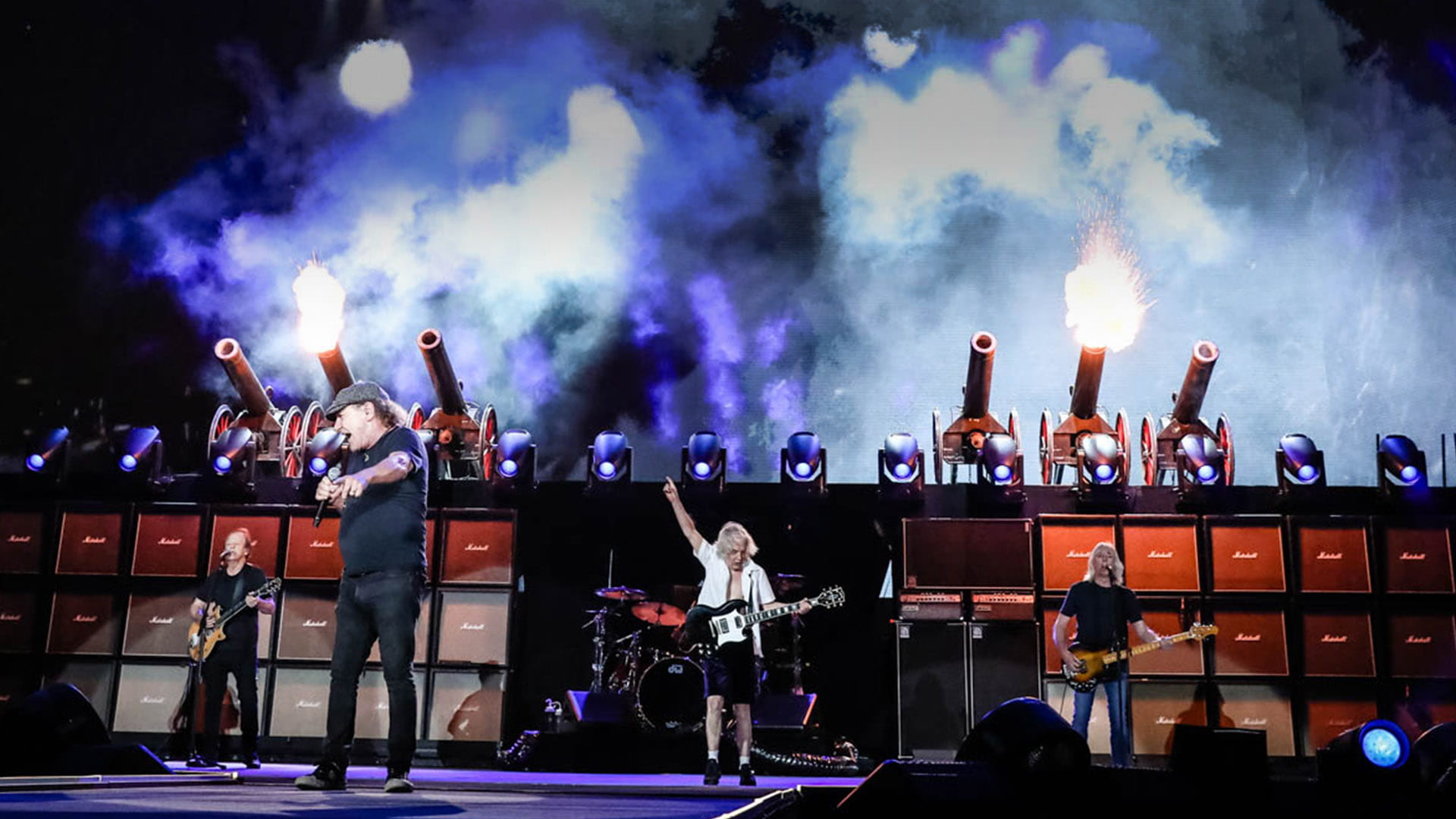
That discipline is the secret hiding in AC/DC’s unruly public picture. Onstage, Angus Young is a blur of knees, cap and Gibson SG. Brian Johnson sings as though addressing a shipyard without a microphone. Cannons fire. A giant bell descends. Yet under the spectacle sits an almost stern musical economy, assembled in Sydney more than half a century ago and maintained with the care of a municipal power grid.
As of September 2026, the grid is still live. The Power Up tour had crossed another continent and reached Winnipeg, with two more stadium dates listed in East Rutherford and Philadelphia. Its name comes from a 2020 album. Its emotional center goes back much further, to Malcolm, the co-founder and rhythm guitarist whose sense of timing still governs the band even in his absence.
The joke had excellent timing
The origin story contains the compact logic of a good AC/DC song. Malcolm and Angus Young wanted a name. Their sister Margaret noticed “AC/DC,” the abbreviation for alternating current and direct current, on a sewing machine. The letters looked energetic and sounded even better. Margaret also encouraged Angus to make a stage outfit of his school uniform, the clothes he had worn while rushing home to practice guitar. A household object supplied the name; ordinary clothes supplied the costume. Nothing required a committee.
The first official show came at Chequers nightclub in Sydney on 31 December 1973. The early lineup shifted quickly, but the band’s center settled when Bon Scott became singer in 1974. He brought a sly voice and a writer’s eye for low company, long roads and bad decisions. Angus supplied the movement. Malcolm supplied the floor beneath it.
“I put on the school suit and I become stronger.”Angus Young
The uniform worked because it revealed something real. Offstage, Angus could be quiet and self-effacing. Onstage, the costume gave him permission to become a small, tireless electrical event. The duckwalk borrowed from Chuck Berry, but the combination of shorts, tie and SG became his own. It was funny without weakening the music. AC/DC understood early that seriousness of craft did not require solemn presentation.
A visual approximation, not sheet music: firm accents, low clutter and enough open air for the guitars to bite.
The rhythm guitarist at the center
Angus became the image, but Malcolm was the structural engineer. His rhythm guitar often avoided the easy temptation to fill every beat. He damped strings, cut chords short and made silence pull its share of the load. The effect can be heard across Let There Be Rock, Powerage and Highway to Hell: drums, bass and guitar behaving like one machine, with just enough looseness to swing.
This is where claims that every AC/DC song sounds alike become useful. They point to a recognizable grammar. A listener can identify the accent, the pace and the guitar tone quickly, just as one recognizes a familiar speaker before parsing the sentence. But grammar is not the same as repetition. “Riff Raff” lunges. “Highway to Hell” struts. “Hells Bells” advances like weather. “Thunderstruck” begins as a single-line guitar exercise and turns a stadium into a nervous system.
Angus once explained the division plainly: “We take the music far more seriously than we take the lyrics.” The line is funny, but it also describes the arrangement. The words grin. The band underneath keeps perfect time.
A black cover, a new voice
By 1979, Highway to Hell had pushed AC/DC into international view. Then Bon Scott died in February 1980. The band considered stopping. Instead, with encouragement from Scott’s family, it began looking for a singer and found Brian Johnson, formerly of the British band Geordie.
The choice should have been impossible. Scott’s personality lived deep inside the songs. Johnson did not imitate him. He arrived with a rasp that sounded industrial, a flat cap, an open grin and the nerve to begin again. Working with producer Robert John “Mutt” Lange, the band recorded Back in Black and dedicated it to Scott.
Its black sleeve offered no explanatory speech. The music handled the memorial in AC/DC’s native language: precision, volume and forward motion. “Hells Bells” made patience ominous. “You Shook Me All Night Long” made economy sound generous. The title track built an arena from a few perfectly placed chords. Estimated worldwide sales eventually reached 50 million, but the record’s stranger achievement is how inevitable it sounds. A band in upheaval produced music with no audible panic.
The public image is juvenile mischief. The long career underneath it is adult discipline.
Staying put while decades moved
Pop culture spent the next forty years changing its trousers. AC/DC mostly kept the uniform. There were leaner commercial periods, lineup changes and long gaps between records, yet the group avoided the undignified business of pretending to be younger than its own music. In 1990, “Thunderstruck” opened The Razors Edge with a needlepoint guitar figure that sounded both entirely familiar and newly urgent. In 2008, Black Ice put the band back atop charts across the world. The scale changed; the grammar held.
Recognition accumulated almost despite the pose. The ARIA Hall of Fame inducted AC/DC in 1988. The Rock and Roll Hall of Fame followed in 2003. “War Machine” won a Grammy in 2010. Melbourne renamed a lane for the band, dropping the slash because municipal rules apparently have less tolerance for danger than a stadium full of amplifiers. In Leganés, Spain, an AC/DC street sign was stolen often enough that the city began selling replicas. Civic tribute met rock-and-roll supply chain.
- Malcolm and Angus Young form AC/DC in Sydney and play Chequers on New Year’s Eve.
- Brian Johnson joins; Back in Black turns a precarious restart into a defining album.
- The Rock and Roll Hall of Fame inducts the band.
- Stevie Young takes Malcolm’s rhythm-guitar place for Rock or Bust.
- Power Up, built from ideas Angus and Malcolm developed together, reaches number one in 21 countries.
- The Power Up tour continues through stadium dates in North and South America.
The promise inside the formula
Malcolm died in 2017, but his method remained available. Angus had kept song ideas the brothers developed together. Those fragments became the basis of Power Up, recorded by Angus, Johnson, Stevie Young, Cliff Williams and Phil Rudd. Angus described the standard he felt while making it: “When your target is to pay tribute to Malcolm, you just really want to do well and you don’t want to let anyone down.”
That sentence explains more than the album. AC/DC’s consistency is sometimes treated as stubbornness, and stubbornness surely plays a part. But consistency can also be a promise between people. Malcolm and Angus learned what their guitars could do together. Each later record tested whether that understanding still held. Each tour carried it out to another audience. Stevie, Malcolm and Angus’s nephew, now occupies the rhythm-guitar position without turning inheritance into impersonation.
On the current road lineup, Matt Laug plays drums and Chris Chaney plays bass beside Angus, Johnson and Stevie. The personnel tell a long story. The sound tells a short one. Count it in, strike the chord, leave the gap, hit again. AC/DC has always reduced rock and roll to components so sturdy they can be rebuilt.
There is wit in that refusal to decorate. The band named albums High Voltage, Powerage, Power Up and, with magnificent economy, Let There Be Rock. It found an idea on a sewing machine and never stopped testing the current. The formula endured because it was never a shortcut. Playing simply makes timing more exposed. Returning to a form for fifty years requires hearing small differences with almost absurd care.
So the lasting image is not the cannon blast or the schoolboy duckwalk, excellent though both are. It is the pause after a chord. In that fraction of silence, five musicians trust one another to land in the same place. Crowds from Sydney to Buenos Aires know where the next beat belongs. They wait anyway. Then the circuit closes.
Official destinations and further reading