The first thing to understand about Green Day is that the joke and the craft arrived together. Long before Broadway ushers handed out programs for American Idiot, Billie Joe Armstrong and Mike Dirnt were teenagers playing quick songs in California’s East Bay. They called the band Sweet Children. The name was almost too innocent, which may explain why it did not last. By 1989 they were Green Day, and by 1990 they had found the drummer whose chosen name sounded like a prank with a perfect backbeat: Tré Cool.
The three have since made a career out of mismatched proportions. The music can be blunt, but the construction is exact. The humor is juvenile, but the work ethic is adult. The shows are communal mayhem run on professional timing. Green Day did not resolve those contradictions. They put them on a bus and kept touring.
A club small enough to have consequences
The East Bay punk scene gave Green Day more than a place to play. Around Berkeley’s 924 Gilman Street, the band encountered an all-ages culture suspicious of hierarchy and commercial ambition. Shows were participatory; credibility could vanish faster than a two-minute song. The education was social as much as musical. A band had to hold a room without hiding behind distance.
That early economy remains audible. Armstrong writes melodies that arrive before the listener has time to object. Dirnt’s bass refuses to behave like furniture, climbing around the vocal and turning empty space into motion. Cool plays drums like punctuation developed a sense of humor. Armstrong later described a three-piece as “a conflict to be heard.” The better half of his thought was about leaving enough freedom for each personality to show.
Listen closely and Green Day rarely sounds like one large object. It sounds like three distinct people agreeing, at speed, on where the song should land. That is why the records travel. The hooks are public, while the friction is intimate.
“It’s like a conflict to be heard when it comes to a three-piece band.”Billie Joe Armstrong
The year the mud answered back
Dookie arrived in February 1994 with songs about boredom, panic, desire and the unglamorous logistics of being young. Its titles did not petition for importance. Its melodies did. “Longview,” “Basket Case” and “When I Come Around” became alternative-radio fixtures, each one proving that a sneer and a chorus could occupy the same mouth.
Then came Woodstock ’94. Rain had turned the grounds into an agricultural disaster. The audience threw mud at the stage. Green Day threw it back. The set became a televised exchange of dirt, taunts and security confusion; Dirnt was tackled by a guard who mistook him for an intruder. For a band accused in some punk circles of becoming too commercial, this was an exceptionally messy advertisement.
The scene has endured because it compressed the whole Green Day proposition into half an hour. Here was a band with songs tidy enough for radio behaving as if the border between stage and crowd were negotiable. Chaos was not the opposite of pop discipline. It was the thing the discipline made legible.
A small voice learns to address a crowd
Armstrong’s early narrator was often trapped indoors, suspicious of his own motives and funny because self-knowledge had arrived without a solution. That scale suited Dookie. The songs took private embarrassment seriously enough to give it a splendid tune, then punctured any claim to grandeur with a bodily joke. The speaker did not lead a movement. He had trouble leaving the sofa.
A decade later, American Idiot pointed the same skeptical reflex outward. Television, war, nationalism and salesmanship entered the frame, but the band did not suddenly adopt the voice of a lecturer. Armstrong built characters who were bewildered inside the argument. The political became personal because the songs showed public language invading bedrooms, friendships and ideas of home.
This shift explains why Green Day could increase its subject matter without losing its accent. The band’s politics were never delivered in neutral prose. They came through melody, sarcasm, costume and the nervous speed of someone trying to say the important thing before the room changes its mind. Even at its most declarative, Green Day leaves fingerprints on the megaphone.
Three turns of the screw
Losing an album, finding a larger canvas
Success creates its own dull danger: repetition with nicer catering. By the early 2000s, Green Day had already stretched beyond the original sprint. “Good Riddance (Time of Your Life)” had put an acoustic guitar into farewell ceremonies everywhere. Nimrod and Warning had widened the palette. Yet the planned follow-up, Cigarettes and Valentines, disappeared when its masters were taken from the studio.
The band chose not to rebuild it. Starting over produced American Idiot, a connected story of disaffection, politics and damaged belonging. The title track was terse enough to shout. “Jesus of Suburbia” ran for more than nine minutes. The album asked a trio known for concision to think in scenes, characters and reprises.
It worked because the expansion was architectural, not cosmetic. Green Day did not abandon the compact force of guitar, bass and drums; it linked that force across a bigger map. The record won the Grammy for Best Rock Album. “Boulevard of Broken Dreams” won Record of the Year. Then director Michael Mayer and a theater team brought the music to the stage, first in Berkeley and then on Broadway, where American Idiot opened in 2010 and ran for 422 performances.
Three personalities, one loud machine
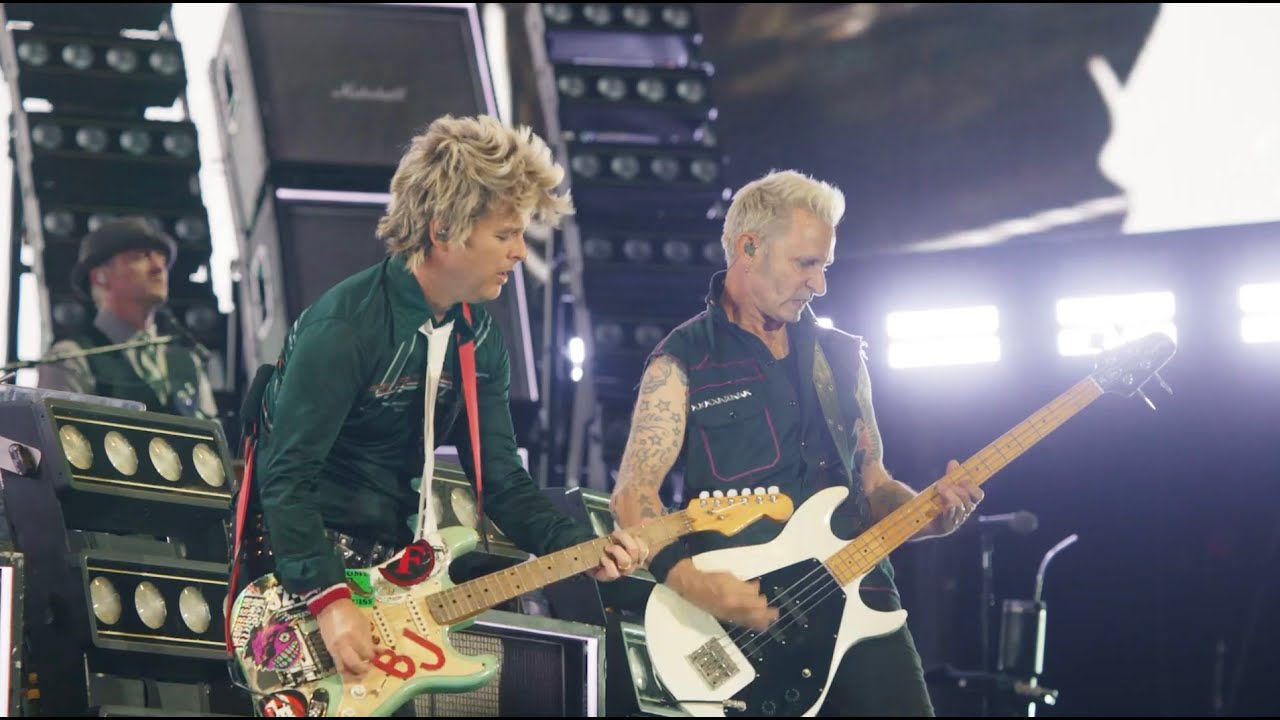
The temptation with a long-running group is to turn its history into the singer’s biography. Green Day resists that shortcut. Armstrong supplies the main voice and most of the songwriting, but the band’s identity depends on the rhythm section remaining conspicuous. Dirnt is the childhood friend who helped invent the language. Cool is the later arrival who made volatility reliable. Their playing creates the physical comedy beneath the words.
The Green Day mix, heard rather than measured
Longevity, in this case, is not serenity. It is a managed argument. The members have side projects, private vocabularies and separate instincts, then return to the same spare format. The reunion happens inside the song. A Green Day recording is most convincing when you can hear each player competing for air without choking the others.
Becoming your own influence
By the time Saviors arrived in 2024, Green Day had accumulated enough eras to become a small argument about itself. Which band should return: the Gilman upstarts, the Dookie hitmakers, the authors of a rock opera, or the garage enthusiasts who kept wandering into side rooms?
The sensible answer was all of them, provided the songs earned the references. Armstrong called the album a reflection on 35 years and described the band as becoming its own influence. Producer Rob Cavallo, present for both Dookie and American Idiot, returned. The result did not erase the intervening years. It used them as a toolbox.
The timing encouraged a reckoning. Dookie turned 30. American Idiot turned 20. On the Saviors Tour, Green Day played both albums in full alongside new material. This could have become a museum exercise. Instead, it made the age of the audience one more contradiction: people who first heard the band on MTV stood beside listeners born after “Boulevard of Broken Dreams.” Everyone knew when to shout.
In 2024, Dookie entered the Library of Congress National Recording Registry, an honor for work judged culturally, historically or aesthetically significant. There is something pleasing about federal preservation meeting an album whose cover resembles a school notebook under siege. Green Day had made juvenile irreverence archival.
“I think in the back of our minds was to be able to play music together for the rest of our lives.”Billie Joe Armstrong
The old tools still work
The band headlined Coachella in 2025, then appeared in its home region during the Super Bowl LX pregame in Santa Clara in 2026. These are civic-scale stages, places where a song becomes less a private object than shared infrastructure. Green Day’s route to them began in rooms designed to prevent performer and audience from becoming different species.
That origin still matters, but nostalgia alone cannot explain the duration. The deeper habit is renewal through use. A guitar is picked up. A rhythm section answers. The lyric looks for a public irritation with a private pulse. The band does not need to impersonate its teenage self, because the collaboration still contains those teenagers’ question: can we keep doing this?
So far, the answer is yes, though never politely. Green Day grew older in public and made the process sound less like wisdom than momentum. It learned scale without surrendering compression, theater without losing jokes, history without becoming a memorial. The argument survived. Better still, it still has a chorus.