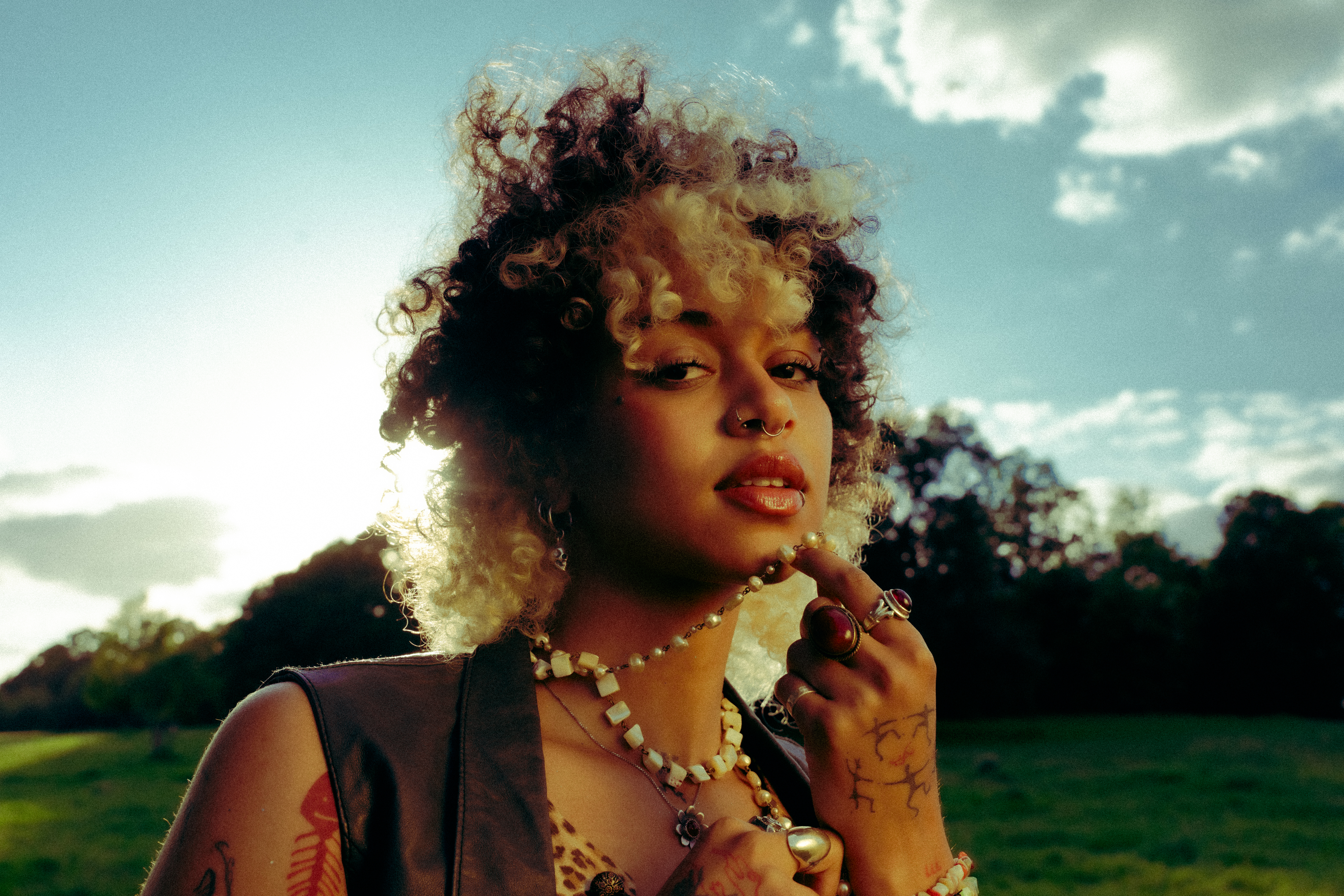
The Story
The Vowel Remover Who Found Her Voice
There is a certain audacity in taking your own name and deliberately breaking it. Nadia Ahmed became Nxdia - stripped of vowels, refashioned into something harder, stranger, more precise. It was not a rebrand. It was a declaration: identity can be restructured, and you don't need anyone's permission to do it.
Right now, in April 2026, Nxdia is on tour with Cat Burns, riding the momentum of "Cool" - a bilingual alt-pop track that Music Republic Magazine called their "more confident, slightly more aggressive older sibling" to the viral "She Likes a Boy." They are 25 years old, Egyptian-British, non-binary, queer, and have just crossed 100 million Spotify streams on a debut mixtape that BRICKS Magazine described as "a riotous, queer coming-of-self." By any metric, they are exactly where they aimed to be.
But to understand Nxdia today, you need to go back to Heliopolis - a district of Cairo, Egypt - where Nadia Ahmed was born in 2000, at the hinge point between two centuries. Their father played AC/DC. Their mother played Umm Kulthum. Neither parent knew they were programming a future bilingual pop-punk artist. Both were right.
A Collision Made Useful
At age 8, the family moved to Manchester. What followed was the specific, grinding displacement familiar to anyone who has arrived as a child in a country that looks nothing like home. Nxdia was bullied for their darker skin in Egypt, then became the Egyptian kid in Manchester. The categories kept shifting. The self kept not quite fitting.
What most kids would suppress, Nxdia started writing down. Diaries first. Then songs. They describe the pivotal realization in plain terms: "I didn't really ever feel like I'd processed an emotion until I'd written about it." This is not a cliche about catharsis. It is a technical observation about how their mind works - and it explains why every Nxdia song feels less like a performance and more like an intercepted letter.
At 16, they won a place in the Levi Music Project, where members of Everything Everything - Manchester's own art-rock experimentalists - taught them music production. The lesson that stuck was not about software or arrangement. It was about trust: trust the weird instinct, follow the strange direction, don't sand down the edges that make you different.
I've spent my whole life thinking in both English and Arabic, and I just thought, 'How can I translate that into music?' Then I realised I didn't have to translate it.
- Nxdia, NME interview
The Language That Was Always There
The bilingual songwriting began as something Nxdia did for themselves, at home, in private. English for the world; Arabic for their mother; both, apparently, for the songs. A producer once suggested removing the Arabic lyrics. Nxdia almost agreed. A close friend talked them out of it. That friend saved the defining element of Nxdia's artistry.
Now the Arabic is non-negotiable. Nxdia translates their lyrics on TikTok - not as a marketing exercise but as an act of inclusion, bringing fans into a part of their internal world most artists keep sealed. Stromae showed them bilingualism could chart. Nxdia is showing that it can also make someone feel seen who has never felt seen in an English-language song before.
The result is alt-pop that pulls double-duty: hooky enough for a playlist, dense enough to reward a second listen. The guitar riffs come from My Chemical Romance territory. The vocal delivery from Pink's rasping directness. The emotional logic from Paramore's confessional heart. And threading through it all, a voice that switches languages mid-thought because that is genuinely how Nxdia's brain works.
Obsession as Subject Matter
"Jennifer's Body" arrived in April 2024 and announced that Nxdia had found their genre home. Named after the 2009 Megan Fox cult horror film - a movie about devouring the people you claim to love - the track is about a toxic situationship: "a bit like a moth to a flame," in Nxdia's own words. Pulsating percussion, frenetic guitar riffs, thrumming bass. Three minutes of controlled chaos about the specific madness of wanting something you know will burn you.
That same year, "She Likes a Boy" became the song. Nxdia posted a snippet on TikTok in November 2023. It went viral before the official release. When the full track dropped in January 2024, it surpassed one million Spotify streams in under a week and charted at No. 74 on the UK Singles Sales Chart. DIY Magazine called it a "queer anthem." It was inspired by an actual diary entry from Nxdia's teenage years - a crush on a girl who liked a boy. The specificity is everything.
This is what separates Nxdia from the crowded field of alt-pop hopefuls: they write from the diary, not the mood board. Every hook is load-bearing. Every lyric is something they needed to say rather than something that sounded good. In a genre that rewards aesthetic consistency above all else, Nxdia keeps insisting on actual content.
The Mixtape and the Milestone
On June 13, 2025, Nxdia released "I Promise No One's Watching" on Bxdger Records. Ten tracks, none longer than four minutes, each one a different angle on the same essential question: how do you stay yourself when every external force - culture, gender, desire, capitalism - is trying to assign you an identity?
The answer, across the tracklist, is stubborn honesty. "Boy Clothes" tackles gender dysphoria and the freedom of dressing for yourself rather than for a category. "Puppet" examines the strings that others attach to you. "Tin Man" closes the record on a note of aching vulnerability. By August 2025, the mixtape had crossed 100 million Spotify streams. Nxdia played Lollapalooza Paris. They headlined Camden Assembly on Valentine's Day to a sold-out room. They toured Europe. They did it without a major label.
I genuinely feel like the lid has been blown off my queerness since I had top surgery. I feel so much more in tune with myself - I actually look like myself now.
- Nxdia, DIVA Magazine, 2025
What Synesthesia Hears
Here is a detail that explains a lot: Nxdia experiences synesthesia. When they listen to music, they perceive colors and visual scenes. They typically close their eyes and let these associations build, then use them to inform music video concepts and visual direction. Every song has a color before it has a title.
This is not incidental. It is the reason Nxdia's work feels so specifically rendered. They are not describing emotions in the abstract; they are reporting what they actually see, hear, feel. The artistic approach is documentary, not decorative. The songs are field recordings from inside their own experience.
It also explains the community Nxdia has built. When someone experiences the world differently and then describes it with precision, other people who experience it the same way recognize themselves. Nxdia is a founding member of Loud LDN, a collective of London-based women and genderqueer musicians. They have done charity work with Mind Cheshire. The music is personal; the intention is communal.
The New Era
"Cool," released February 11, 2026, is the opening statement of whatever comes next. Co-produced with BRIT-nominated producer Joe Kearns, it is bilingual alt-pop at its most assured: casual about desire, unapologetic about identity, celebratory in a way that does not feel performed. Nxdia described it as holding up "two massive middle fingers to any weirdness" - which is, if you think about it, the logical destination for someone who spent years worrying whether the Arabic lyrics belonged in the song.
They belong. So does everything else Nxdia has refused to edit out of their life: the Egyptian heritage, the Sudanese grandfather, the queer identity that resists categorization, the AC/DC DNA running under the Umm Kulthum melody. Nxdia is not a compromise between two cultures. They are the evidence that two cultures can make something neither one could produce alone.
The Paulo Coelho quote they keep returning to: "When you want something, all the universe conspires in helping you achieve it." From a teenager writing diaries in Manchester to Lollapalooza Paris to 100 million streams, the data supports the theory. The universe, it turns out, had opinions about the Arabic lyrics too.