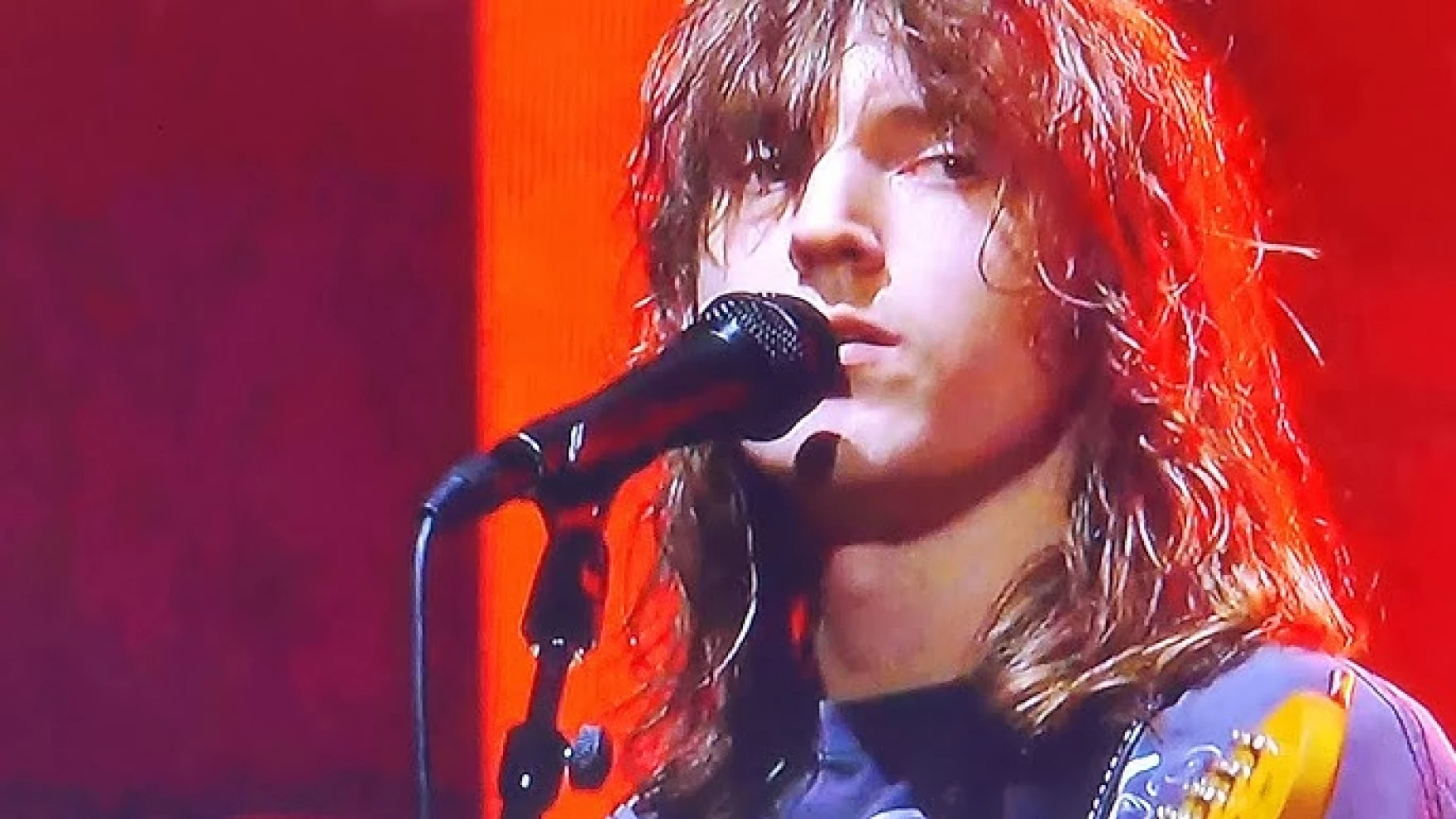
The Man Who Doesn't Explain Himself
There is a version of this story that begins with a kid in South Jersey, bedroom walls hung with guitar magazines, dreaming of Los Angeles. But that version would bore Mk.gee - and probably bore you too. The more honest version starts in February 2024, when a debut album nobody had quite heard anything like landed in the world and refused to announce what genre it belonged to.
Two Star & the Dream Police arrived on streaming platforms without a press campaign, without a promotional blitz, without Mk.gee - real name Michael Todd Gordon - giving many interviews to explain it. The album sold itself on its own terms: 12 tracks of warped guitar texture, lo-fi soul, and emotional rawness that sounded like R&B pulled through a cassette deck and stretched until something broke in exactly the right way.
The New York Times put it at #1 for 2024. So did Dazed. And Clash. Pitchfork, The Guardian, Rolling Stone, and The Ringer all had it in their year-end top tiers. The Metacritic aggregate hit 83 - "Universal Acclaim." Six months later, Pitchfork came back around and placed it among the best albums of the entire first half of the 2020s. All of this happened while Mk.gee remained characteristically hard to locate.
"I'm just looking to heal people. I like to make people feel like a little hero. And if I have acceptance and confidence in my weird self then maybe someone listening can too."- Mk.gee
He is from Linwood, New Jersey - a quiet shore town where nothing much happens, which might be exactly why he learned to hear everything. Piano at age six, guitar by eleven, YouTube-to-MP3 converters and file-sharing platforms filling hard drives with music he could not have found in any store nearby. By the time he enrolled at USC Thornton School of Music in Los Angeles in 2016, he had already built a listening library that crossed decades and genres with the dedication of someone who needed music to make sense of something.
& THE
DREAM
POLICE
Lo-Fi as a Philosophy, Not an Aesthetic
It would be easy - and wrong - to call Mk.gee's sound "lo-fi" as though it were a genre choice, like selecting a filter on an Instagram photo. The distortion and cassette warmth that defines his recordings is not a mood board decision. It is a belief system.
He runs guitar and vocal signals through a TASCAM Portastudio 424 MKI - a four-track cassette recorder from the 1990s - using it as a preamp specifically for the clipping, saturation, and imperfection it introduces. In an era when most recordings are engineered toward crystal clarity, he moves in the opposite direction deliberately.
"There is attitude and stories in the way things are recorded. It's not always about finding the cleanest, most perfect sounds. Much more often it is the opposite if you want some sort of sonic story."- Mk.gee on recording philosophy
Brady Brickner-Wood at Pitchfork wrote that the album's "magic" is that "nothing in contemporary music sounds quite like it, yet it seems to have always been with us, hovering just outside the realm of possibility." That is the paradox at the center of what Mk.gee does: he makes music that sounds ancient and original at the same time, like a recording that was somehow made before the genre it belongs to existed.
His guitar playing has drawn particular attention - which is ironic, because he has said plainly: "I kind of hate guitar." It is a provocative statement from someone whose playing critics describe in near-mystical terms. But it tracks with the rest of his approach: he is suspicious of the instrument's mythology, bored by its conventions, interested only in what it can do when pushed beyond what it is supposed to.
The Network Nobody Expected
Before his own debut album, Mk.gee was quietly building one of the more interesting production resumes in independent music. He co-produced Omar Apollo's Apolonio mixtape in 2020 - a breakthrough project that established Apollo as a major new voice in R&B. The following year he co-produced Dijon's debut album Absolutely, a critically praised work that drew comparisons to 1970s soul and bedroom pop simultaneously.
He also became Dijon's touring guitarist, which led to the moment that changed at least one other artist's creative life. Opening for Bon Iver on tour, Justin Vernon watched Mk.gee play and later said it "reignited something" in him. The three became close friends and backstage jamming partners - a creative connection that eventually produced "From," a co-written track on Bon Iver's 2025 album Sable, Fable, written alongside Jacob Collier.
The Bieber collaboration, in particular, reveals how clearly Mk.gee understands the mathematics of pop. When asked about working with one of the most commercially significant artists of the past 15 years, he gave an answer that was less fan moment and more producer's calculus:
"He's searching. Anything that comes out of his mouth: That's pop music. You can really do pretty wild stuff behind that, just because it represents something."- Mk.gee on Justin Bieber, New York Times
Private by Design, Not Accident
Michael Todd Gordon grew up in Linwood, New Jersey - not a music city, not a creative hub, not the kind of place anyone associates with becoming the subject of critical consensus. His parents, Maureen and Todd Gordon, watched their son gravitate toward piano before he was old enough to read music, and toward guitar before he was a teenager. He found his listening education not in school or record stores but in the unglamorous corners of early internet music culture: YouTube rips, file-sharing platforms, the kind of obsessive catalog-building that happens when you live somewhere music does not come to you naturally.
He moved to Los Angeles at 20 to attend USC Thornton School of Music's Popular Music program, which placed him in a city and a curriculum that exposed him to collaborative production work. That work with Apollo and Dijon followed. But Mk.gee has never been interested in the apparatus of music industry visibility - the interviews, the profiles, the explanatory press. He is frustrated by what he once described as "the persistent reporter's hunger for specific meaning where abstract feeling ought to live instead."
Two Star & the Dream Police - Year-End Rankings
After the Debut: Everywhere and Nowhere
The conventional post-debut album move is: tour, interviews, second album, repeat. Mk.gee's version has been more lateral. In 2025, his fingerprints showed up on two of the year's most anticipated releases - Bon Iver's Sable, Fable and Justin Bieber's Swag - without him becoming the face of either. He wrote and produced. He contributed. He stayed in motion without becoming a fixture.
For 2026, he is confirmed for Austin City Limits and III Points festival in Miami. No second solo album has been officially announced as of April 2026. Whether that means one is coming quietly, or that Mk.gee is simply operating on a timeline that does not correspond to industry expectations, is consistent with everything else about how he works.
The most likely thing is that the next thing will arrive when it is ready. And that whoever gets there first - Bieber's audience, Bon Iver's audience, the festival crowd in Miami - will hear something that sounds unlike whatever they expected, and will probably play it multiple times to figure out why they can't stop.
Things Worth Knowing
"Mk.gee" is pronounced "McGee" - the period is not a typo. The name is a stylized contraction, not punctuation gone rogue.
He uses a 1990s cassette four-track recorder as a preamp - specifically for the tape saturation and clipping it adds to the signal.
Fred Again sampled his 2020 track "cz" on the album Ten Days (2024), giving Mk.gee co-writer credits on two tracks.
The SNL writing staff couldn't figure out how to spell his name on the show. Bill Burr and Sarah Sherman turned the confusion into a sketch.
He grew up in Linwood, NJ - a South Jersey shore town with a population of around 7,000, not typically associated with album-of-the-decade candidates.
His pedalboard includes Chase Bliss Audio Mood MKI, a Rainger FX Reverb-X, and an Empress Effects ParaEq MKII - a setup built for texture, not technique showcasing.