The first Katy Perry record landed with less of a splash than a dropped communion wafer. She was sixteen, recording gospel songs under her birth name, Katheryn Hudson, and the album went nowhere commercially. Then came years in Los Angeles when labels signed her, reconsidered and closed the door. An unreleased album gathered dust. A project with the production team the Matrix stalled. She sang backing vocals, wrote, waited and kept arriving. Pop history remembers the candy clouds. It tends to misplace the long corridor that led to them.
That corridor matters because Perry's defining talent may be endurance dressed as delight. She has spent nearly two decades making colossal effort look like a party trick. The choruses rise on command. The costumes appear to have escaped from a dessert trolley. The jokes arrive with a straight face. Underneath, however, is a person who told Vogue that ambition and determination carried her through the years of false starts. Success felt like a rocket at first, something she was clinging to. Eventually, she said, she learned to ride it.
Act IThe girl with the leopard coat
Perry was born in Santa Barbara in 1984, the middle child of traveling Pentecostal pastors. Her childhood was musically rich and culturally narrow. Gospel was welcome; much of secular pop was not. Schools were makeshift, she later recalled, and education came second to church life. She completed her GED requirements at fifteen and left school to chase music. Around the same age, Queen opened a window. Freddie Mercury offered what she called an imaginative explanation of how to live. The sound suggested a bigger room than the one she knew.
Even earlier, there were clues about her appetite for display. In sixth grade she coveted a fake leopard-fur coat in a vintage-shop window. It cost $175, an extravagant sum for her family. Somehow it arrived at Christmas. Children laughed; stylish mothers asked where she had found it. This is an excellent education in show business: ridicule and recognition often enter together. Perry learned to trust the coat.
She also learned movement - swing, Lindy Hop, jitterbug - and carried a guitar. The early ambition leaned toward the singer-songwriter lane. Yet the version of Perry that connected in 2008 had become brighter, cheekier and more sharply outlined. She changed her surname, borrowing her mother's maiden name and avoiding confusion with the actress Kate Hudson. One of the Boys supplied the breakthrough. “I Kissed a Girl” reached No. 1 and stayed there for seven weeks. The closed doors had finally opened, revealing a room that looked suspiciously like a pinball machine.
“I had so much ambition and determination, and that's what kept me going.”Katy Perry, reflecting on the years before her breakthrough
Act IIHooks you can see from the cheap seats
Perry's best pop is built from images sturdy enough to survive repetition. Fireworks. Lions. Dark horses. California as a confectionery. The metaphors are obvious in the way a road sign is obvious: they work at speed. A listener understands the emotional destination before the second chorus. Then the production adds lift, her voice adds a brassy edge, and the visual world bolts on a memory.
Teenage Dream, released in 2010, perfected the system. “California Gurls,” “Teenage Dream,” “Firework,” “E.T.” and “Last Friday Night (T.G.I.F.)” each topped the Billboard Hot 100. Five No. 1s from one album tied the record established by Michael Jackson's Bad and made Perry the first woman to do it. It was a run of unusual precision, less a lucky streak than a season in which every arrow seemed to find its target.
One album, five trips to No. 1
Billboard Hot 100 peak position
The visuals did their own melodic work. Perry has called fashion a language, and she speaks it in nouns: banana, cupcake, peppermint, hamburger. For a 2009 Grammy performance she descended in a golden banana, an idea she described as a mixture of Carmen Miranda, Lucille Ball, Betty Boop and Swarovski. At the 2015 Super Bowl, she entered on a giant mechanical lion. A backup dancer in a shark suit then missed enough marks to become the internet's favorite part of the evening. Perfection made the production possible; imperfection made it human.
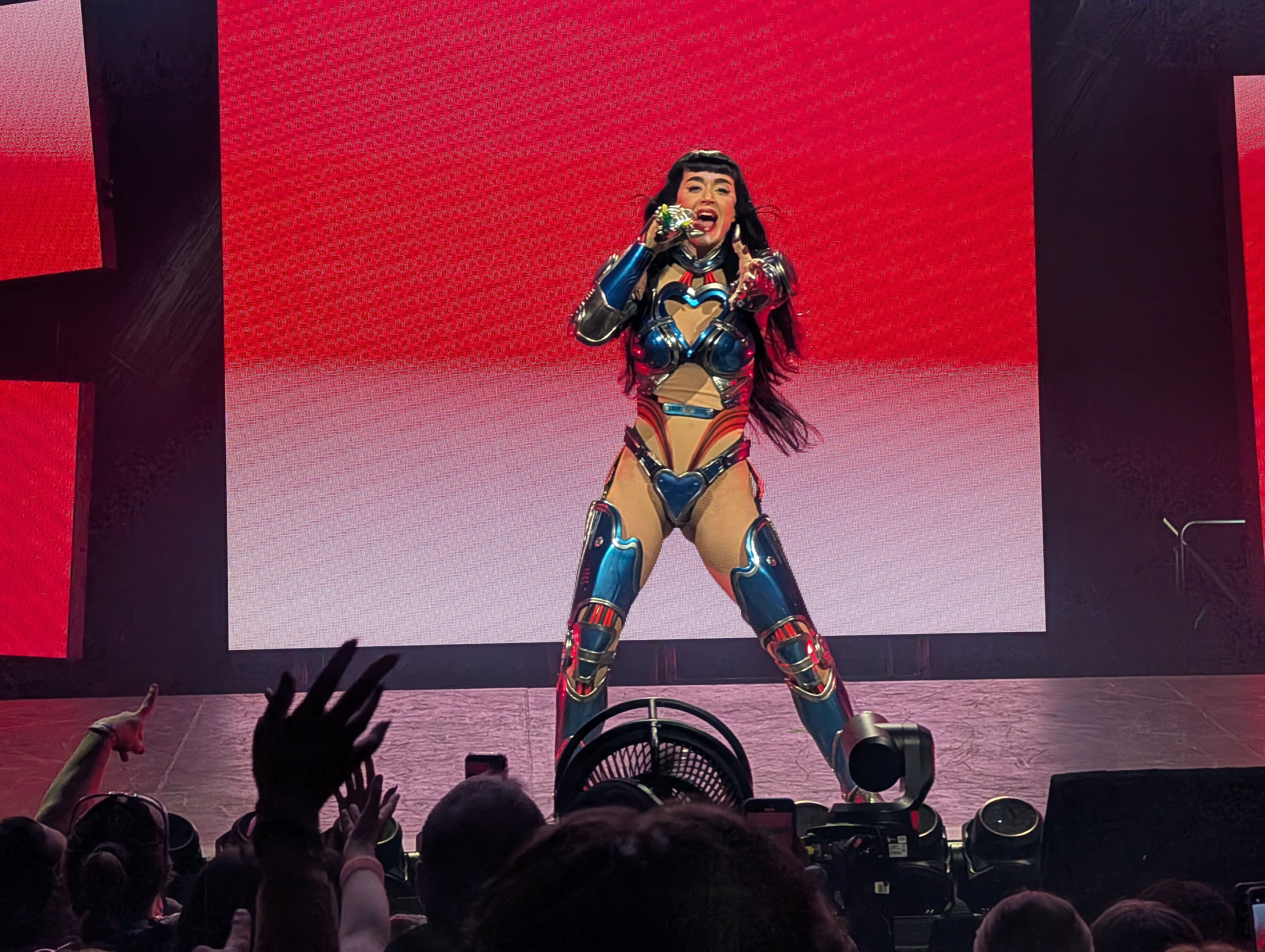
Camp, in her hands, is practical. It makes scale friendly. A stadium can be cold architecture; a dancing shark gives everyone something to discuss on Monday. Perry's dry delivery also keeps the uplift from becoming syrup. She has described her humor as very sarcastic, a useful pressure valve for songs that aim directly at confidence, resilience and love. Her ambition is enormous. Her preferred disguise is a wink.
Act IIIThe hits become a public utility
A pop song changes once its author no longer controls the occasions on which it appears. “Firework” can score a national celebration, a school assembly or a solitary walk home. “Roar” belongs equally to sports arenas and private pep talks. These songs have become portable emotional equipment. The RIAA made part of that reach visible in 2017, when Perry became the first artist to earn three Diamond Song Awards, for “Firework,” “Dark Horse” and “Roar.”
The business eventually caught up with the ubiquity. In 2023, Litmus Music acquired rights connected to Perry's five Capitol albums released from 2008 through 2020. The reported price was $225 million. It was an imposing number attached to something pleasantly ordinary: millions of people knowing which word comes next. A catalog is an asset, certainly. It is also a warehouse of borrowed memories.
Perry had already started occupying a different place in the industry. Beginning with ABC's revival of American Idol, she spent seven seasons judging young singers beside Lionel Richie and Luke Bryan. The job asked her to name the ingredients of performance that she once had to discover by trial and cancellation. When she announced her departure in 2024, she said she wanted to feel the pulse of her own beat and return to music. The phrase was typical Perry: earnest, rhythmic, ready for a lighting cue.
Act IVLove, empowerment and sensible shoes
Her public work has extended beyond records. UNICEF appointed Perry a Goodwill Ambassador in 2013 after she traveled to Madagascar. She later visited Vietnam, advocated for vulnerable children and received the organization's Audrey Hepburn Humanitarian Award in 2016. Her support for LGBTQ+ equality has also been recognized by the Trevor Project, the Human Rights Campaign and amfAR. The through-line is familiar from the music: belonging, expressed at maximum volume.
In 2024 she ended her run on American Idol, accepted MTV's Video Vanguard Award and released 143. The album met a cool critical response, and criticism also followed her choice to work again with producer Dr. Luke. Perry's answer was not a retreat. She planned a career-spanning show, borrowing visual cues from Blade Runner and The Fifth Element, with herself cast as a video-game hero battling forces that steal joy.
A few days before the Lifetimes Tour opened, she took a shorter journey. Perry joined five other women aboard Blue Origin's NS-31 mission in April 2025. She had been reading Carl Sagan and material on string theory, an earnest preflight syllabus for someone whose catalog already contained “E.T.” and “Firework.” She said she hoped young girls would imagine themselves traveling to space. Then she returned to Earth and went to rehearsal.
“It's really about believing in yourself and leading with love. Those are always my messages, no matter how I wrap it.”Katy Perry on the Lifetimes Tour
The wrapping, this time, involved science-fiction armor, choreography and more than eighty planned performances. Perry called the production “Disneyland on wheels,” which may be the neatest description of her entire creative enterprise. Build an environment. Hide the machinery. Give the audience a melody and a door into the joke. She advised ticket holders to wear sensible shoes because the old songs had been given dance-heavy arrangements. Even the practical note contained an invitation.
There is no tidy ending for a pop career that continues to book flights, literal and otherwise. Her official calendar carries new dates; the songs keep finding new rooms. At forty-one, Perry occupies the unusual middle distance between current act and living nostalgia. She can introduce new work, then turn around and hear thousands of people sing a chorus they learned as children.
The leopard coat now has the dimensions of a world tour. The principle has remained intact. Choose the vivid thing. Accept the laughter. Make the hook legible from the back. Keep moving when the first version fails. Pop rarely rewards visible strain, so Perry turned strain into color and gave persistence a beat. The firework was never self-lighting. She simply became very good at concealing the match.