Before Michael Jackson became a silhouette, he was a sound coming through the walls of a small house in Gary, Indiana. The family rehearsed in a city of steel mills, modest porches and practical ambitions. Michael, the seventh of nine children, was five when he began performing with his brothers. By eleven, his voice was arriving through American radios with the authority of somebody who had already lived inside the lyric for years.
The first four Jackson 5 singles released by Motown all went to No. 1: I Want You Back, ABC, The Love You Save and I'll Be There. It was a rapid entrance and a peculiar apprenticeship. Many singers learn in rooms where mistakes disappear into carpet. Jackson learned beneath stage lights, in television studios, and on tour, where timing had witnesses.
That early education explains much of the adult artist. He understood that a song begins before the first note and continues after the last. The entrance matters. So does the coat, the camera angle, the silence, the exit. Pop, in his hands, became less an object than a chain reaction.
First, find the pulse
Jackson did not need an instrument in his hands to arrange one in his head. In studios, he demonstrated drum patterns with his mouth, sang bass lines note by note and layered harmonies for musicians to translate. The method was physical. A record was not an equation on paper. It was breath, consonant, impact and space.
Dance followed the same logic. His widely copied gestures are often remembered as feats of speed, but the stillness gave them force. A toe stand worked because the body stopped. A turn became punctuation because it landed cleanly. A hand at the brim of a hat delayed revelation by half a second. He approached movement like an editor approaches a sentence: cut until the remaining marks carry weight.
“Music with wings.”Michael Jackson, describing Human Nature
The description is only three words, but it reveals a method: Jackson experienced music as motion. Years of rehearsal gave that instinct a vocabulary. He studied James Brown, Jackie Wilson, Fred Astaire and street dancers, then absorbed their grammar deeply enough to speak in his own accent. When he glided backward during Billie Jean on the 1983 television special Motown 25, the step was not new. His framing of it was. Millions saw the same few seconds at once, and the moonwalk acquired a permanent address in pop culture.
Nine songs, no spare furniture
Off the Wall, released in 1979, began Jackson's album partnership with Quincy Jones. It moved easily among disco, soul, funk and pop, and gave the newly adult singer room to sound joyful without sounding weightless. Its success sharpened Jackson's appetite. He wanted the next album to be strong enough that every track could stand alone.
Thriller arrived in 1982 with only nine songs. That compactness now feels almost impolite. There is no deluxe corridor to wander down, no hour of optional furniture. Paul McCartney appears on the playful first single. Eddie Van Halen tears through Beat It. Vincent Price delivers the title track's spoken coda. Yet the album never feels like a guest list. Jackson's voice, rhythmic and tensile, keeps the rooms connected.
A useful argument happened near the start of Billie Jean. Jones thought the instrumental opening ran too long. Jackson wanted it kept because it made him want to dance. The pulse won. The song spends a remarkable amount of time teaching the body what to expect before Jackson begins the story.
Three albums, three kinds of reach
The camera learns the choreography
Jackson called his videos short films, a useful correction. The term insisted that music television could do more than place a singer beside a smoke machine. Billie Jean turned a city pavement into light. Beat It converted conflict into group choreography. Thriller, directed by John Landis, gave a pop single characters, dialogue, suspense, jokes, credits and dancing monsters.
The films also helped break the narrow programming habits that had kept Black artists from regular rotation on MTV. Jackson did not simply fit the new channel. He showed the channel what it was missing. Record, dance and image reinforced one another until a release could feel like a civic appointment. You did not only hear a Michael Jackson single. You waited to see what world it brought with it.
Costume completed the system. White socks pulled the eye toward the feet. A single glove turned a hand into a signal. Cropped trousers clarified the ankle. The fedora gave the face a curtain. These were not merely eccentric accessories. On a distant stage or a small television, they made motion legible.
Fifteen minutes by the pool
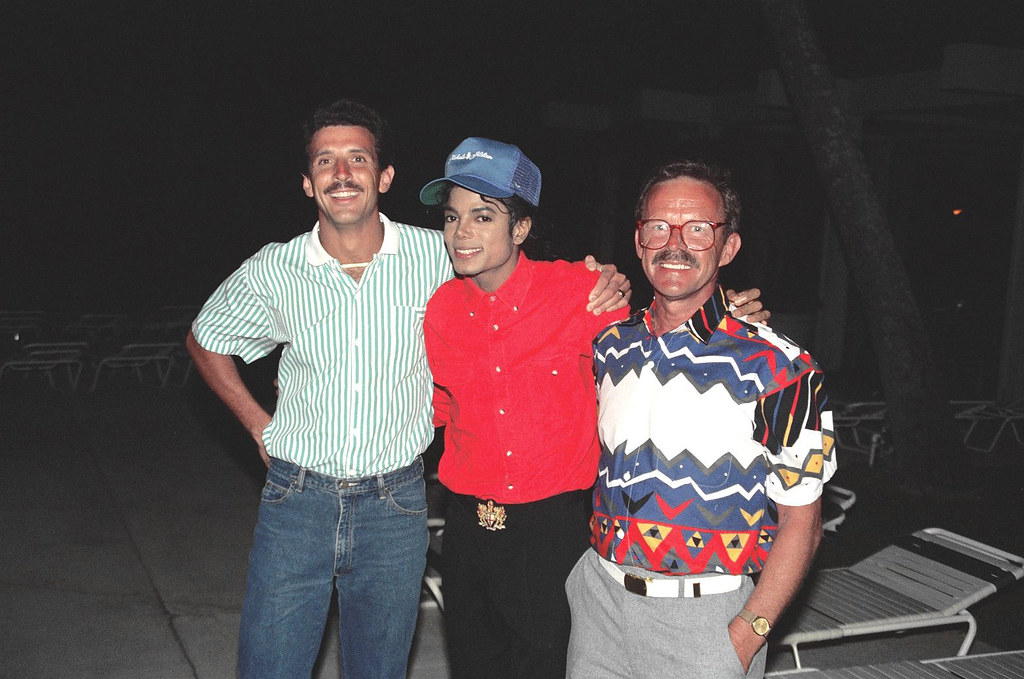
In February 1988, during the Bad era, photographer Alan Light and two friends encountered Jackson at night near the pool of Honolulu's Kahala Hilton. Jackson told them he had slipped away from security. He agreed to a picture, then stayed and talked for roughly 15 minutes.
It is a small scene, which is why it sticks. The photograph has none of the machinery associated with Jackson at full scale: no spotlight, costume cue, crane shot or wall of sound. There are striped shirts, an uncertain flash and four people accommodating themselves to a frame. Fame had made Jackson enormous. Conversation briefly returned him to ordinary dimensions.
That contrast appeared often. Collaborators described a soft-spoken person who could become exacting when a performance was at stake. Playfulness lived beside control. He loved surprise, but rehearsed its delivery. Spontaneity was welcome after every mark had been placed.
Competing with yesterday
Following Thriller posed an absurd professional problem: how do you make a sequel to a phenomenon? Jackson answered with sharper edges. Released in 1987, Bad produced five Billboard Hot 100 No. 1 singles, then an unprecedented result for one album. Its tour let him command stadiums as a solo artist, translating close-up gestures for tens of thousands of people at once.
Dangerous changed the working method again. With Teddy Riley among his collaborators, Jackson brought new jack swing's hard digital snap into his sound. The album could be confrontational, romantic, socially minded and strange. Black or White became a global hit; Remember the Time unfolded as an Egyptian court fantasy; Jam paired industrial rhythm with athletic movement.
The Jackson 5 enter the charts with I Want You Back.
Off the Wall begins the Quincy Jones album trilogy.
Thriller, its singles and short films redraw pop's scale.
Bad yields five No. 1 singles and a solo world tour.
Dangerous and HIStory widen the sonic and visual palette.
The through line was not a genre. It was control of attention. Jackson knew when to crowd a frame and when to leave one figure alone in it. He knew that a chorus can arrive like consensus, while a whispered verse makes the listener lean closer. He pursued scale, but his tools remained specific.
A choir assembled after midnight
Jackson also understood the social force of a chorus. In 1985, he and Lionel Richie wrote We Are the World for USA for Africa. Quincy Jones produced the all-night session, which gathered voices including Ray Charles, Diana Ross, Bob Dylan, Stevie Wonder, Tina Turner and Bruce Springsteen. The song turned celebrity into a fundraising mechanism and became a model for later benefit recordings.
His catalog often returned to collective responsibility. Some of those songs are earnest enough to risk unfashionable sincerity. Jackson accepted the risk. Irony was useful in a video, but inadequate as a worldview. He wanted popular music to gather people, and occasionally asked it to improve them.
The record supplied the pulse. Dance gave it a body. Film gave it a world.The connected logic of Jackson's pop
After the last bow, the work keeps moving
Jackson died in Los Angeles on June 25, 2009, at fifty. The unfinished plans stopped; the recordings did not. His 13 competitive Grammys, two Rock & Roll Hall of Fame inductions and Songwriters Hall of Fame membership provide institutional shorthand. The more vivid measure arrives whenever a new performer isolates a shoulder, delays a beat, or treats a music video as part of the song rather than packaging around it.
Thriller entered the Library of Congress National Recording Registry in 2007. A Broadway musical centered on preparations for the 1992 Dangerous tour opened in 2022 and won four Tony Awards. In 2026, a film companion album drew from the Jackson 5, the Jacksons and the solo catalog; that summer, Sony reported streaming at roughly four times the level seen before the film's release. The formats change. The count remains audible.
Perhaps that is why the work travels so well. Jackson built for a global screen, then filled it with details small enough to imitate in a bedroom mirror. He understood an ancient bargain of performance: the audience wants effort, but it also wants the gift of forgetting the effort. So he rehearsed until the machinery vanished and only the movement remained.