Before the red carpets, the stadium rigs and the wardrobe pieces that required their own engineering brief, there was a piano. Stefani Germanotta learned to play at four. By 13 she had written a ballad; by 14 she was performing in a New York nightclub. It is an almost suspiciously tidy origin for Lady Gaga, a performer who would later treat tidiness as an invitation to misbehave. Yet the piano is the useful clue. The extravagance was never a substitute for the work. It was what the work chose to wear.
Gaga’s career is routinely divided into eras, which suits the album campaigns and undersells the artist. There is the platinum-haired provocateur of The Fame, the leather-and-motorcycle preacher of Born This Way, the standards singer beside Tony Bennett, the unvarnished Ally of A Star Is Born, the actor inside the Gucci household, and the gothic dance-floor architect of Mayhem. The temptation is to call each turn a reinvention. A better word might be addition.
She has spent nearly two decades proving that a pop identity can have more rooms than the public first rented. Some contain synthesizers. One has a jazz trio. Another has a film camera waiting while she deliberately removes the polish from her voice. The piano sits in the hall, available to all of them.
New York taught her to make an entrance
Germanotta entered NYU’s Tisch School of the Arts early, studied in its Collaborative Arts Project 21 program and left before graduating. Downtown became the second syllabus. On the Lower East Side she played clubs, built a performance-art act with Lady Starlight and learned how quickly an audience decides whether to look away. Before singing her own hits, she wrote for other artists. Before the mythology acquired a budget, it had to fit through a club door.
The stage name took its cue from Queen’s “Radio Ga Ga.” It did more than make a good marquee. “Lady” had polish; “Gaga” had babble. Together they allowed Stefani Germanotta to become high culture’s unruly dinner guest. When The Fame arrived in 2008, the joke was already fully dressed. “Just Dance” and “Poker Face” both reached No. 1 in the United States. The album itself peaked at No. 2, a nice bit of Gaga logic in which the parts climbed one rung higher than the whole.
The clothes became cultural shorthand: sharp shoulders, impossible shoes, the meat dress. They were excellent at generating attention and even better at hiding how traditional her discipline could be. Gaga had vocal coaching as a teenager. She wrote. She rehearsed. She understood the unfashionable miracle of a chorus that people could remember after one listen. Her images shocked because the songs welcomed.
“I was really, truly fascinated with artifice as an artistic tool. I still am.”Lady Gaga, 2024
Artifice is often treated as dishonesty with better lighting. Gaga used it more like a novelist uses a character. She could exaggerate a feeling until its outline became obvious. The egg, the blood, the couture and the choreography were not evidence that nothing real was happening. They were methods of enlargement.
Tony Bennett opened another room
The most elegant rebuke to the idea that Gaga was merely a product arrived wearing a dinner jacket. Tony Bennett heard a standards singer. Their partnership produced Cheek to Cheek in 2014 and Love for Sale in 2021; both won the Grammy for Best Traditional Pop Vocal Album. Their pairing worked because Bennett did not ask Gaga to become smaller. Jazz asked for timing, listening and trust. She brought all three, along with gowns that looked perfectly capable of ordering champagne.
Bennett also presented her with the Songwriters Hall of Fame’s first Contemporary Icon Award in 2015. The sequence matters. The elder statesman of American song did not certify a novelty. He recognized a fellow worker. Gaga’s pop maximalism and her feeling for a standard came from the same appetite: both depend on making a familiar emotion feel newly unavoidable.
The club
The Fame converts downtown nerve into global hooks.
The songbook
Tony Bennett invites precision, swing and close listening.
The screen
A Star Is Born joins acting, live singing and songwriting.
The return
Mayhem brings dark pop home with every door left open.
The camera asked her to unlearn
A Star Is Born gave Gaga her first leading film role and a problem worthy of her talents: how does a famous singer portray someone becoming visible? As Ally, she let the camera come close. The performance earned a Best Actress Oscar nomination. “Shallow,” written with Mark Ronson, Anthony Rossomando and Andrew Wyatt, won Best Original Song. On Oscar night, spectacle narrowed to two people at a piano. The image traveled because the arrangement understood restraint.
Her screen work has since moved through the stylized worlds of House of Gucci and Joker: Folie à Deux. For the latter, Joaquin Phoenix encouraged her to sing without her familiar vibrato. She had to make a trained instrument sound ordinary enough to belong to Lee. Gaga described inventing a childhood logic for the character’s dresses and voice. It was costume design, vocal technique and biography braided together.
There is a comic symmetry here. Early Gaga had to convince doubters that the woman in the costume could really sing. Film asked a singer with formidable control to loosen it. Both challenges concerned credibility, and both were solved through technique rather than confession.
Mayhem puts the author before the product
For Mayhem, released in March 2025, Gaga returned to the dark electronic pressure of her early pop without attempting to impersonate her younger self. She worked at Shangri-La in Malibu with Andrew Watt, Cirkut and Gesaffelstein, with her fiancé Michael Polansky serving as a co-executive producer and occasional co-writer. The title promised disorder. The record was made by someone newly interested in where she placed her daily attention.
“I built a routine in my daily life around music all the time, and not around self-promotion.”Lady Gaga, 2025
That distinction may be the hinge of her recent work. Gaga has always understood promotion, perhaps too well. With Mayhem, she spoke openly about wanting credit for invention after years in which critics assigned the intelligence of her work to producers or stylists. “I was the creator,” she said. “This was my work.” The plainness is striking from an artist fluent in fantasy.
A career that accumulates
The public answer was enormous. In May 2025, her free concert on Copacabana Beach drew an estimated 2.5 million people, a Guinness record for a free concert by a female artist. A crowd that large stops behaving like an audience and starts resembling weather. Yet at the center was still the same compact transaction: a person makes a song; another person recognizes something in it.
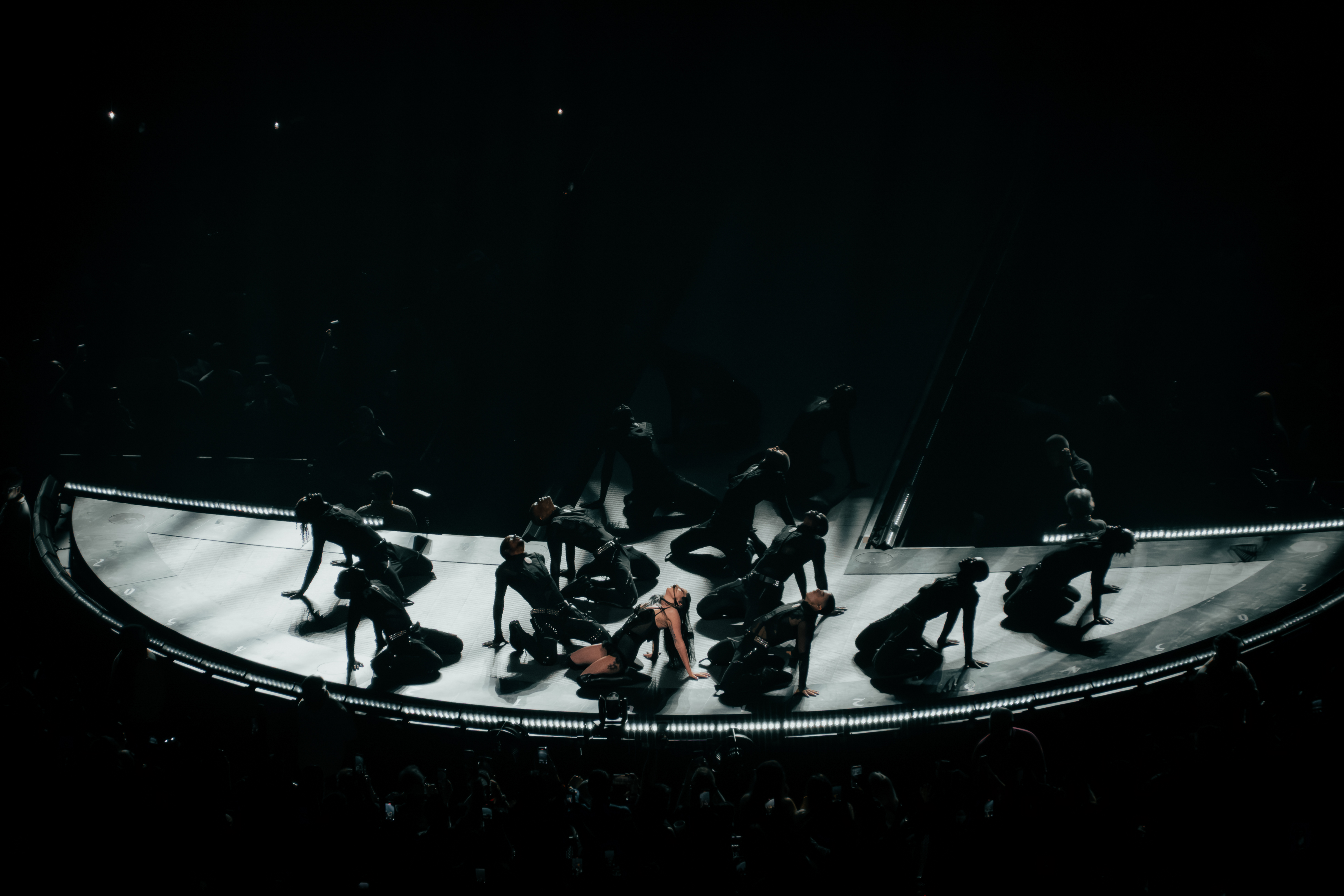
At the 2026 Grammys, Mayhem won Best Pop Vocal Album and “Abracadabra” won Best Dance Pop Recording. The awards brought her total to 16. Numbers can certify reach, not explain endurance. For that, return to the routine. Gaga’s durable advantage is her willingness to treat a huge career as a daily practice.
The whole person keeps the sequins
For years, interviewers searched for the border between Stefani and Gaga, as if one must clock out before the other enters. Gaga now rejects the split. “Lady Gaga is the whole me,” she said in 2024. It is a mature answer and a mischievous one. The woman at home with her dogs does not invalidate the woman performing for 85,000 people. The scale changes. The authorship does not.
Her ambitions still move outward. She has spoken of more songs, films, scores and jazz, alongside a family life that does not have to orbit publicity. The point is no longer to prove range by swerving. It is to let range become ordinary. A founder can write a torch song. An actor can return to a dance floor. A provocateur can love a standard without being domesticated by it.
That generosity extends to the people arriving behind her. In conversation she has cheered Billie Eilish, Chappell Roan, Charli XCX, Kesha and Taylor Swift with the abandon of a fan, not the caution of a market incumbent. It is a small but telling pleasure. Pop loves to arrange women into duels; Gaga, once treated as an invader herself, prefers a crowded stage. Her own collaboration map makes the same case. Beyoncé brought comic-book cool, Ariana Grande met her in a downpour, Elton John supplied family warmth, Bennett offered swing, and Bruno Mars called her to the studio near midnight. She listened, arrived and stayed until morning. Their “Die With a Smile” does not sound like a networking exercise. It sounds like two skilled people delighted by a song that wants finishing.
The young performer in the downtown club knew that attention had to be earned quickly. The artist who finished the Mayhem Ball in 2026 has learned the slower trick: attention must eventually be returned to the work. Costumes age. Platforms wobble. Headlines find a fresher emergency. A strong song sits down at the piano and waits.