The cruel joke of modern architecture is that the surfaces people love to look at are often the ones they hate to listen in. Glass returns sound. Stone keeps it moving. A high ceiling gives every syllable somewhere dramatic to wander. The standard audio answer is an escalating pile of control: more carefully aimed speakers, more digital processing, more absorptive treatment and more patience. FlatPanel Audio has a different proposal. Keep the handsome room. Change the way the loudspeaker launches sound into it.
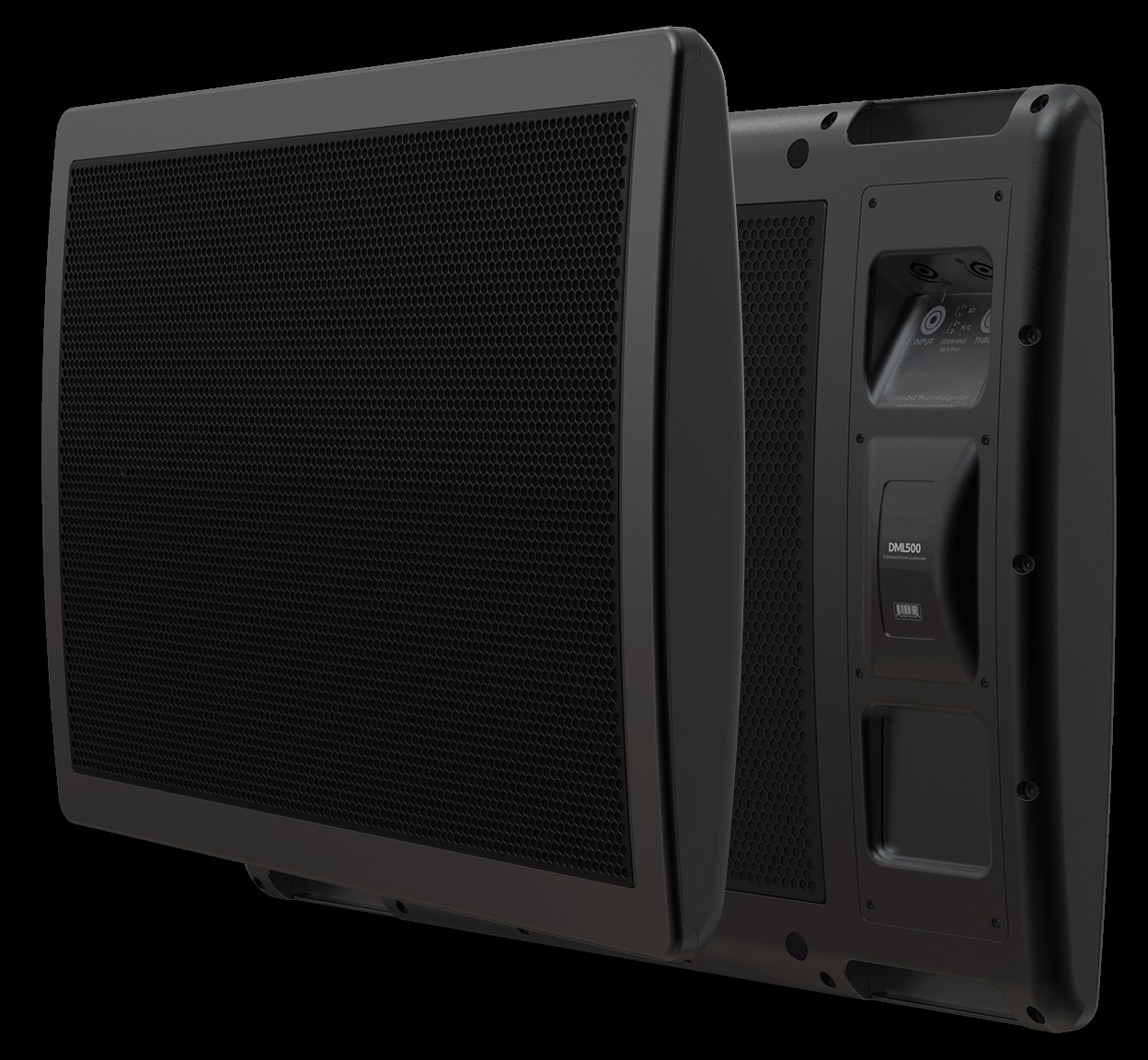
The Los Gatos company, founded in 2024 and publicly launched at that year’s InfoComm show, makes high-output Distributed Mode Loudspeakers, or DMLs. Its flagship DML500 is less a box than a broad, shallow slab: 31.5 inches wide, 21.6 inches high and only 3.5 inches deep. Four exciters make a carbon-fiber honeycomb panel bend in complex modes. Different frequencies emerge from different places across the surface, producing a wide, diffuse field rather than the tightly correlated output associated with a conventional cone.
If that sentence makes you want to reach for an acoustics textbook, FlatPanel would rather bring a pair into your worst room. This is a company built around the demo. Its technical library openly acknowledges that some claims feel odd from a point-source frame of reference, and tells designers that an in-room demonstration can give the customer a truer idea of the result than a familiar simulation workflow. The room that usually kills the sale becomes the showroom.
The cone is the villain in this pitch
A conventional point-source driver moves like a piston. That is useful, familiar and deeply modeled. It can also send coherent waves into hard boundaries, where reflected arrivals contribute to hot spots, dead spots, comb filtering and smeared speech. FlatPanel’s argument is that a resonating panel produces a more spatially distributed, less correlated field whose room interactions are less destructive. The company specifies 165-degree conical coverage for the DML500, a frequency range of 75 Hz to 20 kHz, 200 watts continuous power handling and 123 dB peak output.
The distinction matters because flatness alone is not the trick. Electrostatic speakers are flat. Invisible architectural speakers can be buried behind finishes. Hobbyists glue low-power exciters to foam board and ceiling tile. FlatPanel’s commercial claim is consistent distributed-mode behavior across the useful range at live-sound power. The DML500 is a 44-pound, powder-coated, die-cast aluminum product with protective grilles, Speakon connections and practical mounting points. This is not a craft project wearing a polo shirt.
“Our loudspeakers actually work indoors.”Bryan Cole, co-founder and COO
Cole’s joke is neatly antagonistic, but the business underneath it is sober. FlatPanel sells to AV professionals, not to consumers browsing for a living-room Bluetooth speaker. The target customer designs houses of worship, educational facilities, gyms, airports, museums, government buildings, performing-arts centers, hospitality spaces and immersive venues. These are projects where intelligibility, mounting, visual discretion and predictable coverage all end up on the same spreadsheet.
Fewer boxes is the economic argument
The most dramatic number in the company’s literature is not a wattage. FlatPanel says an American airport replaced 104 conventional speakers with six DML panels. The airport is not publicly identified, and there is no published bill of materials, so the responsible reading is “reported case,” not independent benchmark. Still, it captures the commercial wedge. A wide-coverage speaker can potentially remove cabinets, cable runs, mounting points, amplifier channels, tuning time and visual clutter together.
What did that cost? FlatPanel’s current project pricing is quote-based. One used, predecessor-branded DML500 has been listed by a European dealer at €2,645 before VAT, but that is not a current FlatPanel quote and says nothing about the airport’s economics. The copyable lesson is not a magic price. It is to price the whole installed outcome. Hardware that looks expensive alone can be economical if it deletes enough neighboring hardware and labor.
The public King Center project in Atlanta shows the modest version of the idea. Its lobby is a handsome acoustic obstacle course of brick, tile, glass and stone. Integrator S&L Integrated installed two DML500 loudspeakers and one LS118 subwoofer, powered by a LEA Professional Connect Series 1504D amplifier. The panels handled left and right coverage; the subwoofer supplied the frequencies a thin panel was never pretending to own. Staff reported a significant improvement over the previous system.
A product family, not a parlor trick
The enclosed DML500 is the default workhorse. The 17-pound DML500A removes the protective case for integration into millwork, high-end retail, museums and other architect-led spaces. It delivers the same stated acoustic performance, but the carbon-fiber surface is exposed to impact, dust and debris. FlatPanel’s own guidance is refreshingly specific: use a rigid grille or choose the enclosed model where the panel can be struck. In 2026, the company added the DML500W for outdoor and moisture-rich locations. Its published sheet describes a passive weather-resistant design and four-year warranty, while listing the formal ingress-protection code as pending.
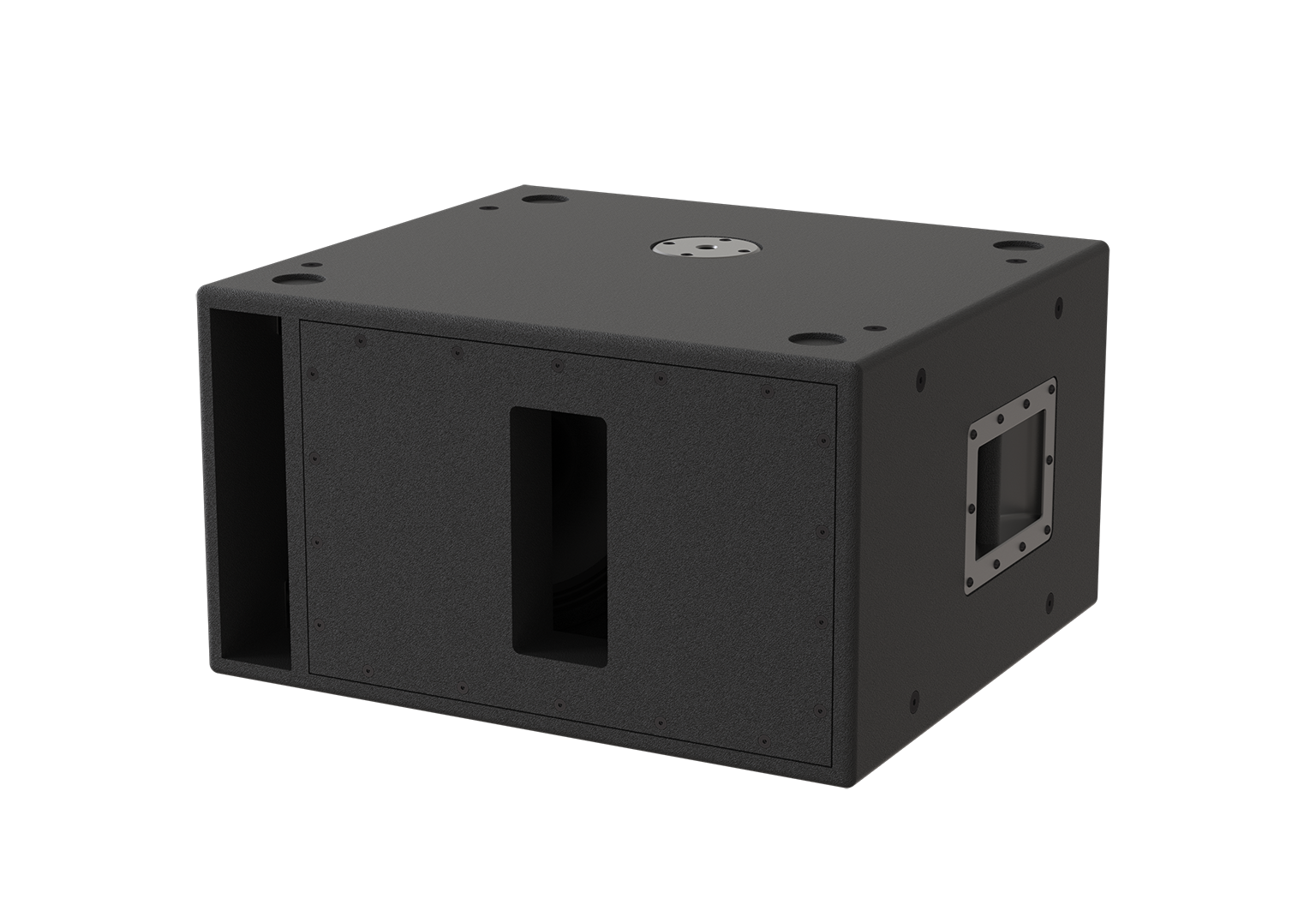
Bass comes from more recognizable wooden furniture. The LS118 uses one 18-inch driver, handles 1,200 watts continuously and reaches a stated 30 Hz at the minus-10 dB point. The LS212 uses two 12-inch drivers in asymmetrical acoustic chambers, handles 800 watts continuously and trades deepest extension for a shorter cabinet. Accessories, rigging, VESA adaptation, configuration guides and DSP presets turn the panels into installable systems. FlatPanel also publishes practical LEA amplifier sizing, and LEA offers FlatPanel tuning files.
The thing to steal
Sell the constraint, not merely the component. FlatPanel’s pitch starts with the reflective room, then turns wide coverage into fewer speakers, fewer compromises and a live proof. A founder building any technical product can copy the sequence: identify the painful environment, package the full system, and demo inside the problem.
What failed first?
In the company’s telling, the first thing to fail is the old workflow: point-source designs meet reverberant interiors, then compensate with acoustic treatment and DSP. The longer historical clue comes from the technology itself. Distributed-mode speakers have existed for decades, but earlier versions were often low-power, domestic, experimental or hard to place in a professional system. The present team’s change of mind is really a change of packaging: treat the underlying physics as a commercial platform with high output, rugged casing, subwoofers, rigging, amplification, tuning and integrator support.
That is also where FlatPanel fits in the market. It is not primarily an “invisible speaker” company, though the architectural model can disappear. It is not a line-array challenger for every arena. It sits at the intersection of professional sound reinforcement and architectural audio, selling an alternative radiation pattern for rooms where conventional coverage creates expensive secondary problems. The competitors include every established point-source and line-array brand, DML and bending-wave specialists, and the acoustic-treatment budget itself.
Reflective interiors, broad audiences, design-sensitive rooms, stable stereo, fewer visible boxes and projects that can be demonstrated on site.
Tightly steered narrow zones, impact-prone bare panels, deep bass without a sub, or exterior specifications that require a finalized IP code.
Designers must learn a diffuse source and may not get the conventional EASE/GLL modeling routine they expect.
Several performance statements remain manufacturer claims. Audition the system in the actual room and measure the result.
The small-company advantage - and burden
FlatPanel has a listed team size of two to 10 and connects its veterans to products including Auto-Tune, Mackie mixers and early distributed-mode speakers. Co-founders Denny Mayer and Bryan Cole lead a business that looks less like a venture-software rocket and more like a channel-driven hardware company: trade shows, demo requests, installation partners, distributor relationships and careful technical documentation. RGB Communications became its exclusive UK and Ireland distributor in September 2025. That partnership gives local integrators stock and support, and returns DML technology to the country where its early development began.
The advantage of being small is a pointed story. FlatPanel does not need to sell every speaker for every room. It can obsess over the rooms that make other systems sweat. The burden is trust. Integrators bet reputations on serviceability, replacement stock, prediction tools and long-lived product lines. A clever radiation pattern opens the door; channel support keeps it open. The company’s growing knowledge base, amplifier recipes and distributor network may be as consequential as the panel.
The broader lesson is pleasantly unromantic. Novel physics becomes a business only after somebody adds handles, mounting holes, warranty language and a person who answers the support form. FlatPanel Audio has taken a technology that can sound like “black magic” and surrounded it with Baltic birch, VESA plates and Butterworth filters. That combination - strange center, boring edges - is often what lets a challenger enter a conservative market.