A glowing mushroom makes an unusual business proposal. At Glenlore Trails, visitors walk through a Michigan forest filled with illuminated installations, projections and sound. Bluewater, the company behind it, usually helps somebody else command a room: a brand, a sales executive, a university. Here, the audience buys a ticket and the room has trees. The equipment has found a different employer.
- One company, several crafts: event production, permanent AV systems, content, software and fabrication.
- A change of customer: Glenlore Trails turned idle event resources into a ticketed attraction.
- A practical lesson: give a space a measurable purpose before choosing its technology.
The idea that had to wait
Bluewater had considered consumer entertainment before 2020. Its corporate events business suffered a recurring third-quarter slowdown, just when the entertainment market was busy. A themed attraction might fill that gap. But putting equipment and people into a six-week experiment meant committing resources without guaranteed returns. The company’s account says that uncertainty held the idea back.
Then the pandemic halted corporate events. Equipment sat idle. The project that had competed with client work now offered another use for resources already available. That is the interesting turn: an old idea acquired a different cost of pursuit. Bluewater brought its lighting, projection, audio and interactive capabilities outdoors, creating Glenlore Trails in Commerce Township.
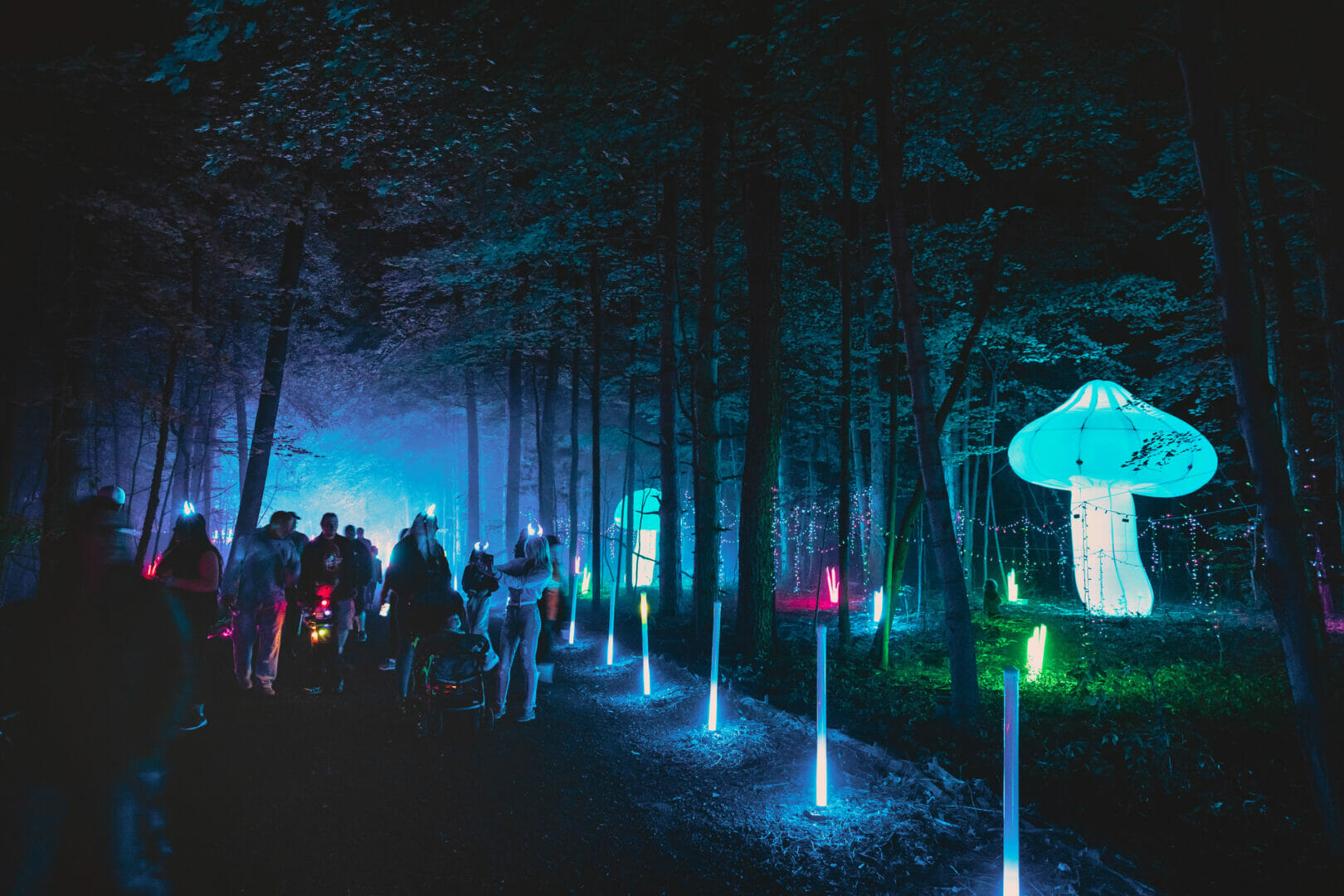
Oakland County’s account of the original attraction describes a half-mile trail with ten installations and no-touch interactions. Bluewater says the experience sold out for months and became a new business unit. Its historical media kit reports more than 150,000 guests across three locations and multiple themed concepts in 2020. That figure belongs to the broader programming effort, rather than one forest path. It also says the work helped event technicians remain employed.
The humble cart, considerably promoted
Bluewater’s first offering was less atmospheric. Brothers Tom Schoeneberger and Paul Rose founded BlueWater Visual Services in 1985, working from the garage at Paul’s family home in Southfield. They rented TVs on carts. There is something pleasingly concrete about that beginning: a customer needed a picture somewhere, and the company wheeled one in.
The business expanded into projection, LED video walls and experiential work. Today, its services join creative development with technical production, software and fabrication. Its stated mission is “Creating Environments that Power Human Connection.” The current leadership includes President and Owner Suzanne Schoeneberger and CEO John Tracy. Bluewater is a WBENC-certified woman-owned business.
Its market position sits across several purchasing decisions. A customer may need a corporate event, a permanent conference system, a trade show environment or an interactive installation. Alternatives include Encore in event production and AVI-SPL in workplace AV and managed services. Those businesses also offer broad capabilities. Bluewater’s particular appeal is the combination illustrated by its own projects: a company that can build a sales-meeting stage, a retail fixture and a seasonal forest attraction.
In 2018, it acquired AR3 Enterprises, an audiovisual consultancy serving corporate offices and large sports and entertainment venues. The acquisition added large-venue expertise to a business already working at Detroit’s Little Caesars Arena. Expansion here meant adding a craft that customers needed, rather than simply adding another screen to the catalogue.
Carhartt needed a bigger conversation
For a more conventional example, consider Carhartt. In 2018, its fall Global Sales Meeting expanded to include the wider company, bringing attendance to 600-700 people. Bluewater developed an industrial-inspired stage design and supplied large-format displays, sound reinforcement, lighting, presentation playback and custom scenery. An audience segment called The Newlythread Game brought a little play into the proceedings. Even workwear has room for a game show.
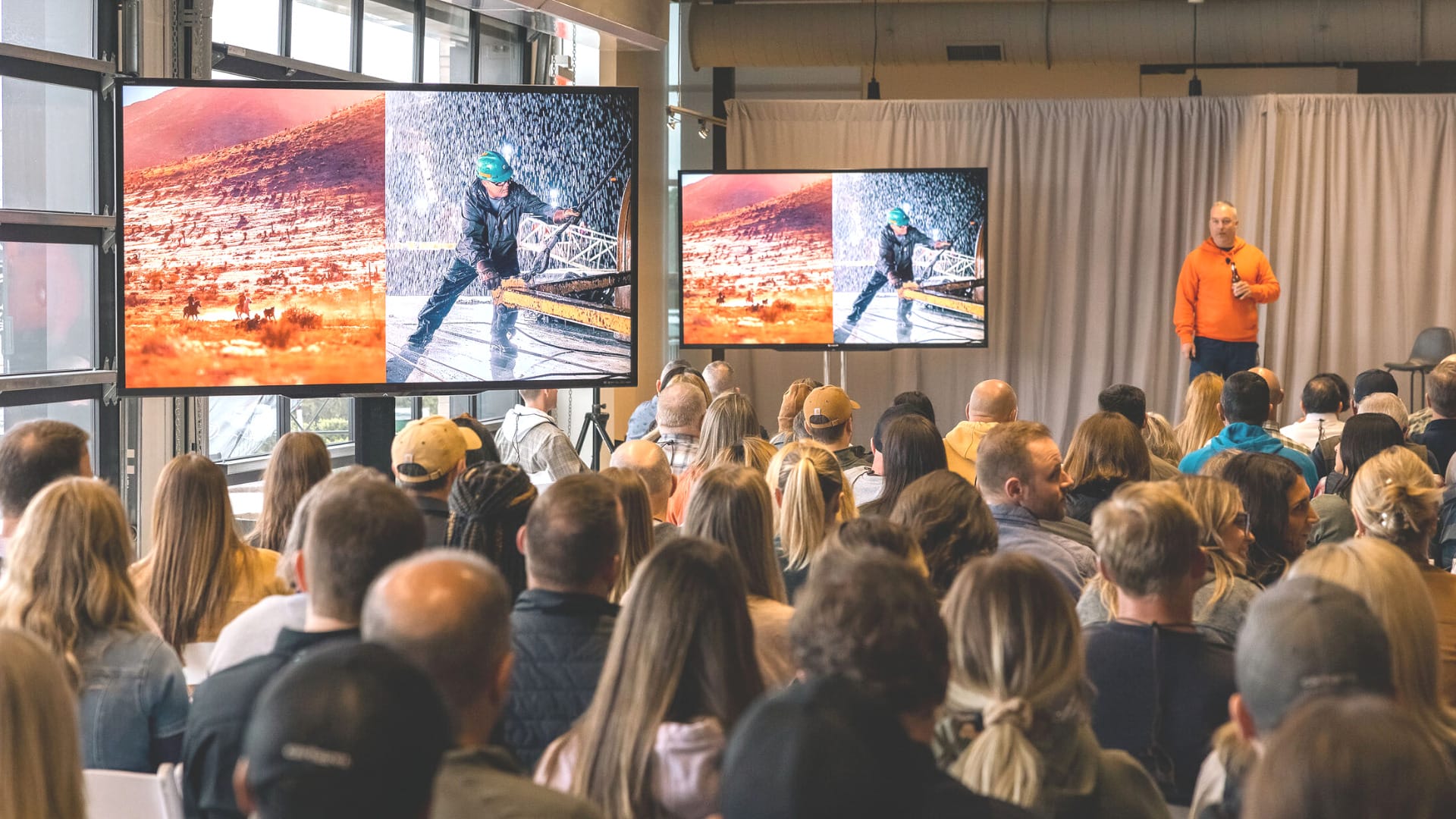
By 2022, the assignment had changed. Carhartt wanted a multi-day headquarters event for 200 attendees after an extended period of virtual engagement. Bluewater designed the meeting room and an outdoor networking space, then connected remote attendees through its Parallel platform. That included live and on-demand content, schedules, speaker information and downloadable resources. The brief involved both the people in the room and those looking at a screen elsewhere.
Parallel, publicly introduced in 2021, extends Bluewater’s role into software. Its features include a schedule-based content system, video and tools for participation. The useful distinction is operational: the same company can work on the physical presentation and the digital route into it. Buying a platform alone still leaves the meeting to produce.
The dog treats make the business case
The SpartanNash Biscuit Bar is a wonderfully unpretentious counterpoint to the forest. SpartanNash wanted better sales from bulk pet products. Previous center-aisle displays had performed well, so Bluewater’s Mesick team designed a freestanding gondola that shoppers could approach from all sides.
The details were shop-floor details. Plastic tubs made bulk products accessible and straightforward to replenish. Deeper wooden containers accommodated larger items. The display gave merchandise more visibility while making restocking easier. It is design with an interest in what happens after the photograph is taken.
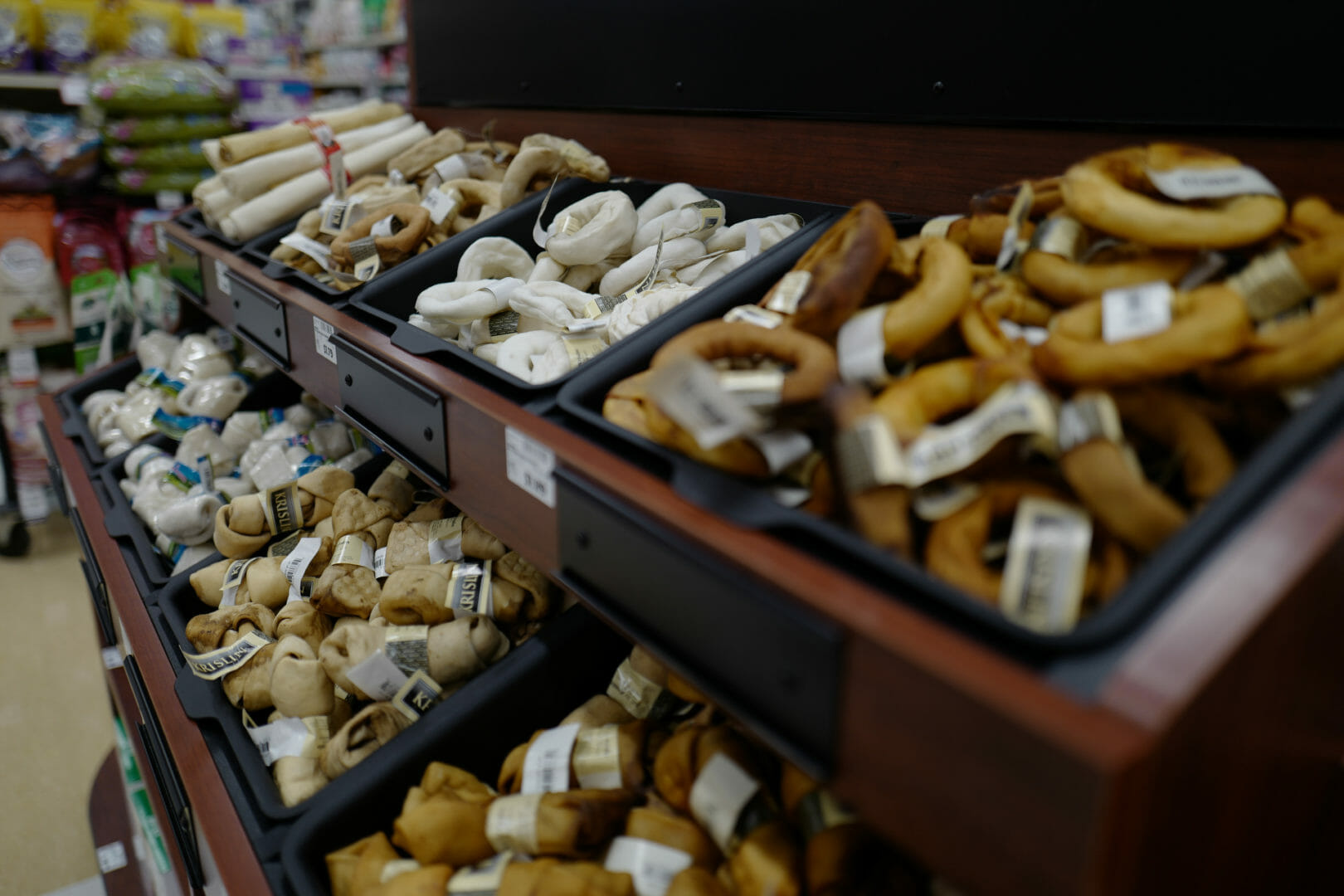
Sales increase in pet food and treats reported by Bluewater for the SpartanNash display project. A company-reported result for this case, with no stated measurement period.
The lesson is modest enough to be useful: make the product easier to notice, handle and replenish. A brighter display is only one possible tool. Sometimes the appropriate technology is a well-designed container.
The invoice continues after opening night
Bluewater earns its place through several kinds of work. Events need production crews and temporary systems. Permanent installations need design, integration and commissioning. Creative assignments need content and interactive development. Retail environments need fabrication. Glenlore adds consumer ticket sales to that mix.
Installed systems also require continuing care. Bluewater offers managed-service agreements covering maintenance, monitoring, training and on-site staffing. Its AV-as-a-Service offering puts hardware and support into a monthly subscription, with typical terms described as 36-60 months and periodic technology refreshes. For a buyer, the choice involves cash flow, support needs and how often equipment should change. A monthly payment still deserves a whole-contract calculation.
This part of the company solves a less photogenic problem: getting the meeting to start. Bluewater’s managed-services offering includes quick-start documentation and user training. A video wall can be impressive and a conference room can be expensive; neither excuses a system that ordinary people struggle to operate.
Borrow the brief before you borrow the lights
Bluewater publishes a four-stage method: align, design, execute, then support and measure. Alignment starts with the business objective. Design spells out content, hardware, code and materials. Execution coordinates the people and production. Support checks that the program continues to serve the original purpose.
- AlignWhat should this space accomplish?
- DesignWhich content, systems and materials fit?
- ExecuteWho builds, installs and operates it?
- Support + measureDoes it work, and is it worth repeating?
That sequence is easy to copy in a smaller organization. Start with a behavior or outcome: participation, usable meeting rooms, product sales. Inventory the resources already available. Assign responsibility for the experience after launch. Then choose the equipment. Glenlore’s timing suggests another question: what could your existing people and assets do for an audience you have not yet served?
The conditions matter. An outdoor attraction needs a suitable site, paying demand and the ability to operate nightly. Diverting busy crews from profitable client work changes the calculation. A straightforward equipment rental may require a narrower supplier. The useful purchase is the amount of coordination the brief actually needs.
The forest still needs its cables
In September 2026, Bluewater announced CarnEvil 2, running at Glenlore Trails from September 18 through November 1. Its in-house work includes characters, music, voices, games and visual effects. Brad Kaminski hand-drew the trail map. Creative Director Eric Minni performs character voices and creates original songs.
“The technology has to survive all of that, work every night”
Erik Smith, Production Manager at Glenlore Trails, on outdoor installation
Production Manager Erik Smith describes miles of power and network runs, hundreds of crew hours and the complications of heat, rain, mud and animals chewing cables. The attraction makes Bluewater’s combination visible: the creative idea, the custom content and the engineering have to cooperate. A talking tree is entertaining. A talking tree that reliably speaks on cue is a business.
Explore Bluewater, its project portfolio and latest stories. Visit Glenlore Trails or watch the Glenlore experience film and STARBASE One interactive learning demo.