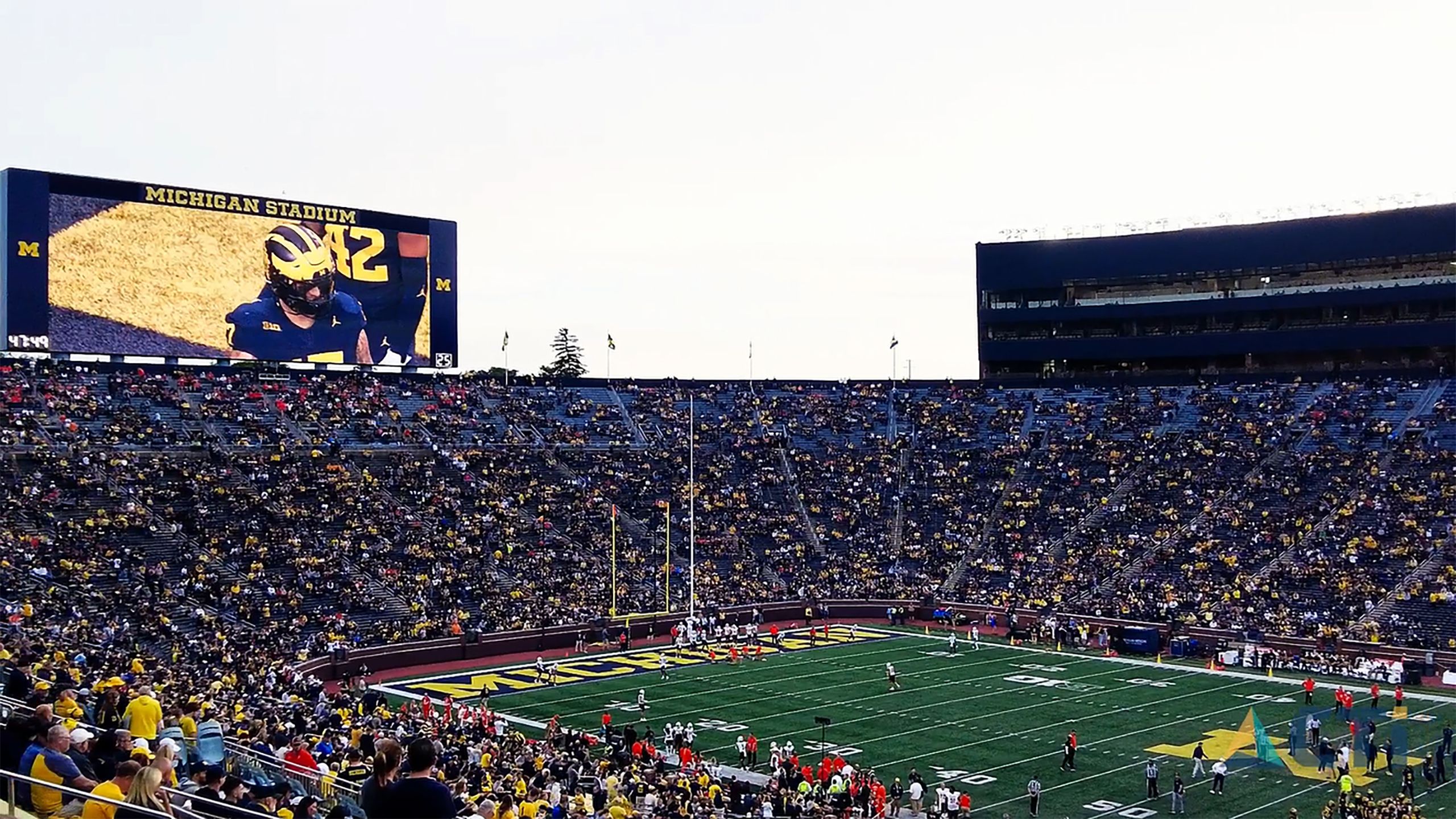
A switch failed during a University of Michigan soccer game. This is an unremarkable sentence until you remember what a modern stadium asks of a switch: keep video moving through a production system while cameras roll, operators cut feeds and thousands of people expect the show to continue. The production crew used patch panels to route around the dead equipment. Within minutes, another feed was live. The audience got the game, not an outage postmortem.
That small rescue explains CTI better than its very large catalog. The St. Louis company designs, installs and supports audiovisual systems for places where a blank screen is not merely annoying. Michigan Stadium holds more than 107,000 people. The New York Stock Exchange produces roughly 3,000 media and broadcast events a year. Courtrooms must make every word intelligible. Emergency centers monitor situations around the clock. A live event has no undo button.
CTI sells the visible equipment - displays, cameras, microphones, speakers, processors and control surfaces. But its more valuable product is invisible: one chain of responsibility from room survey to engineering, programming, installation, training, monitoring and maintenance. The customer is buying fewer vendors to call when the chief executive, judge, producer or scoreboard operator presses the button.
A kitchen table grew cables
Jane and Dennis Woodhouse founded Conference Technologies, Inc. on their kitchen table on October 11, 1988. The company established a formal St. Louis headquarters three years later. In 1997, a friend brought in accountant John Laughlin to straighten out business problems. Laughlin expected a six-month assignment. He stayed, became CEO in 2009 and, with his wife Mary, became the owner in 2011.
The first acquisition came in 2001: the Kansas City location of Visual Works. That year CTI also completed its first multimillion-dollar project, a network-management center that kept a crew in New Jersey for months when the whole company employed only about 20 people. The pattern was set early. Add a local office or specialist team, then give it the purchasing power, engineering depth and service reach of the larger company.
By its 35th anniversary in 2023, the renamed CTI reported more than 750 employees, 34 offices, 1,300 service contracts and 11,000 projects completed worldwide with the PSNI Global Alliance. LinkedIn now shows roughly 1,900 employees and CTI says it serves customers through 45 locations, including European offices. The head count and map moved fast because acquisitions moved fast: control-room specialist Vistacom and three other operations in 2024; Delta AV, MP Productions, LightWerks and London’s Candeo Vision in 2025; then Streamline AV, Nomad AV, Valley Communications Systems and broadcast engineer Texolve Digital in 2026.
Your reputation is built one job at a time.John Laughlin, CEO
The box is not the business
CTI is an authorized reseller of more than 250 product lines. That fact sounds like abundance; it is really a warning. A conference room can contain products from Microsoft, Crestron, Shure, LG, Cisco, Logitech and half a dozen other companies. They share a rack, a network and a user who does not care which manufacturer caused the problem. The integrator’s job is to make the pile behave like one product.
The product the customer actually experiences
The work begins with consulting, acoustics and system design. It runs through procurement, installation and control programming - the “black boxes” that make one touch lower a shade, wake a display, select a camera, set the audio and launch a call. Broadcast teams add routers, replay, graphics, shared storage, media-asset management, cloud workflows and SMPTE 2110 networks. Live-event crews bring staging, lighting, rentals, webcasting and operators. Managed-services teams watch the result, place technicians onsite, clean and inspect hardware, update firmware and plan replacements.
That creates three overlapping businesses. There is project revenue from designing and building a space. There is production revenue from running an event. Then there is recurring support revenue from monitoring, maintenance and onsite staffing. CTI says it can manage systems installed by somebody else, from one room to an enterprise estate. That matters because installation is a date; usefulness is a lifecycle.
The customer decides how much of that lifecycle to hand over. An internal IT department may want remote troubleshooting and a scheduled checkup. A headquarters may put a dedicated CTI technician in the building. A broadcaster or arena may need spare paths, rehearsed recovery and support that understands signal flow as well as the network. The menu scales, but the commercial logic stays consistent: the more consequential the room, the more valuable familiarity becomes. A technician with diagrams and service history starts several steps ahead of a stranger arriving after the alarm.
What failed first - and what changed minds
At Michigan, the failed switch proved the value of a deliberately patchable system. The production team had wanted every feed accessible so operators could test, monitor and route around trouble. Redundancy is easy to cut from a proposal because it does nothing on a good day. On the bad day, it becomes the whole proposal.
In courts, the mind-changing event was larger. COVID forced state and county systems into hybrid hearings before many had funding or institutional enthusiasm for the technology. Judges and staff improvised remote bail hearings, witness appearances and lawyer participation. Once courtrooms upgraded microphones, speakers, cameras and touch controls, the benefits remained after people returned: clearer testimony, better recordings, easier evidence display, assisted listening and remote access for someone with a phone but no convenient trip to court.
CTI’s justice team says it has completed more than 2,500 installations in 33 states and helped bring technology to courtrooms in 45 states. Its premise is practical: access to justice starts with being able to hear, see and participate. A thirty-year-old projector replaced by a display can help. A fully integrated new courthouse can help more. The design uses building blocks so a court can add conferencing, annotation or assisted listening when budget and need allow.
Access to justice - that’s the big problem we’re solving.Adam Lofredo, CTI Justice Division
A moat made of people and receipts
CTI competes with AVI-SPL, Diversified, Ford AV, CCS, Solutionz, regional specialists, event houses and internal IT teams. Most can buy familiar hardware. CTI’s distinction is the breadth it can place behind one contract: local branch service, national engineering, broadcast and control-room specialists, event production, a partner network for global delivery and a support operation after handoff.
That breadth is not automatically an advantage. Acquisitions can produce duplicate processes and inconsistent service. CTI’s answer has been a people-first culture and internal training. Several senior leaders have worked there for more than two decades, often moving through reception, accounting, sales, operations and project management. Its internship bootcamp teaches job-site safety, tools and system drawings. A registered apprenticeship for AV technicians formalizes a trade that awkwardly combines construction, networking, programming, acoustics and customer service.
The customer list is an index of high-consequence rooms: University of Michigan, New York Stock Exchange, Houston Rockets, Philadelphia Union, Coca-Cola, Citigroup, LinkedIn, PayPal, NETGEAR, universities, courts and emergency centers. The glamour varies. The requirement does not. The room has to work for the person in it, not merely pass a commissioning checklist.
The part worth copying
CTI’s playbook travels well outside AV. Start with the user’s stressful moment, not the component catalog. Standardize the parts that should repeat across rooms or branches. Customize the workflow that creates actual value. Build an escape route for the first likely failure. Document what was installed. Train the operator. Stay available after launch, when the system meets software updates, dust, staff turnover and ordinary human improvisation.
Design the failure path while everyone is calm. A bypass that looks wasteful in planning can save the live moment.
Track room uptime, response time, repeat incidents and user confidence - not just whether installation finished on schedule.
Bundle accountability across design, deployment and support. Customers pay to avoid the vendor blame carousel.
The room is low-stakes, the workflow is simple and replacement is cheaper than engineering, monitoring and redundancy.
The model is a poor fit when a buyer wants commodity equipment at the lowest upfront price, will not fund documentation or training, or lacks the network discipline to support connected AV. It also weakens when every location insists on a unique design but expects national support to behave like a standard product. Customization creates delight until it creates 100 different failure modes.
For CTI, the next challenge is hiding more complexity while owning more of it. AV is merging with enterprise networks, software platforms, security, cloud production and building controls. Each acquisition adds expertise and another integration problem inside the integrator. The company that promises a quiet room must keep its own machinery quiet, too.
Still, the switch at Michigan is a useful ending. Hardware failed. The plan did not. In a business decorated with enormous video walls, that invisible distinction is the thing worth seeing.