There are two ways to look at a ballroom before a corporate meeting. The first is as a room with unfortunate carpet. It needs a stage, screens, microphones, chairs, lunch, and an emergency supply of confidence. The second is as a temporary communications machine. Every entrance tells the audience where to look. Every screen decides what deserves attention. Every speech, lighting cue, video, app notification, and coffee break either reinforces the central idea or steals oxygen from it.
FLIRT Communications belongs to the second school. The Chicago firm calls itself a communications company, then backs up the claim with a service list that crosses the usual agency borders: strategy, key messages, speechwriting, presentation coaching, graphic design, video, websites, social media, event apps, scenic design, technical direction, and project management. It produces sales meetings, product launches, leadership conferences, recognition programs, training, and employee-engagement campaigns. The common unit is not the room. It is the idea that must survive the room.
That distinction sounds fussy until the event begins. The executive's speech has one thesis. The opening film has another. The set suggests a third. An app arrives without instructions. Five suppliers execute five good briefs and produce one confusing experience. FLIRT's business is the removal of those seams.
The app was never just an app
A useful early example came at CDW's three-day Partner Summit. In 2011, when a corporate event app still carried the faint smell of an experiment, FLIRT and technology partner DoubleDutch built one for the company's vendors. The practical purpose was to put CDW's marketing and communications material in attendees' hands and let vendors and employees talk to one another during the meeting.
The easy move would have been to launch it and call the technology innovative. FLIRT instead treated adoption as a communications problem. Before the summit came an email campaign. Employees got live demos and webcasts. At the venue, an app lounge offered help. Contests and prizes supplied a nudge. The result was 394 Apple downloads and access by 232 Android users among 744 attendees. Participants posted status updates, check-ins, reactions, and more than 500 photographs. Ragan gave the project its 2011 award for Best Mobile Application.
The enduring lesson is almost impolite in an industry fond of shiny objects: the app was only half the product. The other half was teaching people why and how to use it. A download link can fail quietly. A staffed lounge cannot. FLIRT did not wait for curiosity to do the distribution work.
The event is not the thing. The change in attention, understanding, or behavior is the thing.The operating idea behind FLIRT's broad service mix
A company built around the handoff
FLIRT was formed in 2008. Kari McGlinnen, now president and CEO, helped launch it after working in production management. Its stated ambition was to build long relationships with a select set of clients through a more strategic, creative, and technical response. The phrasing matters. Strategy, creative, and technical are often three departments, three budgets, or three companies. Here they are three views of the same assignment.
The firm's customers make this integration valuable. Named work includes CDW, W.W. Grainger, American Family Insurance, Cardinal Health, McKinsey, and Mead Johnson Nutrition. Its client roster reaches across pharmaceuticals, medical devices, healthcare distribution, consumer goods, industrial supply, mechanical contracting, and information technology. These are businesses in which an annual sales meeting or leadership conference carries real organizational weight. The audience may need to understand a new product, believe a new strategy, recognize colleagues, learn a process, and leave ready to perform it.
The alternative is a conventional roster: a strategy agency, production company, AV vendor, scenic fabricator, filmmaker, speaker bureau, and digital shop. That can work, particularly when a client has a strong internal producer. It can also turn the client into the sole keeper of coherence. FLIRT competes by assuming more of that connective burden.
The room that changed jobs
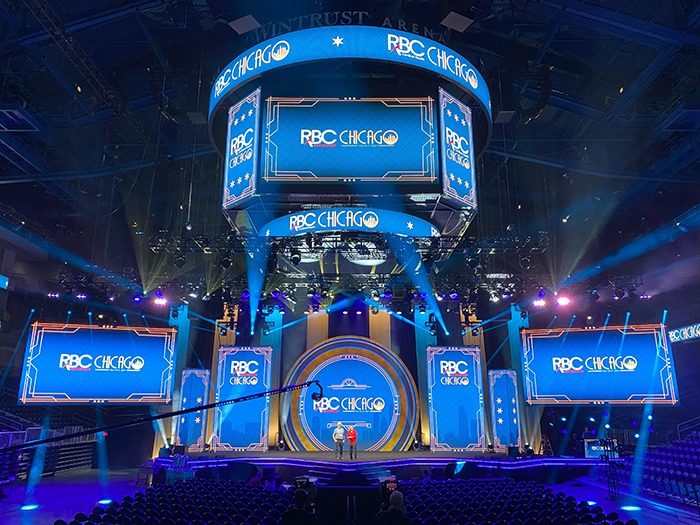
At Cardinal Health's 2024 Retail Business Conference, the room was Wintrust Arena in Chicago. FLIRT partnered with Production Resource Group on a general session built with audio, LED, video, lighting, and a large crew. After the keynote, the same space had to become a concert venue for Sheryl Crow. This was not simply a bigger version of a hotel meeting. The production had to anticipate a second identity, including concert-grade requirements and a fast transition across disciplines.
The work offers a tidy picture of FLIRT's place in the market. It can own the communication and design logic while a specialist such as PRG supplies large-scale technical systems and touring capability. A smaller agency does not need to pretend it owns every speaker cabinet. It does need to know what the idea requires and which partner can deliver it.
That principle appears again in FLIRT's relationship with Entire Productions. In a 2025 podcast conversation, FLIRT vice president and partner Leslie Fenton and Entire Productions founder Natasha Miller described a non-exclusive alliance. Entire adds sophisticated entertainment and experiential production. FLIRT brings video, writing, communications, and related capabilities. The two can white-label work, handle billing flexibly, and combine teams when the client benefits. The notable decision is restraint: partnership without the theater of a merger, and capability without false ownership.
The useful economy of one good idea
Corporate events invite a peculiar kind of spending. A weak idea makes every physical object work harder. More screens, more scenery, more content, more transitions. FLIRT has recently promoted a simpler method: a modular scenic backdrop, placed lighting, and a skilled lighting director can transform rooms of different shapes and sizes while controlling cost. Reusable structure plus variable light is cheaper to change than a custom physical world rebuilt for every scene.
This is where the company's name earns its keep. FLIRT once described itself as being in the “business of attraction.” The joke is obvious; the observation underneath it is better. Attention cannot be ordered like pipe and drape. It must be earned, directed, rewarded, and renewed. The CDW app lounge earned it with help and prizes. The Cardinal Health arena used scale, entertainment, and a visual system. A smaller leadership meeting might use a tight theme, a coached speaker, and lighting that makes an ordinary room change mood on cue.
What another team can copy on Monday
- Write the audience action before designing the stage. “Feel inspired” is not an action.
- Give one owner authority over the message across invitations, scripts, screens, apps, and follow-up.
- Budget for adoption. A tool without demonstrations, support, and incentives is merely available.
- Use modular scenery and programmable light when the room must change without a second build.
- Partner for specialist depth. Keep the alliance transparent, culturally compatible, and organized around the client.
The model has conditions. It is most useful when the event carries a message important enough to coordinate, when leaders are willing to rehearse, and when the agency enters early enough to influence the brief. It is less useful for a simple social gathering, a client buying production strictly by the lowest line item, or a program whose strategy has already been frozen into conflicting pieces. Integration requires permission to integrate.
FLIRT is a compact, privately held firm in a market full of global experiential networks, destination managers, production giants, and niche creative studios. Its answer is neither maximum scale nor proprietary software. It is proximity between disciplines. The person worrying about the sentence can talk to the person worrying about the screen. The person booking the performer can talk to the person timing the transition. The audience experiences one show because the team has argued through one idea.
That is the quiet trick of a good corporate event. When it works, nobody notices the handoffs. They notice what the company wanted them to notice.