Twenty seconds can be a small eternity when a show is about to begin. During rehearsal for RSA Conference, an opening video commissioned for the event turned out to be 20 seconds too short. There was roughly a day left. Toy Robot Media’s Michael Moore volunteered to make another piece, producing a Chinese-lantern-style animation in a couple of hours on site.
The incident, recounted in a Notch case study, is a useful introduction to a company whose work usually sits behind somebody else’s announcement. Moore had brought two computer towers. They stayed packed. His laptop handled the versioning and support. For anyone who has dragged equipment through an airport, that detail deserves its own small round of applause.
It also suggests a sensible way to judge an event-design agency. Look at the finished pictures, certainly. Then ask what happens when the pictures need changing. Toy Robot Media’s business occupies that awkward, valuable stretch between an approved creative idea and the moment an audience actually sees it.
The work continues after “final”
The Pasadena agency organizes its offering around live events, presentation design and immersive video. That means moving images, speaker slides, editing, broadcast graphics and the people needed to get the material into a show. A client can commission the creative work and also bring in support for the practical business of managing it.
Its short sales line is “More Show. Less Stress.” The second half carries considerable weight. Content management and onsite support are hardly glamorous phrases. But they identify the buyer’s predicament with unusual accuracy: a roomful of people is waiting, the material must be right, and the schedule has stopped being negotiable.
The useful distinction is between delivering an asset and supporting its use. An animation may be finished while the presentation around it remains unsettled. A speaker may have new language. A producer may need a different sequence. Buyers evaluating this kind of service should ask who owns those changes, when that person is available, and how revisions reach the show crew.
“I brought two towers with me and didn’t take them out of their flight case!”
Michael Moore, on the RSA production
A stadium adds some arithmetic
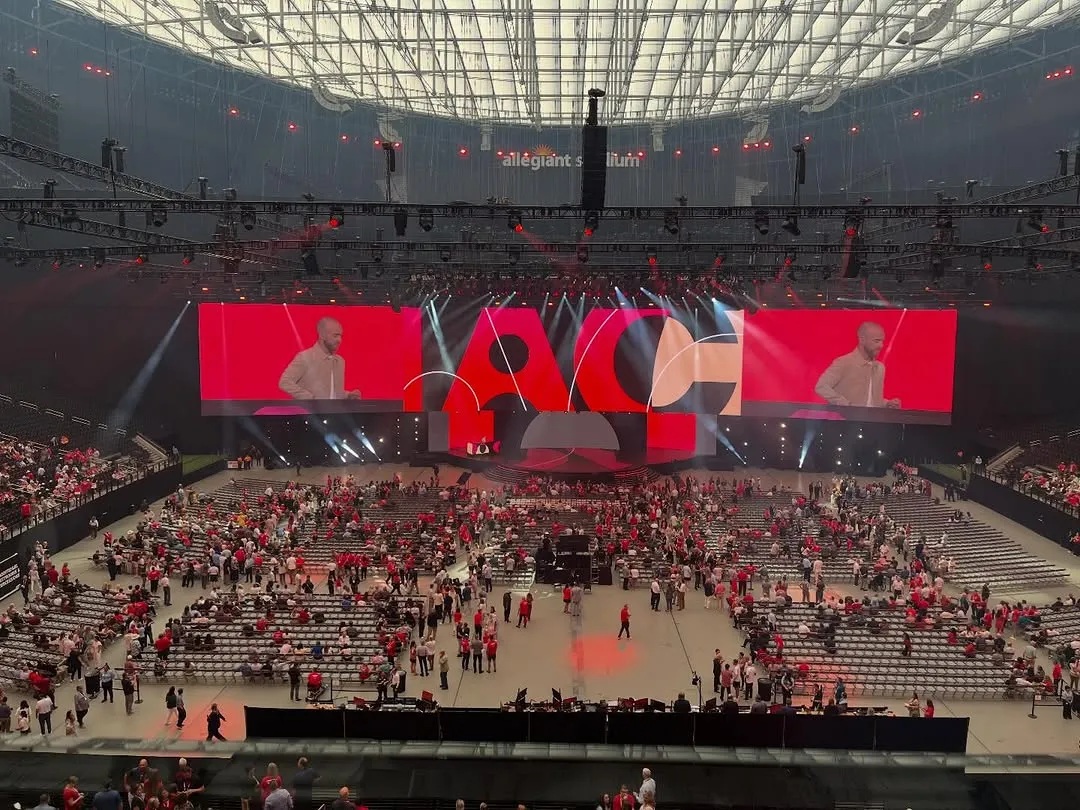
By May 2026, the review problem had become considerably larger. A Foveate case study describes a corporate stadium production for 20,000 people, with five interchangeable assets on each of three surfaces. That creates 125 combinations. One asset alone needed a 16-hour preparation operation.
Toy Robot used Foveate’s 3D previs to swap content in a virtual venue and inspect audience viewpoints. During production, the DJ booth became an additional live video surface; Foveate supplied timeline support within the week. The studio participates in the vendor’s Founding Partner program. These are the vendor’s reported results, and the distinction matters: faster review does not mean the finished show required no rendering.
Peacock’s stage had a second life
For a more theatrical example, consider Peacock’s early-2020 briefing. Motion designer Josh Crews describes spending the first weeks of that year working with Toy Robot Media on the Saturday Night Live stage. LED panels carried the team’s content, including a digital version of the familiar set used for projection-mapping effects. His project video makes the assignment tangible.
This was corporate communication with a stagecraft problem attached. The message concerned a streaming service; the setting supplied a recognizable entertainment context. The graphics had to inhabit that setting. It is a more specific job than simply making a handsome video and pressing play, and it helps explain why event experience features so heavily in the agency’s pitch.
NBCUniversal’s Andrew Gottlieb also identifies Peacock Investor Day in a testimonial on Toy Robot’s site. Other endorsements come from Imagination and Zed Ink. Together, those references describe two routes into the business: a brand can need a creative production partner, and an agency serving that brand can need one too.
The name on the screen is often somebody else’s
A Microsoft project offers a useful corrective to the way creative-company portfolios are sometimes read. The Hermes Creative Awards entry for an E+D animated opener lists Zed Ink’s creative team, Rezonate for animation, and Toy Robot Media for broadcast motion graphics. Microsoft’s Experiences + Devices organization includes the people behind Office, Devices and Windows.
That credit is precise. It establishes a contribution to a larger undertaking, rather than authorship of everything the audience saw. For a buyer, this is useful information: the studio has worked inside a production with divided responsibilities. Hiring a specialist often means asking that specialist to fit into an existing creative team.
The agency also reported supporting the 2022 Warner Bros. Discovery Upfront at Madison Square Garden, thanking collaborators including SOREN WEST, ATOMIC, Visual Noise Creative, Pretty Damn Sweet and Brin Hill. Its place in the market comes into focus through those relationships. This is a business serving other businesses, frequently helping make another organization’s big public moment.
The commercial offer is commissioned creative and production work. DesignRush lists a minimum-budget band of $10,000 to $25,000 and an average hourly rate of $160. Treat those directory figures as indicative, not a current quote. A sensible comparison requires a defined scope: deliverables, revisions, event days and the support included in the price.
The slides have to follow the speaker
Presentation design is where the company’s practical streak becomes particularly clear. Its service page describes a script-to-slides process built for changing scripts, alongside specialist onsite teams and work across time zones. It also says its experience covers thousands of shows. That is the company’s account of its workload, rather than a count of distinct customers.
For a communications team, the immediate application is straightforward. Bring the message, the speaker material and the event requirements; commission visual development and a process for keeping the deck current. The work can include templates and themes as well as the finished presentation. Reusability belongs in that conversation from the start.
The lesson readers can borrow is to give revisions a route. Decide who can change the words, who approves the resulting slides, and who releases the version used on stage. Even a small internal meeting benefits from those decisions. The larger the team, the less sensible it becomes to let a filename ending in “FINAL” carry all that responsibility.
- MessageWhat must the audience understand?
- SurfacesWhere will the content appear?
- RevisionsWho approves the next version?
- ShowtimeWho supports the final delivery?
Editorial checklist based on the service scope.
A buyer can also separate the decisions that affect meaning from those that affect delivery. Approving a sentence is different from approving how long it stays on screen. Agreeing on a visual direction is different from checking its legibility in a room. Putting both kinds of decision in the brief makes the assignment easier to price and easier to evaluate.
Somebody still has to conduct the orchestra
The official team page names Rob Jalil as founder and CEO, with Mike Moore leading creative and Erin Knowles as chief design officer. The company dates its founding to 2014 and describes a team spread across time zones. LinkedIn places it in the 11-to-50-employee range and says the business began in New York before relocating to the Los Angeles area.

The media arm, toyrobot.tv, gives its people affectionate alternative job titles. Moore is “The Hat”; Knowles is “Project Sorceress.” The humor is modest but revealing. The team biographies make room for estimating, organizing and keeping people paid alongside animation and design. Someone has to make the creative work administratively possible.
Culture claims are easy to print. Here, the more useful observation is that client testimonials repeatedly discuss collaboration and delivery. An event buyer is selecting people who may need to absorb a late request without turning it into a crisis. A calm working relationship has a practical purpose when several companies share responsibility for one deadline.
The brief should decide how much machinery you need
Toy Robot’s live-event offering includes custom automation, real-time graphics tools, and content intended for broadcast and social streaming. Its immersive-video work adds scripting, motion branding and post-production. These capabilities make sense together when one message must travel through several formats and a production team needs help keeping it coherent.
They also suggest where the fit is strongest: a changing presentation, a screen-heavy event, or a production that needs creative staff close to delivery. A fixed, simple asset with plenty of lead time may call for a smaller commission. The right comparison is the work required, rather than the length of a studio’s services list.
The same discipline helps with a streamed event. A remote viewer sees the camera’s selection of the room, rather than the whole environment. Ask which graphics belong in that view and which need a separate treatment. That question gives the agency something concrete to solve before the production schedule starts dictating the answer.
A prospective client can make the first conversation useful by bringing screen specifications, a draft script, deadlines, approval responsibilities and an honest account of likely changes. Ask to see related work, then discuss how it was delivered. The visual idea matters. So does having somebody available when rehearsal reveals the missing 20 seconds.
Watch the work. Meet the team.
Explore the studio reel, Peacock stage visuals and Microsoft E+D opener. For services and contact, visit Toy Robot Media or its media portfolio.