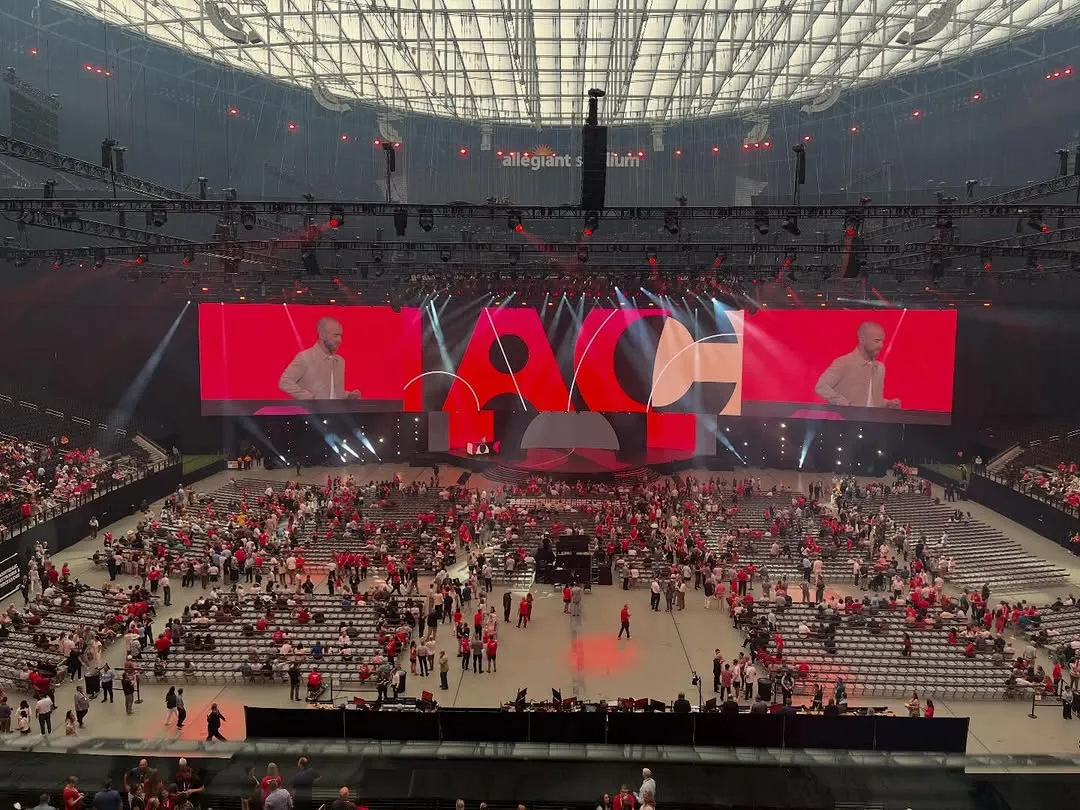
Five choices for the main screens. Five for the DJ booth. Five for the ribbon of LED running around the audience. Multiply them and you get 125 possible combinations. For Rob Jalil’s team at Toy Robot Media, a corporate stadium production in May 2026 came with a particularly awkward question: how do you check every version without spending the production waiting for previews?
The audience would number 20,000. What looked right from one seat might look quite different from another. The screens had to work together, and the people making decisions needed a way to see that relationship. An attractive picture of one surface would answer only part of the question. Multiply the pictures, the viewpoints and the requests for changes, and a creative assignment starts behaving like a traffic problem.
Jalil’s description was admirably plain: “Five assets in three slots that are all interchangeable.” There is something appealing about a creative executive who can reduce a stadium to a sentence that belongs in a school mathematics exercise. The arithmetic explains the difficulty. It also explains why organizing the work deserves as much attention as making the images.
reviewed live in 3D
An Atlantic crossing, then a company
Jalil moved from the United Kingdom to the United States in 2002. His education includes Imperial College London, where he studied from 1990 to 1993. Today he is based in Pasadena, California, and leads Toy Robot Media as its founder and CEO. The company dates its beginning to 2014, after years of project work across finance, automotive, technology and entertainment.
Those industries have different vocabularies, but their public presentations share an unforgiving feature: somebody eventually has to face an audience. A concept must become a sequence of images, a script must become something a speaker can use, and the whole arrangement must survive contact with an actual room. There is considerable distance between approving a design and delivering a show.
Jalil built a business that works across that distance. Toy Robot’s offering includes motion graphics, presentation design, content management and production support. The scope puts the studio in the creative conversation and in the practical business of getting material to the right screen. Its work continues beyond the moment when a client says the picture looks good.
A company can offer beautiful examples of past work and still leave the practical assignment unclear. Here the service list includes both making the material and supporting its use. That gives a client a reason to discuss the route from the first brief to the final presentation, including the changes along the way.
The spreadsheet gets a seat at the creative table
On the website for toyrobot.tv, the company’s media arm, Jalil has an alternative title: “Finesser of Spreadsheets.” It is a modestly ridiculous credential, which is part of its charm. Creative businesses tend to photograph the finished spectacle. A spreadsheet is less likely to receive applause, although a production can become rather attached to having one that works.
The joke sits beside a serious division of labor. Mike Moore leads creative work. Erin Knowles is listed as chief design officer on the main company site. Designers, animators, editors, producers and content coordinators complete the senior team. Jalil’s role sits within this group of named specialists, rather than floating above an anonymous collection of people making things.
The studio describes a team working across time zones. That makes coordination part of the product: someone must understand which decision has been made, which file reflects it and who needs the next version. Read the spreadsheet title in that light and it becomes an unusually economical job description. The humor depends on recognizing how much creative work needs organization.
What people go to an event for
In a 2020 conversation with digital multimedia student Lauren Schoth, Jalil considered a basic question about events: what are people actually there to do? Discussing a virtual graduation, he argued that recreating the surroundings could miss the social purpose of the occasion. A simple way for people to communicate might answer that purpose better than a more elaborate environment.
His interest in virtual and augmented reality came with practical questions about budgets and adoption. He also described design work becoming a matter of connecting different inputs and systems. That combination is telling: curiosity about the medium, paired with attention to the people expected to use it. An environment can be technically elaborate while leaving its audience with very little to do together.
He spoke about honest conversations with colleagues and clients, and encouraged new designers to develop a specialty. These were professional concerns with an everyday human scale. What can a person contribute? What does a team need to understand? The questions are useful long before a screen is switched on. They make room for judgment before the tools begin multiplying.
“People go to connect with each other.”
Rob Jalil · on the purpose of events, 2020
The revision is part of the performance
Toy Robot’s presentation work includes turning changing scripts into slides and assembling specialist teams for onsite support. That is a revealing service to sell. It assumes that revision will remain part of the assignment. The production has to accommodate a speaker’s evolving words while keeping the visual sequence coherent enough for an audience to follow.
The company also builds custom automations and uses real-time platforms for motion graphics. Its live-event work accounts for people watching through broadcasts and social streams as well as those in the room. A screen can serve several audiences, each with a different relationship to the same presentation. The studio’s job includes keeping those relationships in view.
These details help explain the kind of founder Jalil is. His company puts design beside delivery, and content beside the systems that move it. A revision has to travel through that arrangement without losing its meaning. The useful question becomes whether the people approving the work and the people executing it are looking at the same version of the show.
A slide has to relate to the sentence being spoken. An animation has to fit its allotted place. A replacement file has to reach the people responsible for playback. These are ordinary requirements, but they give the work its shape. They also explain why a creative company keeps production specialists close to its designers.
A stadium, reduced to something you can review
For the May 2026 production, Toy Robot used Foveate’s 3D previsualization tool to review the screen combinations in a model of the stadium. The team could switch video assets on the surfaces and examine the result from different audience positions. All 125 combinations were reviewed live, without rendering a separate preview for each combination.
The workflow connected the studio’s existing Cinema 4D models, Dropbox conventions and Airtable comments. Partway through production, the DJ booth changed from a static element into another video surface. Foveate added the needed timeline support within a week, before the next review. Toy Robot was participating in the software company’s Founding Partner development program.
Those are project-specific results, and the distinction matters. The useful achievement is the ability to examine more of the show while it is still possible to change it. A review should help people make decisions. When preparing the review consumes the available time, the process has begun charging admission to its own conversation.
- 01 Place the content
- 02 Switch the combination
- 03 Check the audience view
The credits are crowded for a reason
Collaboration shows up in the company’s relationships as well as its tools. NBCUniversal’s Andrew Gottlieb has described Toy Robot’s contribution to events including the Peacock Investor Day launch. Imagination’s Chris Israelski and Zed Ink’s Julia Zarro describe repeat working relationships involving screen content, speaker support and demanding event assignments. The recurring emphasis is on working together and delivering.
Jalil also appears in ZED INK’s team acknowledgment for BlizzCon 2023. In May 2024, the agency announced Eventex gold awards for Convention, Experiential and Event Storytelling, plus silver awards for Set Design and Event Team. It thanked a long list of collaborators, Jalil among them. The recognition belongs to a production involving many people and disciplines.
Producer Molly Gray’s recommendation of Jalil describes managing a team through a three-month project with changing needs and schedules. She emphasizes his precision and calm. It is a useful description because it concerns the experience of working beside him. The finished image cannot tell you whether the process of reaching it was clear, courteous or exhausting. Collaborators can.
The list of collaborators offers a useful check on the scale of the undertaking. An event puts several kinds of expertise in the same room. The audience experiences the result as one occasion, even when the work behind it has passed through many separate hands.
After the screens, the turntables
There is a small photograph in the toyrobot.tv team gallery of Jalil behind DJ equipment at a gathering. The company’s caption identifies him as the person providing the music at his own parties. It gives the profile a welcome change of scale: away from a stadium and toward a room where the person organizing the occasion also selects the records.
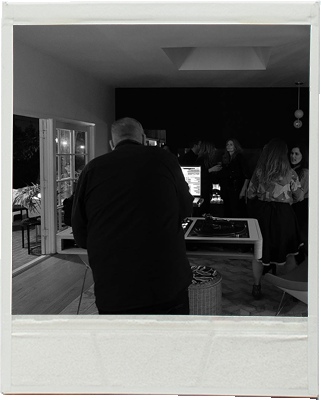
The photograph needs no grand theory. It is simply a nice detail about a founder whose working life involves pictures, timing and other people’s experiences. He can be found at the controls when the gathering is his own, too. Every corporate biography should be allowed an occasional record change.
Back at the stadium, the numbers remain satisfyingly exact: three surfaces, five options each, 125 combinations. Jalil’s business operates around the choices those numbers represent. Which version works? Who needs to see it? Can the team change it in time? For the people in the audience, the machinery behind those answers should be easy to overlook. Someone still has to give it their full attention.
Keep the conversation going
- Toy Robot MediaTHE COMPANY · LIVE EVENTS, PRESENTATIONS & VIDEO
- Rob Jalil on LinkedInHIS PROFESSIONAL PROFILE
- The people and pictures at toyrobot.tvTHE TEAM · AND THE PARTY PHOTOGRAPH
- 125 combinations, zero rendersTHE MAY 2026 STADIUM PRODUCTION
- Lauren Schoth’s conversation with Rob JalilTHE 2020 DISCUSSION ABOUT EVENTS & DESIGN
- ZED INK celebrates the BlizzCon 2023 teamEVENTEX RECOGNITION · 2024
- Toy Robot Media on InstagramTHE COMPANY’S WORK & UPDATES
- Toy Robot Media on FacebookTHE COMPANY’S SOCIAL PAGE