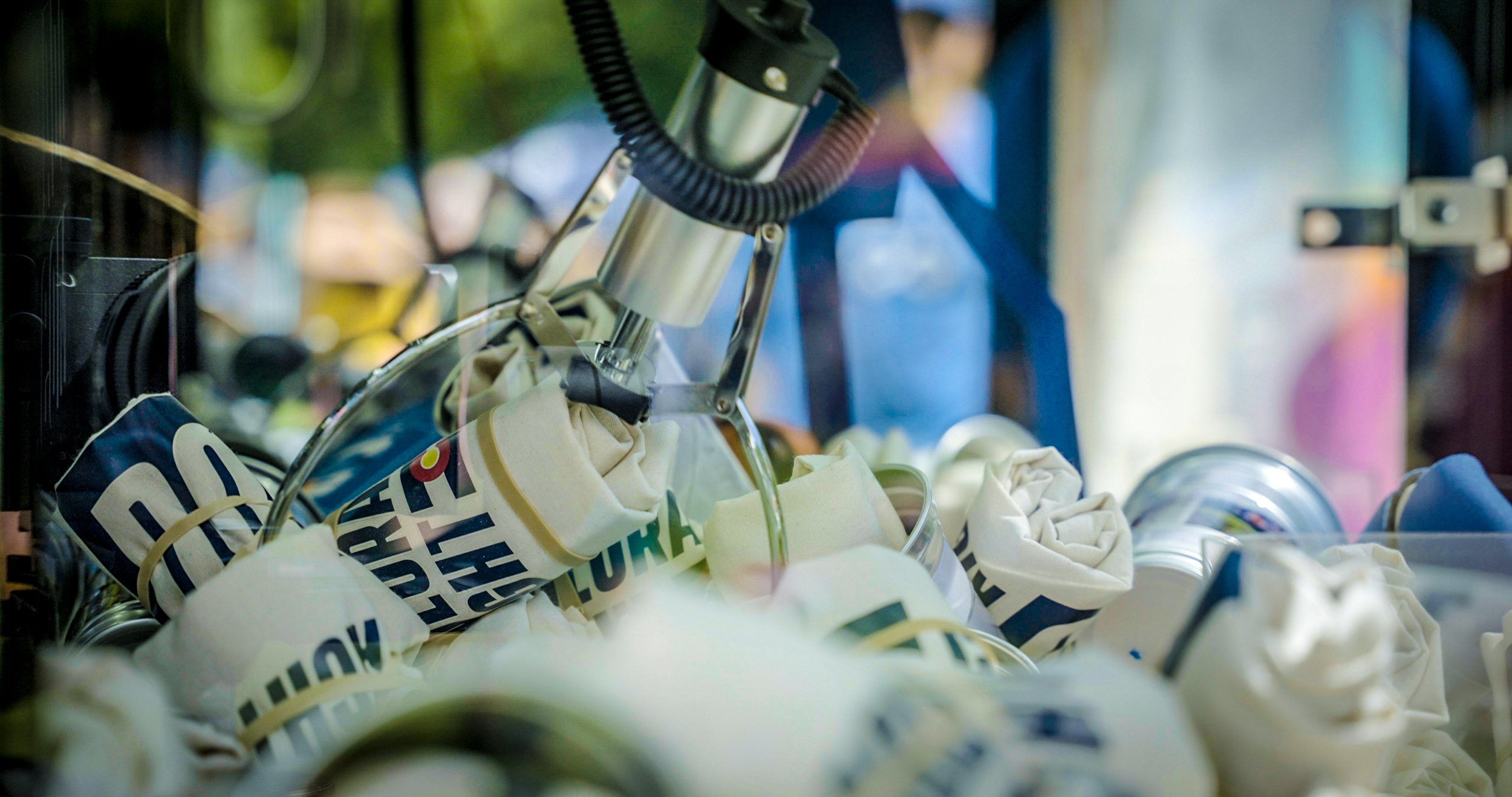
The object at the center of one Brand Revolution campaign is a claw machine. It has the carnival joystick, the transparent box and the maddening promise that this time the metal claw might actually hold on. But there are no plush bears inside. To play the Recyclaw, a fan feeds it a used Ball aluminum cup or can. Recycling becomes the token. The prize might be team merchandise, a ticket or signed gear. At arenas and festivals, the machine recorded 15,622 plays and dispensed 1,275 prizes.
This is a useful introduction to the company because it shows the whole mechanism in miniature. Someone had to find the behavioral hook. Someone had to design the thing, fabricate it, transport it, operate it and wrap a story around it. A conventional campaign might divide those jobs among a strategy shop, an event producer, a fabricator and a logistics vendor. Brand Revolution's wager is that the idea survives better when those people share one roof.
The origin
A merger built around the missing middle
Brand Revolution appeared in October 2024 when Haute, an Austin-area agency known for video, events and branded experiences, merged with Fluid Branding, the British merchandise company founded by Matt Franks and Miles Lovegrove. Haute brought creative and production muscle. Fluid brought sourcing, online stores, fulfillment and international buying power. Alisa Haynes, who had led Haute, became chief executive of the combined business.
The merger solved a familiar irritation. Haynes said her years on the client side had made her wish an agency like this existed. A brand can have a sharp strategy and still produce a forgettable experience because execution is scattered. The film looks unlike the room. The giveaway arrives after the event. The social team receives assets made for a widescreen presentation. In this diagnosis, the first thing to fail is not the concept but its translation between vendors. Every handoff can shave meaning from the original thought.
The product is not the long list of capabilities. It is the short distance between them.YesPress
The merged company then bought the missing rooms. Brilliant, acquired in April 2025, added a social-first team in Leeds. Lumenati, acquired that October, added an Emmy-winning Denver studio, cinematic production and fabrication. In March 2026, fresh id brought custom packaging and merchandise expertise in Germany plus direct-to-source capacity in Hong Kong. Four months later, Brussels-based DDMC Event Design and Alice Events added large corporate gatherings and public-institution events across Europe.
One brief, six rooms, fewer translations
What it sells
One idea in all its physical forms
The customers are mostly enterprises, institutions, destinations and other agencies. The public roster includes Dell, Marriott International, Google, TikTok, Booking.com, Salesforce, American Airlines, IBM, Ball and Vail. A client can hire one discipline - a film, a conference, a social program or a merchandise store - or connect several of them. Partner agencies can use Brand Revolution as a white-label production and fabrication arm.
Dell shows why the combined model can be more than an agency convenience. Dell needed its sellers to move several laptops, accessories, gifts and collateral between meetings. Brand Revolution designed a structured backpack and then produced videos explaining how to use it. The bag was merchandise, product design, logistics and training content at once. In a separate account of the relationship, Dell executive Dan Ireland said the agency had worked with the client product group for six years, supporting roadshows, tradeshows, media series and the practical intake-and-shipping work behind them.
For Vail, the unit was not an object but a content engine. Brand Revolution made television-first films and recut them into different lengths for streaming and digital audiences. With 970 Design, the campaign extended into display, print and sponsored Pandora placements. The agency reports 86.8 million impressions, $5.8 million in hotel revenue and a 93 percent year-over-year rise in rooms booked. The copyable lesson is not “make a ski commercial.” It is to plan the master idea for all its eventual shapes before production begins.
The measurement bet
Five feelings walk into a spreadsheet
The company's most distinctive intellectual property is Return on Emotion, or ROE. After an event or experience, participants score five dimensions from zero to 100: accepted rather than rejected, active rather than passive, adventurous rather than hesitant, hopeful rather than hopeless, and motivated rather than uninspired. The average becomes an ROE score. Brand Revolution says a score of 86 or above consistently indicates a strong likelihood of referrals, partnerships and revenue.
It is an appealing correction to the industry's affection for reach and impressions. An impression proves that a message crossed a screen. It says little about whether anyone wanted to stay, participate or act. ROE tries to measure the human condition that comes before commercial behavior. The method is also plainly the agency's own framework, not a universal accounting standard. Its value rises when clients pair it with observed behavior - scans, meetings, repeat visits, qualified leads and sales - rather than treating one score as a magic number.
The part worth stealing
Before commissioning anything, write down the emotion each touchpoint should create and the action that should follow. Then give one owner responsibility for the journey across channels. The discipline costs nothing. The hard part is refusing work that looks impressive but does not advance the sequence.
Where it fits
Between a holding company and a specialist shop
Brand Revolution competes from an interesting middle position. Global experiential networks such as Momentum Worldwide, Jack Morton, Freeman and George P. Johnson can field broad international programs. Small specialists can offer exceptional depth in one craft. Brand Revolution argues for both: local expert teams in multiple markets, coordinated through a founder-led independent group.
Its business model follows the work. Revenue can come from projects, retained social programs, production, event execution, merchandise, sourcing, fulfillment and e-commerce stores. That mix can deepen an account because a successful film can lead to an event, which can lead to a store, which can produce a continuing stream of orders. It can also make accountability unusually clear. When the object arrives late or the social cut feels bolted on, there is no supplier chain to blame.
The same structure has limits. A company with a narrow, local brief may not need an international operating system. A client that wants creative tension from independent specialists may prefer separate partners. And acquisition-led integration only works if the acquired experts keep their judgment while learning to collaborate. Brand Revolution has so far emphasized continuity: acquired teams remain in place, existing client relationships continue, and specialist identities are not immediately erased. That is sensible. A house of experts is valuable because of the experts, not the floor plan.
The early evidence is concrete enough to watch. The business announced its third Inc. 5000 appearance in August 2026 and ranked No. 204 in Advertising, Marketing & PR. The preceding month, it announced two Heartland Emmy wins for work involving the Town of Vail and Ball Aluminum Assist. Awards do not settle the integration question, but they show that the acquired production capacity is visible in the work.
The claw machine remains the cleaner test. It makes the intended behavior obvious, gives the audience a reason to perform it and turns the brand promise into a physical mechanism. No departmental org chart is required to understand it. Drop in a can. Move the claw. See what happens. Brand Revolution is trying to build an agency that works the same way.