The aircraft could spend almost as long rolling around the airport as it spent flying. In 2017, Fernando Poitevin described flights with 25 to 40 minutes in the air and ground taxi times of 15 minutes on departure and another 15 to 20 on arrival at Bogotá’s El Dorado. For the passenger, this meant watching a journey refuse to begin, or refuse to end. For an operator, it meant aircraft, fuel and time committed to going nowhere particularly quickly.
Poitevin was then running LATAM Airlines Colombia. He wanted better ground operations and infrastructure so the airline could use its aircraft more efficiently. The observation makes a useful introduction to him. Aviation has magnificent machines and elaborate branding. He was talking about the minutes between the magnificent bits. A timetable, after all, can be undone by a very unglamorous traffic jam.
Nearly a decade later, he had completed a different assignment: helping a digital freight company simplify the way it worked. He joined Nowports in August 2024, became CEO in April 2025, and announced his departure on September 30, 2026. Cofounder Maximiliano Casal took over. Across those changes of company and title, a question keeps surfacing in his public remarks: what must happen behind the scenes for the customer’s experience to work?
Before the cargo, the arithmetic
Poitevin is Argentine, with an industrial engineering education from the Instituto Tecnológico de Buenos Aires and graduate study at Northwestern University’s Kellogg School of Management. His early airline work began at United Airlines in 2002, in planning and management control. This was a career entrance through the numbers: the work of understanding what an operation costs, where resources go and whether the plan survives contact with the accounts.
In 2005 he moved to LAN Argentina, initially in planning and management control, then in finance and investments. He subsequently joined the cargo business, working in planning and finance before taking senior operational responsibilities in Miami. By the time he was appointed to lead LAN Colombia in 2015, his experience ran across the financial and operational sides of an airline. The route to the chief executive’s chair had passed through the machinery underneath it.
- 2002United Airlines
Planning & control - 2005LAN Argentina
Finance & planning - 2015LAN Colombia
Chief executive - 2024Nowports
Chief operating officer - 2025Nowports
Chief executive - 2026Leadership handover
Departure announced
The progression matters because finance and operations ask related questions in different languages. A budget asks what an organization can afford. An operating plan asks what it can actually do. Customers encounter the answer when a flight departs, a shipment clears, or a promised update arrives. Poitevin’s career puts those disciplines alongside one another. The spreadsheet and the departure board eventually have to agree.
A cheaper ticket still has to take off
His Colombia assignment coincided with the transition from LAN to the LATAM brand and changes in the airline’s domestic offering. In 2017 he explained a fare model that let passengers pay for the services they valued, including baggage and other options. It was a commercial change with operational consequences: different customer choices required different processes, and a lower advertised fare still needed a workable cost structure behind it.
He also described the constraints. In a July 2017 interview, he said about half the industry’s costs were denominated in dollars, while the exchange rate had made the business more expensive to run. Airport taxes and charges limited how far fares could fall. These details temper the cheerful simplicity of a promotion. An airline can put a small number on an advertisement; it still has to pay a rather extensive cast of supporting characters.
The same year, Poitevin appeared on an aviation panel with SKY Airline’s Holger Paulmann, discussing how established carriers were responding to low-cost competition. His working world included arguments about price, service and which parts of the traditional airline model could change. It was an education in competing while carrying an existing organization with you, with all its obligations attached.
In October 2017 he moved into LATAM’s group services leadership in Santiago. A 2023 aviation technology conference listed him as corporate vice president of network operations control. The session concerned digital tools for monitoring operations and crew, responding to disruptions and understanding the financial consequences of operational decisions. The old concerns had acquired new software, and a wider field of responsibility.
Nineteen years, plus the football
When Poitevin left LATAM in 2024, his farewell traced 19 years through the creation of LAN Argentina, the LAN-TAM integration, cargo, Colombia and the group’s Chapter 11 restructuring. It was a long institutional life, measured in several kinds of change. His thanks were specific, too. He named Roberto Alvo as his first boss and Hernán Pasman as his last, and acknowledged what he had learned from both.
Then came the barbecues and the football matches. They appeared among his thanks to colleagues for their companionship and support. The detail gives the career some texture without requiring a heroic origin story. A multinational organization is experienced locally: in teams, conversations and the people who keep showing up. A farewell can fit the restructuring and the asado into the same paragraph. Both belong to the memory of work.
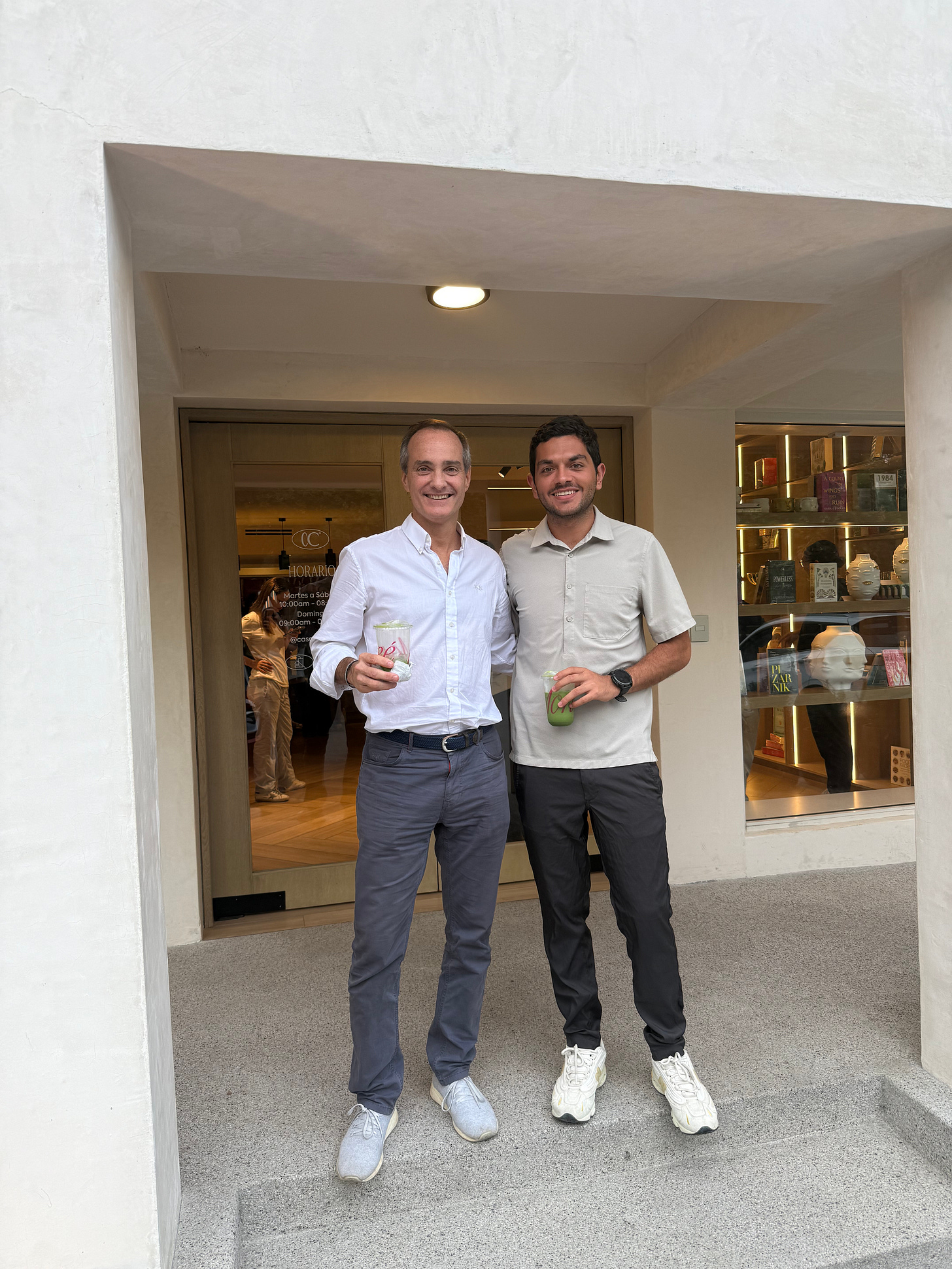
A few weeks later, his first-day message at Nowports thanked Alfonso de los Ríos and Maximiliano Casal for their confidence. He described the opportunity in terms of integrated logistics and financial solutions, reliable service, and digital and execution capabilities. He had moved into freight forwarding, but the vocabulary already sounded familiar. Technology would have to earn its place in an operation serving real customers.
A founder hands over the controls
De los Ríos announced Poitevin’s promotion to CEO in April 2025. He credited the incoming leader with operational change since joining as COO: clearer decisions, faster processes and a more focused team. De los Ríos moved into the president’s role. Later, reflecting on the transition, he wrote that the company needed the operational discipline and maturity Poitevin brought. A founder was making a choice about the kind of leadership the next phase required.
That choice is an interesting part of Poitevin’s story. He entered a business someone else had founded and helped it work through a different stage. The job carried a particular tension: preserving the energy that creates a company while making its commitments more repeatable. A founder’s confidence is useful; a customer’s confidence has to be renewed shipment by shipment. They are acquired by different means.
By May 2026, Nowports’ operations were concentrated in Mexico and Chile, with partners providing international coverage. Poitevin’s explanation was direct: “nos enfocamos en mercados donde somos más fuertes” - we focus on markets where we are stronger. The remark sets a boundary around ambition. Physical presence, customer knowledge and execution capacity had to match the geographical plan.
For an executive whose career had crossed Argentina, Miami, Colombia and Chile, this was hardly an argument against working internationally. It was an argument for understanding the cost of doing so. A pin on a map is easy to add. The people and processes needed to serve that location have to be built. His task was to make the map and the organization correspond.
“nos enfocamos en mercados donde somos más fuertes”
Fernando Poitevin, May 2026
“We focus on markets where we are stronger.”
Give the machine the repetitive part
In June 2026, Poitevin joined Diego Rodriguez Paez on the LatAm UnBoxed podcast to discuss digital freight forwarding. He described artificial intelligence applied to prospecting, pricing and finance processes. His stated aim was to remove repetitive work so employees could spend more time on proactive customer attention. The discussion placed automation inside a service business, where speed matters but so does knowing who will answer when something goes wrong.
The distinction is practical. A price calculation is one task; understanding a customer’s urgency is another. Faster administration can create room for conversation, provided someone actually uses that room. Poitevin’s argument gives technology a clear test: whether it helps the team deliver. The appeal lies in its modesty. A tool does not need to be the star of the relationship to improve it.
His public account of an Ask Me Anything session with the Mexico team returned to proximity and face-to-face work. He also described a dinner with customers in Monterrey, where conversations covered their growth plans and adoption of AI. These are small scenes in the larger operational story: employees comparing concerns, customers explaining what comes next, an executive listening. The freight may cross an ocean; understanding the customer can require crossing a room.
The next handover
On September 30, 2026, Poitevin announced that he had left Nowports’ leadership. He thanked the founders, board and employees, described two intense years of learning, and wished Casal success as the new CEO. Early October reporting confirmed the transition. His farewell characterized Nowports as more mature and efficient after the changes. That is his assessment of the chapter he had just completed.
Casal’s return brings another emphasis: designing logistics around artificial intelligence. The sequence is instructive without requiring a verdict on either leader. Companies change their operating needs, and the person responsible changes with them. Poitevin’s time at Nowports can be understood as an assignment with a beginning and an end, rather than a title frozen on a biography.
The pattern across his career remains legible. He has worked where financial plans, operational systems and customer expectations meet. His public remarks repeatedly return to the execution that makes a promise believable. At El Dorado, the issue was time spent taxiing. At Nowports, it was how to organize people and technology around the customer. The setting changed. The troublesome minutes still needed someone’s attention.