The first temptation in digital logistics is to admire the screen. A rate appears. A route assembles itself. Somewhere, a container icon glides obediently across a blue map. Shihao Zhou knows what happens after the demonstration ends. A truck misses a window. A document waits for a stamp. One customer wants the cheapest sailing; another will pay for speed; a third refuses any route with a transfer. The software may be elegant. The cargo remains gloriously, expensively physical.
That gap between an attractive interface and an executed promise has occupied Zhou for more than two decades. Known in international business as Cash Zhou, he is the founder and chief executive of YQN Logistics, the Shanghai-born digital freight company. Its online platform compares rates, takes bookings, and follows orders, while the organization behind it handles the distinctly offline business of ocean, air, rail, trucking, customs, warehousing, insurance, and delivery.
Zhou arrived at freight by way of international trade. He studied the subject at university, worked in the field after graduating, and noticed that his customers’ most persistent difficulties gathered around delivery. Trade begins with an order, but it becomes real through fulfillment. In 2005 he entered logistics and, along the way, operated a logistics company of his own. By 2012, he had diagnosed the constraint: pricing, service matching, documents, and fulfillment moved through a business with too little shared information and too little standardization.
A crisis with useful instructions
YQN’s earliest form was not the one that survived. Before the transaction platform launched, Zhou’s team made software-as-a-service products and social tools for shipping professionals. In 2014 the company tracked the familiar digital measures - users, activity, retention - yet found itself in trouble. Attention did not move a box. Engagement did not guarantee that anyone could complete the job.
Zhou contacted Cao Yi, the founding partner of Source Code Capital, through a direct message on Weibo. The reply contained a proposition and, implicitly, a dare. Move into transactions. Take responsibility for fulfillment. Build standards and processes by doing the work. It would be the hardest mountain, Cao argued, and therefore the most defensible.
“Without fulfillment capability, rapidly scaling users through subsidies is meaningless.”The lesson behind YQN’s 2014 pivot
Zhou accepted the difficult version of the business. Source Code made its first institutional investment, and in 2015 YQN emerged as a one-stop international logistics transaction platform. The choice explains nearly everything that followed. A freight booking is not a completed product; it is the moment the product begins. Tracking, supervision, customer service, documents, and exception handling belong inside the experience. Price matters, but Zhou calls it a label for service rather than the service itself.
The operating route
The intelligence of a steel box
Zhou’s philosophy of technology is unusually unseduced by theater. He has pointed to the shipping container as a consequential invention: sheets of steel made into a standard box. Its power is not that it resembles science fiction. Its power is that it can be repeated, stacked, transferred, counted, and understood around the world. For logistics technology, Zhou favors the same tests. Can it lower cost? Can it improve efficiency? Can it be deployed at scale?
This is why YQN’s work lives in the connections. A customer specifies cost, speed, and route preferences. Carriers have changing capacity. Ports, trucks, warehouses, customs systems, and overseas agents each hold a piece of the truth. The platform’s job is to turn those scattered facts into a usable match, then keep the promise after the match has been made.
The sketch becomes a system
Zhou compares end-to-end digitization with drawing: begin with marks in separate places, deepen one area, connect the outlines, and only gradually reveal the complete picture.
The metaphor is more honest than the usual promise of frictionless commerce. Logistics is a long chain, and its data sits with many participants. Every new port or supplier connection takes work. Every country brings different service infrastructure and a different appetite for digital methods. A global office may look like a pin on a map; Zhou describes it as a node joining online demand with local supply.
Capital arrived as the model proved itself. YQN completed a $70 million Series C in 2019. By the end of 2021, reports described seven financing rounds and more than $300 million raised in total, including two substantial Series D financings that year. Zhou said the money offered a reserve against uncertainty and room to recruit and reward talent. The company had climbed the investor’s mountain; now it had to avoid tumbling down the fashionable side of it.
Where the cargo asks you to go
YQN expanded rapidly in 2018 and 2019, establishing companies in more than ten countries. Zhou later called it a period of “passionate expansion.” His description of the next phase was cooler: rational, deeper, steadier. By 2023, YQN said it had 25 global branches, ten of them overseas, and more than 1,500 employees. After acquiring California-based COPE in 2022, it also had 13 foreign warehouses, mostly in the United States and Canada, extending its reach into bulky e-commerce goods and last-mile delivery.
The operating rule is pleasingly plain: “We go where the shipping needs are.” Manufacturing has spread into new hubs. Chinese businesses have expanded through Southeast Asia, Latin America, the Middle East, and other markets. Customers moving components, machinery, consumer products, and raw materials need networks that follow those routes. YQN’s task is to make its digital system consistent while allowing local teams to handle the details no universal dashboard can wish away.
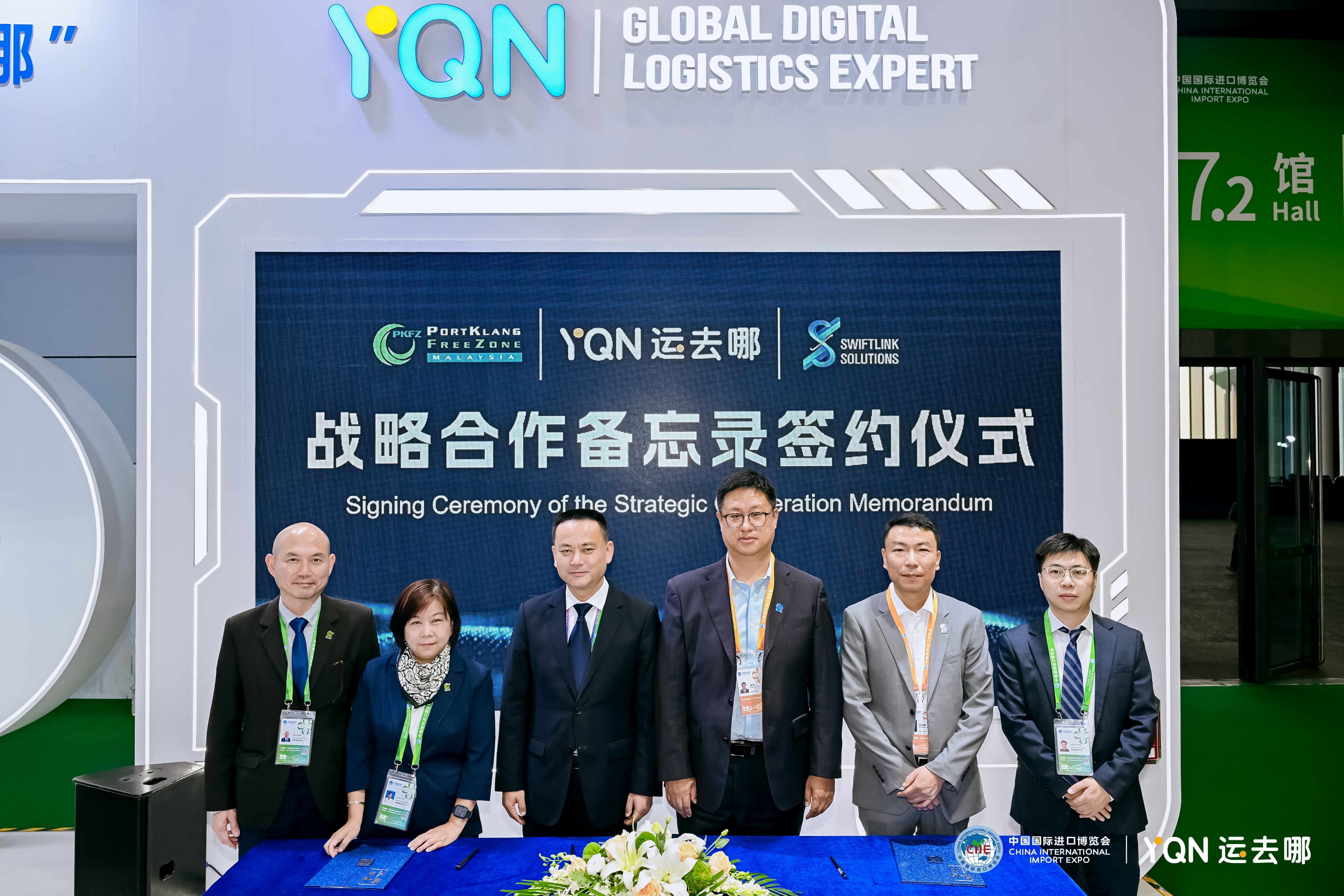
At the 2025 China International Import Expo, that logic appeared in a partnership with Malaysia’s Port Klang Free Zone. YQN proposed connecting its customs declaration system with the free zone’s digital platform so shipment data could pass to carriers and authorities, with a projected clearance saving of up to 24 hours. Zhou used the occasion to speak about taking Chinese logistics overseas. The grand theme was globalization; the tangible deliverable was one day removed from a customs process.
“We don’t pursue growth by piling on people.”Shihao Zhou on YQN’s overseas buildout
The sentence reveals both economy and ambition. Zhou does not dismiss people; he wants their work aimed at judgment, trust, and exceptions rather than repetitive handling. Inside YQN, document preparation was once estimated to consume 40 to 50 percent of the time spent on a single order. Connecting systems, reading forms automatically, generating route plans, and tracking orders can release employees from some of that repetition. The remaining work is often the human kind: reassuring a customer, negotiating an anomaly, understanding why a supposedly standard shipment is anything but.
An algorithm with mud on its shoes
Zhou’s current view of artificial intelligence follows the same practical line. AI can combine large datasets, predict congestion, monitor containers, and estimate time and cost. Automation already works in controlled ports and large warehouses. Open logistics routes are less obedient. Small facilities face cost constraints; specialized cargo varies; custom orders still require manual handling. He once joked that he did not want to force the fashionable “AI” label onto YQN, even while noting that it maintained a dedicated algorithm team.
His management language is equally procedural. For incremental innovation, new employees can tackle new work while experienced colleagues protect the core. When the change is directional, veterans should lead because they understand how the old logic behaves under new conditions. Move in small steps, test, verify, then enlarge. In hiring, he has named intelligence, pragmatism, and loyalty: understand the need behind the stated need; do not let a link in the chain fail; use ability in service of the group.
There is a modest wit in Zhou’s favorite subject. He calls logistics fun, although its pleasures appear to involve customs forms, capacity imbalances, and the possibility of a warehouse becoming a very expensive waiting room. Yet the attraction is understandable. Few industries offer such a complete argument between the abstract and the real. Data says the vessel will arrive. Weather, labor, politics, and physics are invited to respond.
The aspiration behind YQN is not to abolish that argument. It is to make more of it visible, earlier. A shipper who can compare choices, plan against a plausible schedule, trace a container, and understand each charge possesses something more valuable than the illusion of control: the ability to decide. Zhou’s career has been an extended exercise in producing that ability, first by learning the physical trade, then by bringing its participants onto a common system.
The screen still matters. It is where complexity can become legible. But Zhou’s lasting insight was earned when his early digital metrics met the blunt fact of fulfillment. The company had to step through the interface and into the transaction. It had to accept the documents, the delays, the people, and the ports. The hardest mountain was made of ordinary work. That, of course, is why it was worth climbing.