Before there was a company to sell, there was a university employment office. During an exchange in New York, Fernando Leibowich Beker began applying for jobs available to students. An Indian company offered him work at its Latin American operation in Mexico. He accepted. In his later telling, he took care to specify the capacity in which he arrived: as an employee.
It is a useful beginning for a founder’s story. The business plan did not precede every border crossing. A course of study opened a job search; the job search opened another country. Beecker, the automation company he would eventually sell, came after the move. His route into entrepreneurship had room for a salary, corporate experience and somebody else’s organizational chart.
By 2023, back at the Universidad de Palermo speaking to students and graduates, he could describe the other end of that journey: building a company with the intention that it should be sellable. A business needed value of its own. Ownership could change. The work had to survive the change of name on the paperwork.
A programmer learns to explain
Leibowich Beker’s relationship with software began earlier. He dates his first programming to age 11 and his first teaching to 16. While still at technical secondary school, he co-founded LID Software. He graduated from Buenos Aires’s Otto Krause in 1999, specializing in computing. The school years already contained two occupations he would keep returning to: making things work and explaining how they worked.
At the Universidad de Palermo, where he studied from 2000 to 2005, he combined his degree with full-time employment. In an early recollection, he singled out a small courtesy: the university would tell him when a professor was going to be late. Even a telephone call about a delayed class mattered to someone fitting study around work. The detail has more personality than another line of credentials.
He became a teaching assistant in programming and data structures, then taught after graduating. His professional career included Accenture, where he worked in consulting. Later came an MBA at Palermo and the New York exchange. Studying, working and teaching overlap in his account; they were activities he was managing together, rather than successive lives neatly packed away.
- 1999Otto Krause graduate
- 2013Beecker founded
- 2022Beecker sold
- 2025Lidd–UDB agreement
The bank form becomes the product
He founded BeeckerCo, originally Beecker Consulting, in Mexico in 2013. Banking processes supplied the work. Its consultants helped clients automate internal tasks, using business process management and robotic process automation. The terminology had plenty of capital letters. The underlying concerns were recognizable: an application that took too long, a task passed between teams, a customer waiting for an answer.
Working inside those processes exposed a constraint of consulting. A team could become skilled at improving a workflow while still depending on tools selected by the client and made by other companies. Expertise in the problem did not automatically confer control over the product used to solve it. Beecker began developing software of its own.
BeBOP, short for Beecker Banking Origination Process, addressed account opening and credit origination. Leibowich Beker described customers abandoning loan applications because the process became cumbersome. The product brought together simpler workflows, interfaces and connectors. That move, from handling assignments to packaging a recurring solution, became a defining turn in the company’s development.
The scale changed too. In his account to Palermo, a venture begun with three people had grown past 100 within five years, operating in four countries. The university later described Beecker as having more than 300 employees. Those are different moments in its growth, rather than a single snapshot. By then, the founder had a business whose headcount required more than a quick look around the room.
Account opening + credit origination
A recurring banking problem became software of Beecker’s own.In 2018, Palermo gave him a special mention for professional achievement in entrepreneurship. That same year, he presented a corporate-loan process demonstration at bpmNEXT. The demonstration combined a state machine with business rules: a technical view of how a loan could move from one stage to the next. Behind the company story, there was still a programmer explaining the machinery.
Built with the exit in mind
The sale was part of his thinking about how to build. Returning to Palermo in 2023, he described a company designed to have independent value. His account of the commercial decisions was equally concrete. He emphasized specialization, learning from businesses that had failed, and pricing that could remain competitive through economies of scale.
He also emphasized profitability. “Siempre traté de vender con mucha rentabilidad,” he said: he always tried to sell with strong profitability. In his explanation, margins provided room to withstand future blows. The combination is revealing. A lower selling price and a healthy margin were objectives he wanted the business model to reconcile.
“I still think of myself as an entrepreneur.”
Fernando Leibowich Beker
Translated from Spanish
He sold Beecker to an American investment fund in 2022. His personal account identifies Brookline Partners. The transaction completed a business intention he had articulated clearly: the company should be worth owning beyond his own ownership. When he returned to speak with students, there was a completed sale behind the advice.
There is an appealing lack of romance in the mechanics. Specialize. Price carefully. Protect the margin. Make the enterprise saleable. These are instructions that can survive contact with an invoice. His continued preference for calling himself an entrepreneur suggests that selling one company did little to settle the question of what to build next.
The classroom stays open
Alongside the businesses, he developed an educational institution. The Instituto de Posgrado en Inteligencia Artificial, or IPIA, grew out of the Kirjner educational initiative. Based in Cuernavaca, it became a place where his interest in software met the work of preparing people to manage it. He serves as its president.
The institute retained its independence after Beecker’s sale. That is a consequential detail in a career organized around companies: the educational work had a continuity of its own. Its current offerings include an executive MBA in artificial intelligence, a doctorate in AI and executive programs for corporate teams.
His own education extends beyond computing and the MBA to a doctorate in administration at Universidad Internacional in Mexico. His academic profile connects that work with questions about organizations and knowledge. The relationship between technology and the people expected to use it has occupied more than one part of his working life.
His CloudShore concept gives that interest a name. He describes humans and digital workers operating together in the cloud, using automation and process technologies. It is an ambition linking a software business with an educational one: build systems that can perform work, and help people understand how to direct them.
The next bottleneck is human
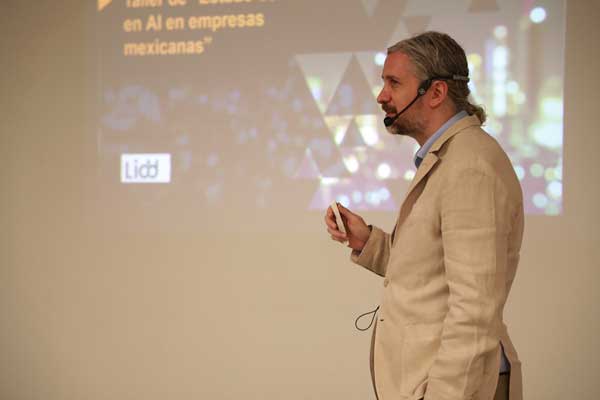
His current company is Lidd AI, co-founded with Héctor Rosado in 2023. Leibowich Beker is its CEO. The company works on enterprise AI, observability and turning services into software. Observability concerns understanding what is happening inside a running technology system. For a business that depends on the system, that understanding becomes part of keeping operations working.
Lidd’s work received the LATAM recognition in Grafana Labs’ 2025 Partner Awards. Its announced projects covered enterprise customers in Mexico, Peru, Colombia and Chile. The geography fits a career that has repeatedly crossed national borders, while the specialization keeps the commercial proposition focused.
The resemblance to Beecker is in the movement from knowledge carried by people into something repeatable. Lidd organizes work around discovery, building and running systems. Its current description of incident handling includes detecting a problem, using AI to write a correction and having a human engineer authorize it. There is still a person with a decision to make.
A description of the company’s approach, not a performance forecast.
In February 2026, Leibowich Beker argued that useful enterprise applications could be built with existing AI, without waiting for artificial general intelligence. The emphasis was on specific tasks and available tools. For someone whose earlier product concerned the progress of a bank application, it is a consistent place to direct attention.
By June, he was discussing an obstacle closer to the organization itself: its capacity to learn. Established companies could recognize the possibility of greater productivity and still hesitate to change working arrangements while financial results remained satisfactory. Software could move faster than the institution buying it. His educational work gives that observation a practical connection to his business.
Another signature, another classroom
On September 11, 2025, he signed a cooperation agreement for Lidd with Universidad Don Bosco in El Salvador. The agreement made provision for training, applied research, technology transfer and collaboration between the university and industry. It connected a company looking for talent with students preparing to use their engineering, data and programming skills.
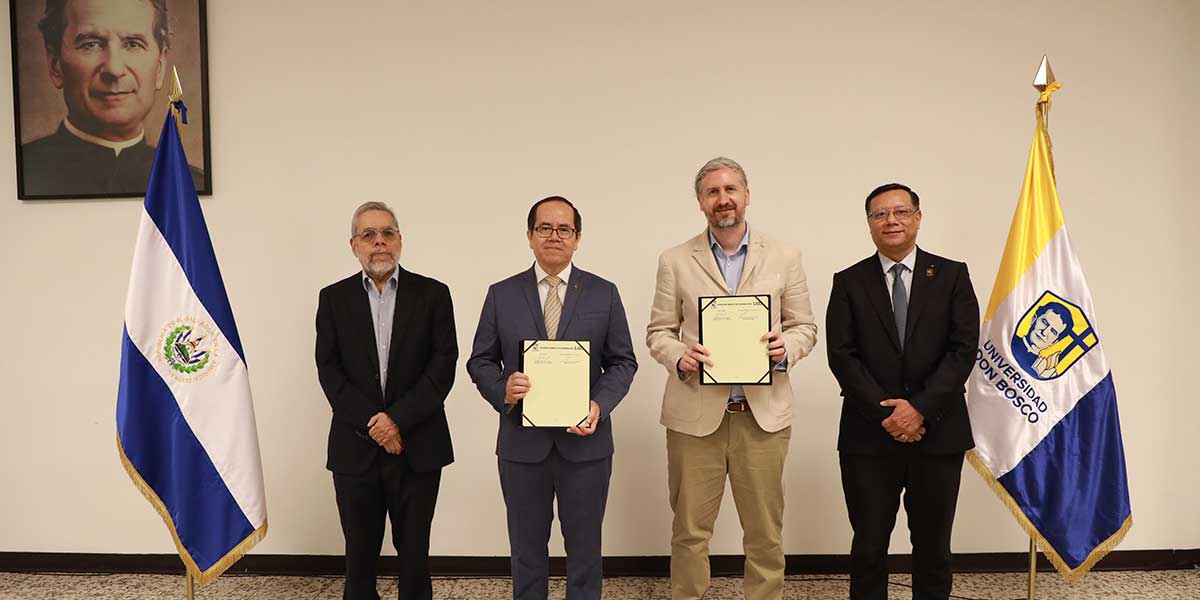
He also gave a talk to students and faculty about AI applications. Signing the agreement was one task; standing in front of a class was another he already knew. He spoke about finding talent and establishing a relationship that could support research together over time. The business visit included a reason to return.
That makes a fitting scene for this chapter of his career: a founder holding an agreement, then taking up a microphone. He had sold Beecker. He was building again. The work still required people who could understand a system, question it and make it useful. After all the changes of company, country and software, he was back explaining.
Follow the work
Fernando’s projects, conversations and a look inside the banking software.