In May 2015, Feng Lee opened a small issue on GitHub. It concerned a problem familiar to anyone who has hosted a party: knowing who is actually there. His guests were MQTT clients. He wanted their connections registered, their arrivals and departures announced, and a dashboard that could show the room. Four lines of proposed work, with very little ceremony. Years before EMQ was discussing artificial intelligence, its creator was attending to the guest list.
It is a useful place to meet him. Lee is the co-founder and CEO of EMQ, the company behind EMQX, a messaging platform for connected devices. His professional life includes communications protocols, a programming language and the business of keeping software useful to other people. The business has grown around a particular engineering concern: what happens when a great many things need to communicate at once?
The dates give the story its shape. EMQ places the software’s Apache 2.0 launch in 2013 and the company’s establishment in 2017. Before the organization came the thing people could use. That interval matters. A repository can travel before its creator has assembled a sales operation, an international office network or a boardroom explanation for what happens next.
Before the incorporation papers
Lee’s earlier work was already concerned with communication at a level most users never see. At Huawei, he worked on core communications protocol stacks. He also founded an enterprise software business before the EMQ project. This was a route through the plumbing of technology: the rules, software layers and exchanges that let more conspicuous products function.
The earliest EMQ project website dates its creation to 2012. Later company accounts use 2013 for the launch. The distinction leaves a straightforward sequence: a project taking shape, a public software release, and then a commercial company. It also keeps the beginning in proportion. EMQ’s business history starts after Lee had already begun the engineering work.
He built around Erlang/OTP. Erlang grew out of telecommunications and was designed for systems that have to keep numerous activities running concurrently. Its attractions for messaging include distribution and tolerance of failure. These are practical qualities when the connected world consists of devices that can disconnect, reconnect or send information at inconvenient moments. Software has to accommodate the interruptions without treating each one as a philosophical crisis.
MQTT organizes messaging through publishing and subscriptions. A device can publish information on a topic; interested clients subscribe to receive it through a broker. The arrangement reduces the need for every participant to maintain a separate conversation with every other participant. For Lee, the broker became the center of a software project with applications well beyond a single kind of device.
The early GitHub discussions preserve the texture of that work. In June 2015, Lee raised another question: what happens when two clients use the same identifier? They could keep displacing each other as they tried to reconnect. The resulting discussion dealt with identity and sessions. It was the sort of problem that sounds minute until two machines spend their afternoon insisting they are the same guest.
A language inside the messaging business
By 2020, Lee was working on another layer of the problem: the language developers used to build reliable programs. EMQ announced the first public release of Hamler in June and credited him as its designer. Hamler brought Haskell-style syntax and compile-time type checking to the Erlang virtual machine. The ambition was to catch certain mistakes earlier while keeping the runtime’s facilities for concurrent, distributed applications.
This was a specific response to years spent building Erlang systems. EMQ’s announcement described a desire for a stronger compile-time type system and friendlier syntax. Lee and his colleagues were trying to improve the tools with which they did their everyday work. A programming language is an unusually demanding expression of dissatisfaction. Most people settle for complaining about the existing one.
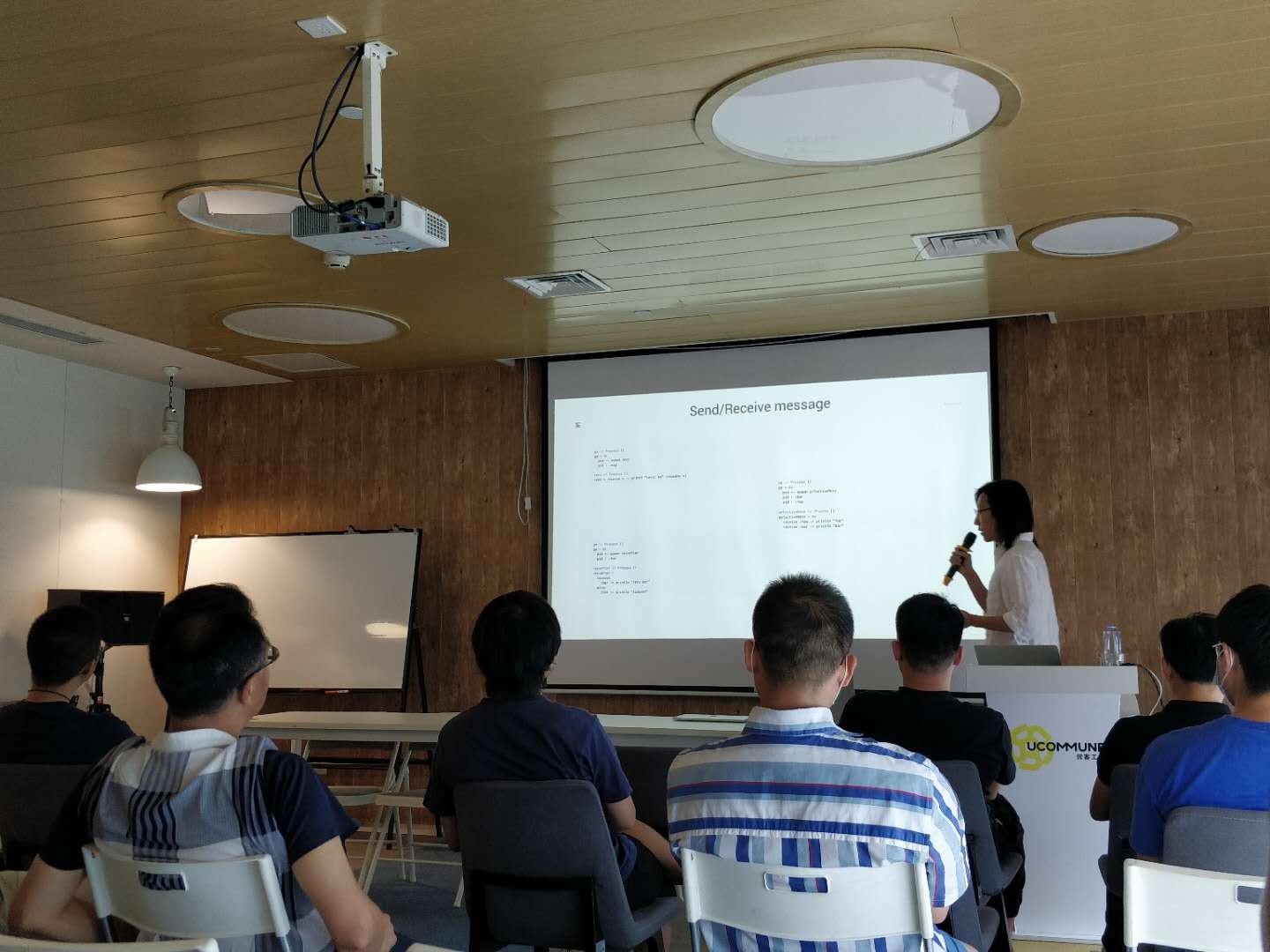
At an August meetup in Chengdu, Lee introduced Hamler to developers. In the event photograph, he stands beside a projected code example while the audience sits close enough to examine it. The scene supplies a more useful portrait of his work than a list of executive titles. Here was a company founder explaining the machinery, with a screen full of material that would have to survive contact with a compiler.
Hamler also places Lee among collaborators. The release credited Yang M with the compiler, along with contributors responsible for documentation, tooling, the website and its identity. Even a language associated with a named designer needs people to make it usable. The credits offer a compact account of how an engineering idea becomes something another developer can pick up.
A hundred million is a test, too
EMQ’s growth brought a different kind of evidence. A 2018 conference presentation on MQTT brokers counted 1,970 commits by the project’s author out of 3,147 recorded commits. The figures capture a particular historical snapshot, rather than a permanent measure of contribution. They nevertheless put substance behind the description of Lee as the project’s creator. There was a considerable amount of code underneath the title.
In 2022, EMQ reported that EMQX 5.0 could handle 100 million concurrent MQTT connections in a single cluster in a scalability test. The setting is essential to understanding the number. A benchmark describes what a system achieved under test conditions. A customer deployment brings its own traffic patterns, hardware choices and operational demands. The achievement was a demonstration of capacity, with the work of applying it still attached.
Concurrent MQTT connections in one EMQX 5.0 test cluster.
Reported benchmark capacity; separate from deployed-device totals.Lee’s company also backed the technology community underneath that capacity. EMQ became a founding sponsor of the Erlang Ecosystem Foundation in July 2022. Lee’s accompanying statement made the attachment plain:
“We’re passionate about Erlang and will continue making contributions to Erlang frameworks and toolsets.”Feng Lee · July 2022
The commercial task was becoming broader than performance. EMQ joined the AWS Partner Network’s Global Startup Program and made EMQX Enterprise available through VMware Marketplace. Those moves concerned access, deployment and the places enterprise buyers already worked. A messaging platform has to fit into purchasing and infrastructure arrangements as well as it fits into an architecture diagram. Procurement is rarely invited to the product demonstration; it still gets a vote.
The developer detail continued alongside the enterprise work. The MQTTX 1.9.4 changelog credits Lee’s GitHub handle, emqplus, with reviewing and updating the manual. It is a small contribution to mention in a CEO profile, which is precisely its attraction. Documentation is one of the places where a useful product can become an awkward one. Someone has to read the instructions before the next person is obliged to follow them.
The price of an open door
In May 2025, Lee faced a decision that went beyond the next feature. EMQ announced that EMQX 5.9 would combine the community and enterprise editions into a unified platform under Business Source License 1.1. The project that had started under Apache 2.0 was changing the terms on which its software could be used in production.
Under the announced model, the code remained available to inspect and modify, with commercial-use restrictions. Each version was scheduled to move to Apache 2.0 after four years. The additional use grant included free single-node production deployments, while other uses depended on the license terms. Source availability and unrestricted open-source permissions carry different implications for an organization choosing its infrastructure.
Lee presented the decision as a way to concentrate development and support further investment in MQTT and AI. It put a business question directly into the technical story. Maintaining a widely used platform creates recurring obligations: releases, compatibility, support and engineering work whose costs continue after the original download. The license change made those obligations visible in the relationship between the company and its users.
For a founder whose work reached people through an open project, the decision has particular weight. An invitation to use software creates expectations. Sustaining the organization creates requirements of its own. The 2025 transition belongs in any account of Lee’s achievements because it shows the choices that accompany them. Keeping a project alive can require decisions as consequential as the ones that brought it into existence.
Back in Hangzhou, looking toward the devices
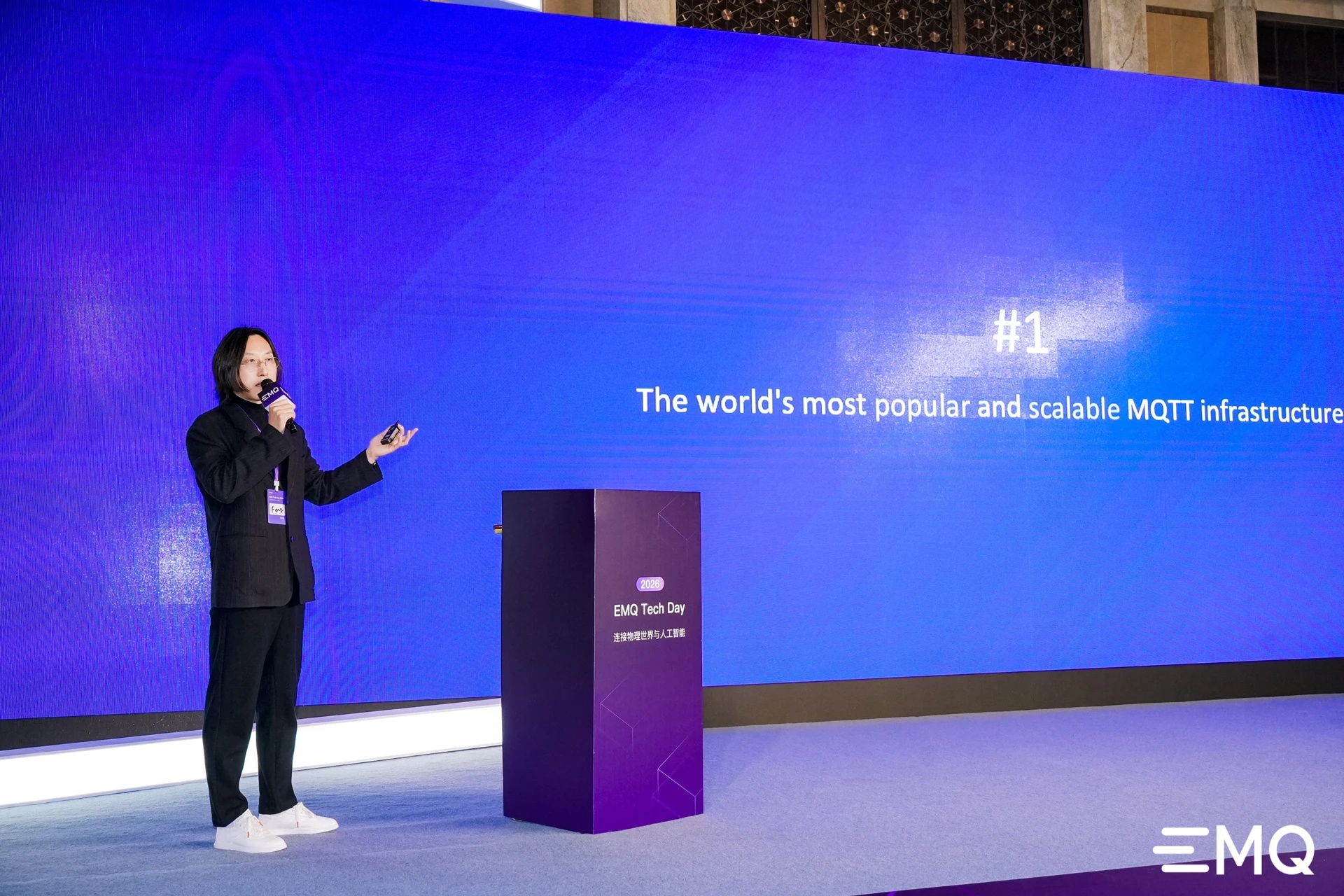
In March 2026, Lee stood on a stage in Hangzhou at EMQ Tech Day. His subject was the connection between the physical world and AI. The direction included device agents: a way of making a device’s capabilities available for AI systems to call and coordinate. It extended the company’s concern from moving messages toward helping software act through connected equipment.
In October, EMQ announced its first customer transaction through Oracle Marketplace. Lee’s statement emphasized making the platform easier for enterprises on Oracle Cloud Infrastructure to adopt. The news brought the story back to a familiar founder’s obligation: helping the thing he built reach the organizations prepared to use it.
The distance between that marketplace and the 2015 GitHub issue is considerable. Yet the earlier question remains legible. Which clients are present? How do messages reach them? What can another system safely assume about a connection? Lee’s career has accumulated a company, collaborators and commercial decisions around such questions. The guest list has become much longer. Somebody still needs to know who is in the room.