Before Felix Kim had a company built around crossing borders, he had the less glamorous experience of being crossed by them. He has described himself as an introverted child who moved constantly between countries, meeting each arrival with the cultural puzzles and playground cruelty reserved for the visibly unfamiliar. The child does not yet know the phrase “information asymmetry.” He only knows that everyone else has received a handbook he cannot see.
Years later, Kim would give the problem a founder’s vocabulary. Context travels badly. A university that signals prestige in Delhi may mean very little to a hiring manager in Seoul. A job title in one market may imply a completely different level of responsibility in another. An excellent candidate can look ordinary after crossing an ocean, while an ordinary candidate with familiar signals glides through. Kim’s company, Redrob, is an attempt to repair that translation layer.
The route into artificial intelligence was crooked enough to be interesting. Kim studied business at Yonsei University, spent time at the Georgia Institute of Technology, returned to Yonsei for law, and built a legal career in Seoul. Public profiles place him on the board of the Seoul Bar Association. The habits of that profession are still visible in the founder: define the terms, assemble the evidence, and persuade a skeptical room that the bridge between two positions can bear weight.
“As an introverted child who moved constantly across different countries, I faced cultural challenges and bullying.”Felix Kim, on the experience behind Redrob
Six years before the applause
In 2018, Kim left legal practice and started McKinley Rice, the company that became Redrob. It began in the practical machinery of international hiring: skill tests, recruitment services, employer-of-record work, and the administrative details that make global talent possible after the keynote ends. He relocated to India and bootstrapped. For roughly six years, there was no cinematic leap from idea to abundance. There was work, then more work, with the product changing as the problem came into focus.
That slow beginning matters. Startups like to speak in compressed time, as if the world changed between two funding announcements. Redrob’s history is a rebuke written in invoices. Its founder learned the needs of employers who could not compare candidates, sales teams that could not locate decision-makers, and workers whose credentials lost meaning at customs. The products shifted, but the motif did not: convert unfamiliar people into legible opportunities.
The first outside round arrived in 2023: $4 million, co-led by Murex Partners and DS & Partners. In November 2025, Redrob announced a $10 million Series A led by Korea Investment Partners, with KB Investment, Kiwoom Investment, Korea Development Bank Capital, Daekyo Investment, and DS & Partners participating. The company put its total funding at $14 million.
Capital is often mistaken for the plot. Here it is better understood as punctuation. The plot is a Korean former lawyer building an India-focused operating base while running a company headquartered in the United States. Seoul supplied legal formation and investor relationships. India supplied users, engineering talent, and the pressure test for affordability. San Francisco and New York supplied proximity to the commercial market Redrob wants to enter. The corporate atlas looks untidy. So does the problem.
Context is infrastructure
Kim’s public explanation of Redrob sounds less like a software menu than a theory of social friction. The company started with online skill tests and employer-of-record services, then widened into global people search. Its sales product promises verified contact data and outbound workflows. Its hiring products assess skills and help source candidates. Passport, a newer product, is designed to translate educational and professional credentials across 190 countries.
The temptation is to see a collection of adjacent products. Kim sees one missing layer. People and companies on opposite sides of a border possess facts about themselves, but facts without local meaning are weak signals. A Korean executive may not know what an Indian transcript implies. An Indian graduate may not recognize a Korean industrial employer. Each side can search for the other and still fail to understand what it has found.
“Redrob exists to build the bridge - AI that speaks both sides.”Felix Kim, New Delhi, April 2026
This is where the lawyer’s career and the immigrant child’s memory meet the database. Law is a technology for making claims portable. A contract allows two strangers to agree on the meaning of a future promise. A credential is supposed to perform similar magic for ability. Kim’s critique is that the spell breaks across jurisdictions. Redrob wants algorithms to restore enough context for trust to begin.
The price of a language
By 2025, Redrob’s pitch had expanded from cross-border people data into the economics of AI itself. Kim argues that frontier models inherit the purchasing power, language patterns, and infrastructure of the wealthy markets that built them. A subscription that is modest in California can be absurd in Pune. Tokenization that works efficiently in English can make Indian-language use more expensive. The technical design arrives carrying a geography lesson.
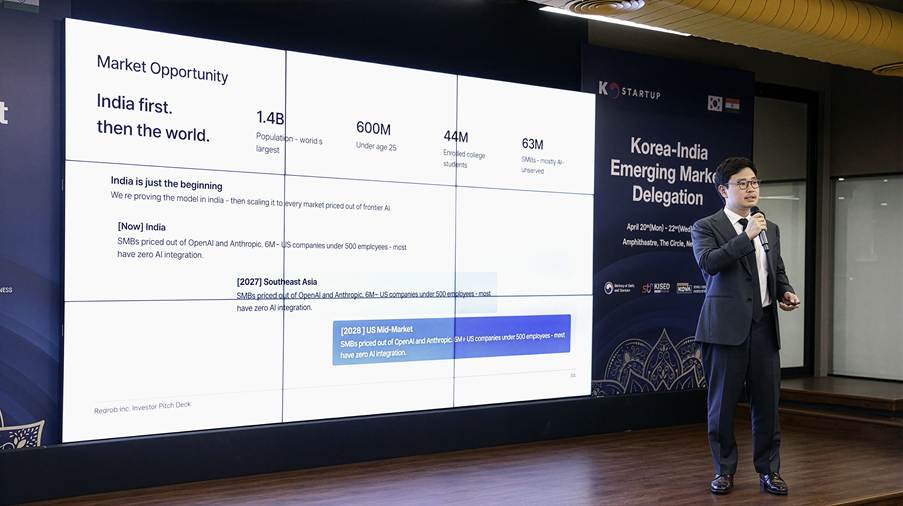
At a Korea-India delegation in Gurugram in April 2026, Kim presented an alternative. Redrob would adapt open-source models for Indian languages, route different kinds of work through an ensemble, and connect the models to applications in hiring, sales, credentials, and employment. The company’s stated sequence was India now, Southeast Asia by 2027, and the American mid-market by 2028.
The ensemble idea is pleasantly thrifty. Not every query needs the computational equivalent of a grand piano dropped from a crane. Summarizing a document, reasoning through a difficult question, and generating an image place different demands on a system. Route each task to suitable machinery and the bill can fall. Years of bootstrapping have apparently survived as architectural taste.
Redrob describes its current model stack as a five-model ensemble on AWS Bedrock, including versions of Llama adapted with LoRA for 22 Indian languages and FLUX for image generation. Its wider suite includes HR, go-to-market, Passport, and employer-of-record applications. These are company claims, and their durability will be decided by customers rather than conference slides. Yet the strategy is coherent: begin with useful work, make the inference cheaper, and let distribution through campuses and businesses compound.
That distribution is not incidental. Redrob says it partners with 500 Indian universities, departments, and colleges and serves more than 3 million users. The company has pitched free AI access to Indian students and announced products that follow them from campus into work: skill credentials, job search, hiring, and sales. A student who learns with the product today may become an enterprise buyer tomorrow. The funnel has the patience of an educational institution and the appetite of a software company.
A corridor with no signs
Kim’s most concrete stage arrived in New Delhi in April 2026. At the Korea-India Talent Exchange & Startup Fair, organized by Korea’s Ministry of SMEs and Startups and the Korea Institute of Startup & Entrepreneurship Development, he addressed hundreds of professors and students. The room offered a tidy demonstration of his larger argument: Korean companies are expanding in India, Indian graduates want international work, and neither side has enough shared context.
“The Korea-India talent corridor is one of the most consequential in the global economy right now,” Kim said. “But it has no infrastructure.” His examples were deliberately ordinary. A Korean CEO cannot interpret every Indian transcript. An Indian engineering graduate may know little about an industrial company inside a Korean conglomerate. Opportunity exists, but it is poorly labeled.
Kim’s personal connections now mirror that corridor. His investors include Korean institutions. Redrob’s chief operating officer, Kartikey Handa, leads India operations. Enterprise customers named by the company include Robostar, associated with LG Electronics, and Hanwha Vision. The platform’s campus network supplies a view into how Indian students represent their skills. Each relationship adds another dictionary to the translation project.
There is an obvious tension in building a people-data company around trust. Contact discovery, candidate assessment, and automated outreach all raise questions about consent, bias, provenance, and the difference between being discoverable and being watched. In a 2024 interview, Redrob said it prioritized data privacy and had patents pending around privacy and cross-border AI. The lawyer-founder’s second act will be judged partly by how carefully the company handles the evidence it gathers.
An introvert builds a network
The amusing detail in Kim’s story is not that an introvert became a public chief executive. Startups perform that conversion every day, with varying results. It is that his response to feeling foreign was to build machinery for meeting strangers at scale. The lonely child became interested in networks. The lawyer became interested in machine learning. The bootstrapper began talking about billions of users.
His public writing has grown more direct as the company has grown. He writes about the hidden “tax” paid by graduates whose institutions are unfamiliar abroad. He argues that job seekers should not have to send dozens of applications into silence. He promotes credentials that show what a person can do rather than merely where they studied. Across the posts, the recurring protagonist is someone capable but illegible.
That gives Redrob a sharper aspiration than the usual promise to make work efficient. Kim wants to change who gets interpreted generously. Software cannot abolish prejudice, and a score can become another gate as easily as it can open one. But the founder’s wager is that more context, carried cheaply across borders, can give ability a fairer hearing.
The next phase will test whether this story survives scale. Redrob has to deliver multilingual systems at the costs it advertises, earn trust around personal data, turn a broad suite into a comprehensible product, and expand without losing the local knowledge on which its thesis depends. Three continents offer perspective. They also offer three calendars, several regulatory systems, and meetings at hours polite society did not intend.
Kim appears comfortable with the complication. His career has been a sequence of translations: country to country, business to law, law to software, Korea to India, enterprise buyers to students. The company’s name is “border” written backward, a bit of startup wordplay that also reads like an instruction. Reverse the border. Examine what it hides. Then build the missing context until two strangers can recognize each other.