A canceled flight has an unusually efficient way of turning a competent adult into a person staring at a phone. There is the airline app, the hotel booking, the insurance policy somewhere in an inbox. Each contains a piece of the answer. None necessarily tells you what to do next. Faye has built a business around that gap.
- Travel insurance, live assistance and approved payouts share one app.
- U.S. residents can cover domestic and international trips, one journey at a time.
- A $50 million funding round is backing expansion and more claims automation.
The company’s proposition is easy to grasp: insurance should become useful while the inconvenience is happening. A reimbursement that arrives after a vacation can repair a bank balance. Money available during the vacation can help someone make their next decision. That difference in timing explains much of what makes Faye interesting.
01 / The wallet is part of the policy’s delivery
Faye launched its U.S. travel protection product in 2022. Its app puts policy information, flight alerts, human support and claim submission in one place. Approved reimbursements can go into Faye Wallet, whose travel card works with Apple Pay and Google Pay. Customers can also transfer wallet funds to a bank account.
There is an important little word in that description: approved. A fast payment mechanism does not make every disrupted trip eligible for compensation. It changes how an eligible benefit reaches the traveler. The policy still determines whether there is a benefit to deliver.
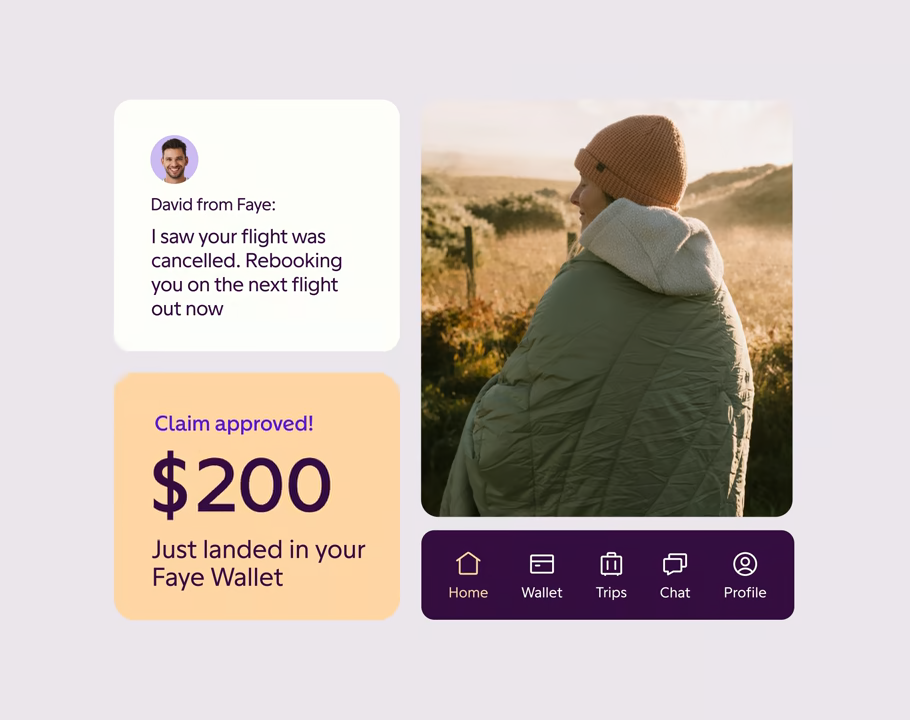
Flight monitoring gives the company another way into the problem. Once customers enter flight details, the app can flag delays, cancellations and gate changes. Instead of expecting the traveler to assemble every piece, Faye brings information and assistance closer together. Its competitive argument concerns the experience of using protection as much as buying it.
02 / Three trips should not mean one policy
The customer is a U.S. resident traveling at home or abroad. That includes a family holiday, a cruise or a more adventurous itinerary. It does not mean anyone living anywhere can buy a policy. Faye’s current FAQ also says it sells coverage one trip at a time; there is no annual plan.
In March 2026, Faye introduced three tiers. First is positioned for domestic trips. Forward increases protection for international travel. Flagship targets complex, multi-leg and luxury itineraries. The change gives customers and advisors a more explicit way to match the policy to the journey.
Coverage can address medical emergencies, cancellation, interruption, delays and belongings. Optional additions include extreme sports, pet care, rental cars and vacation rental damage. Air Doctor supplies access to telemedicine abroad. The useful question becomes quite specific: what might this particular trip require that another trip would not?
Price follows that specificity. Destination, duration, traveler ages, residence and selected extras affect the quote. There is no honest universal ticket price to attach to the company. Nor should a traveler assume that Cancel For Any Reason means a full refund: Faye describes partial reimbursement and purchase and cancellation deadlines.
03 / The people behind the purple shirts
Founders Elad Schaffer, Daniel Green and Motti Bebchuk sit behind a brand that wants to feel approachable. Schaffer is CEO; Green is CTO. Historical reporting dates the company’s origins to 2019, before the 2022 consumer launch. Its present operation pairs software development with the less photogenic work of claims and customer support.
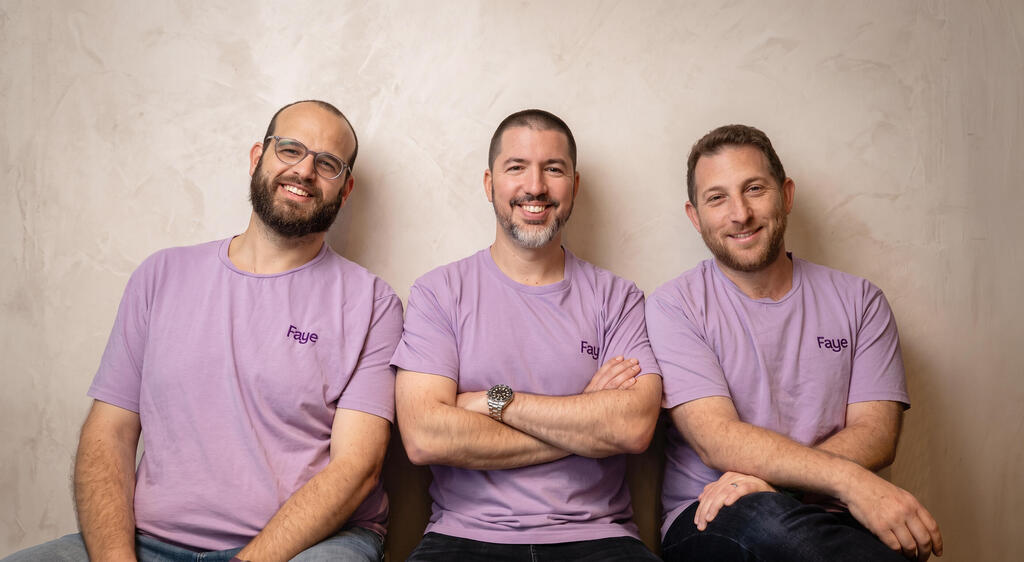
“It’s people who first and foremost truly care about the traveler.”Elad Schaffer, speaking to CTech in 2024
In May 2026, Faye opened a 6,100-square-foot U.S. headquarters in Richmond’s West End. Its local team had grown to about 60 people under Jeff Rolander, the vice president of customer experience and claims, who previously worked at Allianz Partners USA. Richmond offered something a polished interface cannot supply: experienced insurance people.
The legal machinery matters, too. Faye is a brand of Zenner, Inc. and related entities. Authorized carriers underwrite the insurance. Customers buy protection through a digital experience, but their coverage remains an insurance contract backed by a carrier. Faye competes in a market that includes established providers such as Allianz and Travel Guard.
04 / A second customer: the person who booked it
Faye also sells through travel advisors and other distribution partners. Its Advisor Portal lets agencies quote coverage, manage sales and follow claim status. An API supports integration into partners’ systems. Advisors earn commissions on policies they sell. For an agency, protection becomes another service attached to a trip it has already arranged.
That creates a business with two demanding audiences. Travelers want someone available when plans unravel. Advisors want useful coverage without another administrative obstacle. Putting both workflows on the same platform gives Faye a distribution route beyond persuading each traveler to discover the brand independently.
05 / The next claim might start without you
In August 2026, Faye announced a $50 million Series C led by Madrona, bringing its reported total funding to roughly $100 million. Planned uses included international expansion, travel partnerships and AI. Funding is the capital available for those ambitions, rather than evidence that they have already been fulfilled.
In a September article, Green said AI and other technology already automatically handled 30% to 40% of claims. He described a future in which the insurer detects a disruption, evaluates the relevant information and delivers help without making the traveler initiate every step. Those percentages are company-reported; the ambition still needs human judgment around difficult cases.
The lesson other businesses can copy is practical: put the next action beside the information that makes it necessary. Faye joins a flight alert to assistance, a claim to its status, an approved payout to a usable wallet. At an airport, with a suitcase missing and a connection gone, that is a sequence a customer can understand.