The first purchase was never really one click. A stranger still had to supply a name, an address and a card number. The magic came next: on another participating shop, perhaps on another device, the shopper could press a button and be done. Fast built a company around that second purchase. It also built the paradox that would undo it: to spare each buyer a few fields, Fast needed an enormous merchant network, a great deal of integration work and enough transactions to pay for both.
The short version
- Fast sold online retailers a checkout button that remembered shoppers across participating stores.
- It expanded from product pages into articles, ads and QR codes, and raised about $124.5 million.
- It closed in April 2022 after reported revenue stayed tiny beside its spending.
The origin story was ordinary enough to be good. Co-founder Domm Holland has described watching his grandmother-in-law fail to order groceries online because she had forgotten a password. His initial answer was a passwordless login prototype. The larger realization, in his telling, was that the web kept asking people to prove who they were from scratch. Fast Login came first. Fast Checkout followed: a reusable shopping identity with payment and delivery details attached.

The button was simple; the network was the product
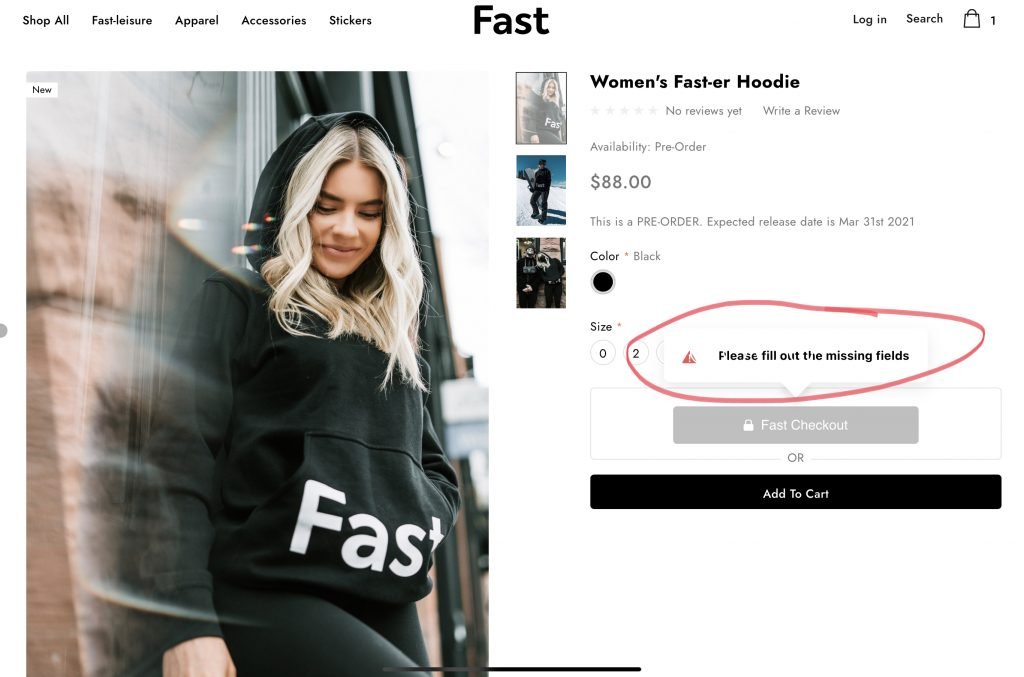
Fast Checkout launched with selected merchants in September 2020. A retailer could place its button directly on a product page, beside the usual Add to Cart control. A first-time shopper entered ordinary checkout details. On later visits to Fast-enabled stores, those details could be reused without another password or form. Fast also offered an order hub for tracking deliveries and reordering. Fast Login, its companion sign-in product, was described as free to use. In a 2020 interview, Holland described default US checkout pricing as 2.9% plus 30 cents per transaction, including card processing. Fast earned nothing merely for installing a button; completed purchases paid the bill.
That last phrase carried most of the business risk. A network becomes useful when a shopper meets it often enough to recognize it. Fast could promise compatibility with browsers and devices, but it still needed stores. It began on BigCommerce, added WooCommerce in December 2020 and later published code for other integrations. These were useful routes into the market. They were not the same thing as a dense network of high-volume retailers.
The field was already crowded. PayPal had a long-established button and consumer accounts. Apple Pay used its device base. Shopify's Shop Pay arrived with merchants built into its own platform. Bolt chased a similar cross-store checkout vision. Fast's pitch was to be broadly available and to know enough about an order to move the entire purchase, not merely provide a payment token. That distinction mattered when Fast took the button off the merchant's website.
“Our goal is to build a consumer network.”Domm Holland, speaking to Future Commerce in 2021
A checkout button leaves the checkout page
In September 2021, Fast announced what it called headless checkout. A reader could buy a product inside an article, a viewer could use a code in an ad, and a fan could scan a code at an arena seat. The company said Apartment Therapy and The Kitchn used the feature in select content. At AMALIE Arena, it worked with Vinik Sports Group to place QR codes on 10,000 cup holders. That is a wonderfully literal expression of the strategy: bring the register to wherever the impulse strikes.
The use case had real appeal for publishers, merchants and customers. A merchant could sell through an article without forcing the reader through a series of redirects. A publisher could make a product mention transact. A shopper could avoid another account. But each new setting also raised the operational bar. Fast needed the right product data, shipping rules, taxes, order handling and support connections behind what looked like a modest button.
On March 28, 2022, Fast announced a more conventional retail win. The Honest Company had placed Fast Checkout on product detail pages. The companies also discussed buying from articles, emails and codes on packaging, with repeat orders as an obvious fit. Fast described batching technology that could add purchases to a single order during a brief window. These were specific product ideas, not just a slide about frictionless shopping.
The financial form had more fields
Fast raised $20 million in a 2020 Series A led by Stripe, then $102 million in a January 2021 Series B, also led by Stripe. Its last reported valuation was around $580 million. The big round let Fast hire for the network it meant to build. It also set a clock running. The Information later reported about $600,000 in 2021 revenue and cash burn of roughly $10 million a month for much of the period. Those figures are reports, not audited accounts, but even generous rounding cannot erase the scale of the gap.
Fast had reportedly told The Information it counted about 700 retailer customers by autumn 2021. That sounds respectable until the question changes from How many stores signed? to How many orders passed through? A merchant integration can consume engineering time even when it produces little transaction revenue. Former employees later described daily sales summaries too small to justify the workforce and custom work for small clients. The problem was visible in the unit of measure: merchant logos were arriving faster than merchant volume.
By late March 2022, Fast was looking for fresh capital, then reportedly explored a sale. Its Honest Company announcement and its financial crisis occupied the same week. On April 5, it announced the company would close. Around 450 employees lost their jobs, according to Axios. The button disappeared from checkout soon after.
What survived the click
Fast is often reduced to a burn-rate cautionary tale, and the arithmetic is hard to ignore. But the product question is more interesting. Passwords and repetitive checkout fields remain annoying. Buying directly from a useful article or from a reorder code can be genuinely convenient. Fast proved that those experiences could be built. It did not prove that an independent network could acquire enough active buyers and high-volume merchants before the cost of building it came due.
A retailer evaluating a checkout tool can take a practical lesson from the episode: measure completed orders and incremental conversion after integration, not the size of a provider's fundraising round or its list of signed stores. A software company can take the same lesson inward: watch revenue per integration and support cost per merchant. A reusable identity works best when shoppers return often and encounter the button across many stores; a thin network makes the second click rare. For Fast, one click was the visible part. The invisible work determined the outcome.