The revealing word in Chase Ward’s résumé is not engineer. It is early. Engineer number three at Calm. Early engineer at CloudKitchens. Founding engineer at Tiptop. Most careers are narrated as ascents, a procession of larger titles and wider kingdoms. Ward’s public record suggests a different appetite: the half-built room, the whiteboard still clean enough to be intimidating, the product whose nouns have not yet settled. He keeps turning up before the furniture, when every technical decision is also a decision about what sort of company will occupy the place.
This makes for a curious kind of professional visibility. Founders give interviews. Products get launch videos. Engineers near the beginning are often most legible through the systems that eventually work. Ward’s online biography is spare. He lives in the San Diego area. He studied at the University of California, Santa Barbara in 2012 and 2013. His GitHub account, opened in July 2012, offers a sentence that could fit on a particularly restrained office wall: “Building great software with great people.” The absence of ornament feels appropriate. The work is already complicated enough.
“Building great software with great people.”Chase Ward, GitHub profile
Three early seats, three different worlds
Calm, CloudKitchens and Tiptop do not make an obvious set. One is a consumer subscription app. Another joined software to the physical choreography of commercial kitchens. The third places a financial and logistical instrument inside e-commerce checkout. Yet the engineering problem beneath each is recognizably related. A clean screen must coordinate a disorderly backstage. The customer taps once; databases, services, vendors and rules must agree on what that tap means. Ease is not the absence of complexity. It is complexity that has been persuaded to behave in public.
At Calm, Ward describes himself as engineer number three. By June 2020, a public Indie Hackers introduction identified him as a staff software engineer there. The company name may evoke stillness, but an early consumer app is rarely a tranquil object. It is accounts, subscriptions, content delivery, experiments and the thousand tiny negotiations required to make software feel immediate. Ward later worked early at CloudKitchens, where software had to keep one foot in the world of orders and another among buildings, operators and meals. The settings changed. The attraction to consequential infrastructure did not.
Then came Tiptop. Ward’s LinkedIn description puts the title plainly: founding engineer. The company began in 2022 under Postmates founder Bastian Lehmann and announced a $23 million Series A that May. At the time, its public description was deliberately foggy, somewhere around consumer finance and a changing web. By July 2024, the fog had cleared into a proposition anyone with a drawer of retired electronics could understand: use the value of something you own to pay less for something new, directly at checkout.
The tiny button with a long backstage
Tiptop’s public flow is almost impolite in its neatness. A shopper selects a participating checkout option, finds an owned item in a catalog of more than 50,000 products, answers questions, receives a value and applies that credit to the purchase. The balance can be paid in full or split into four installments. The old item then travels by prepaid carrier or scheduled courier. Tiptop handles the merchant-facing trade-in program, payments and shipping. To a buyer, it is a short detour before the order confirmation. To an engineer, it is several businesses wearing one button’s coat.
What the checkout must reconcile
Consider the obligations hidden in that coat. The quoted value must be timely enough to survive a market where used electronics depreciate. The item identity and condition must be described without making checkout feel like a tax return. Credit has to appear before the object has been received and assessed. A merchant wants the sale without inheriting the trade-in risk. A customer wants to know where the old device goes, how to send it and when a changed assessment might alter the offer. Fraud prevention must be firm without turning every honest shopper into a suspect. Then all of this has to fit inside Shopify or a direct integration without behaving like a visiting circus.
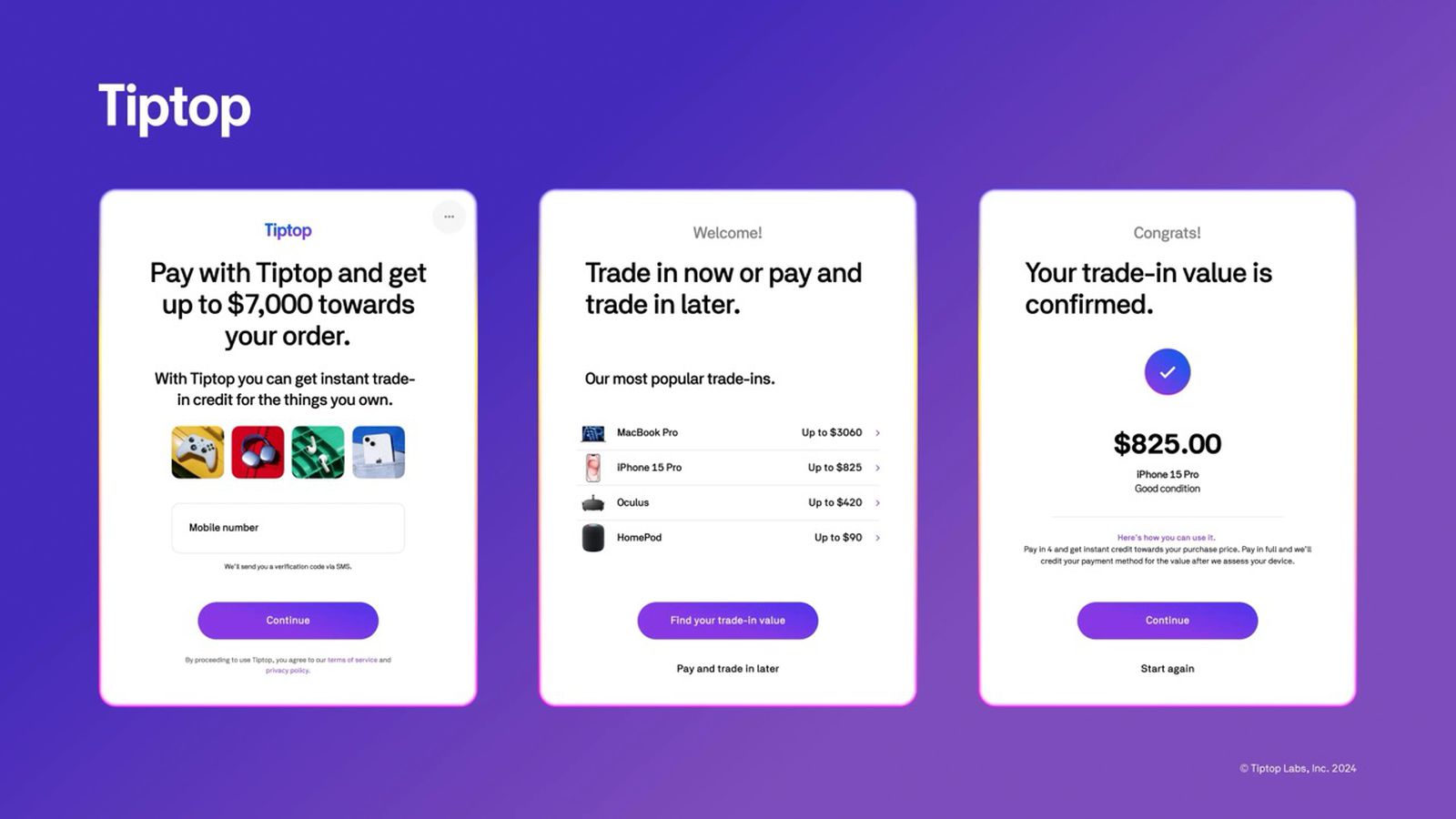
Tiptop’s developer documentation gives the less glamorous view, which is often the more revealing one. A direct checkout object carries the order identifier, currency, total, tax, shipping, line items and addresses. A JavaScript call opens a secure payment portal. Callbacks report success, failure, cancellation, opening and validation errors. None of these elements makes a stirring launch slogan. Together, they are the difference between a proposition and a product. Founding engineers live in that difference. Their craft is partly construction and partly the prevention of embarrassing surprises.
A weekend, a deadline, an earlier clue
Two years before Tiptop’s funding announcement, Ward left a useful breadcrumb in an Indie Hackers welcome thread. His team was moonlighting on Custom Uptime, a monitoring service intended for startups that did not want a conventional $20 monthly bill. The proposed price was a dollar per check per month. The plan was brisk: daily stand-ups, a weekend hackathon, finishing touches during the following week, and a usable minimum product by the end of June. There was no grand theory of disruption. There was a price, a deadline and work scheduled for Saturday.
The same post introduced WinningWithChase, then described as Ward’s blog. He wanted to publish three pieces by month’s end, beginning with an explanation of compute engines for engineers and product managers. He also planned an open-source tool for DevOps teams managing secrets and variables in Ansible. “The focus of the blog will be educating and empowering engineers and business leaders,” the post said. It ended with “Happy building!” Four years later, the personal site had become Winning With Chase LLC, offering fixed packages for web, mobile and more complex product development. The specifics moved, but the old combination remained: make a thing, explain the thing, give the effort a boundary.
Opens the GitHub account he still uses and attends UC Santa Barbara.
Staff software engineer at Calm; publicly plans Custom Uptime and a technical blog.
Works as an early engineer at CloudKitchens.
Becomes a founding engineer at Tiptop; the company separately announces its Series A in 2022.
Tiptop launches trade-in credit at checkout across a catalog of more than 50,000 items.
There is a temptation, when the archive is modest, to turn every old side project into prophecy. Custom Uptime was not Tiptop in miniature. Monitoring checks are not consumer credit, and a blog plan is not an origin myth. The connection is simpler and more credible. Ward was already attracted to product work where pricing, infrastructure and usability meet. He liked a short path from code to consequence. He also treated communication as part of building, not as decoration supplied after the machinery was complete.
The engineer as editor
That last instinct matters at checkout. A founding engineer is an editor of possibilities. Every additional state may help a rare case and confuse the common one. Every abstraction may speed tomorrow’s work and delay today’s launch. Every promise in the interface creates an obligation somewhere out of sight. Tiptop’s idea works only if the difficult parts are neither denied nor passed to the shopper. It must know a great deal while asking relatively little. Wilde observed that the truth is rarely pure and never simple; he might have enjoyed payments infrastructure, though perhaps only from a safe distance.
Ward’s career so far is best understood through this editorial lens. At Calm, the product had to make technology recede. At CloudKitchens, software had to negotiate with physical operations. At Tiptop, a checkout must absorb a secondary market, a credit decision and a parcel’s journey. These are not merely interfaces. They are compressed institutions. The engineer near the beginning helps decide what the customer should see, what the system must remember and which complications deserve to exist at all.
There are flashier professional creeds than “Building great software with great people.” There are certainly longer ones; LinkedIn has seen to that. Ward’s line survives because it makes two commitments and declines to decorate either. The software should be good. The company around it should be human enough to build with. His record offers no sweeping manifesto about where technology is going. It offers a pattern of showing up when the answer remains negotiable, putting the first systems in place, and helping a difficult operation acquire the manners of a simple product.
The product looks simple at the exact moment the engineering has done its job.The recurring logic of Ward's early-stage work
The room is less empty now. Tiptop has merchant documentation, a Shopify app, direct integration tools, public partners and tens of thousands of possible trade-ins. The button has a backstage. The idea has edge cases. The founding title has accumulated the ordinary obligations that prove something was actually founded. Ward arrived before the furniture. The interesting part is that he appears to enjoy assembling it.