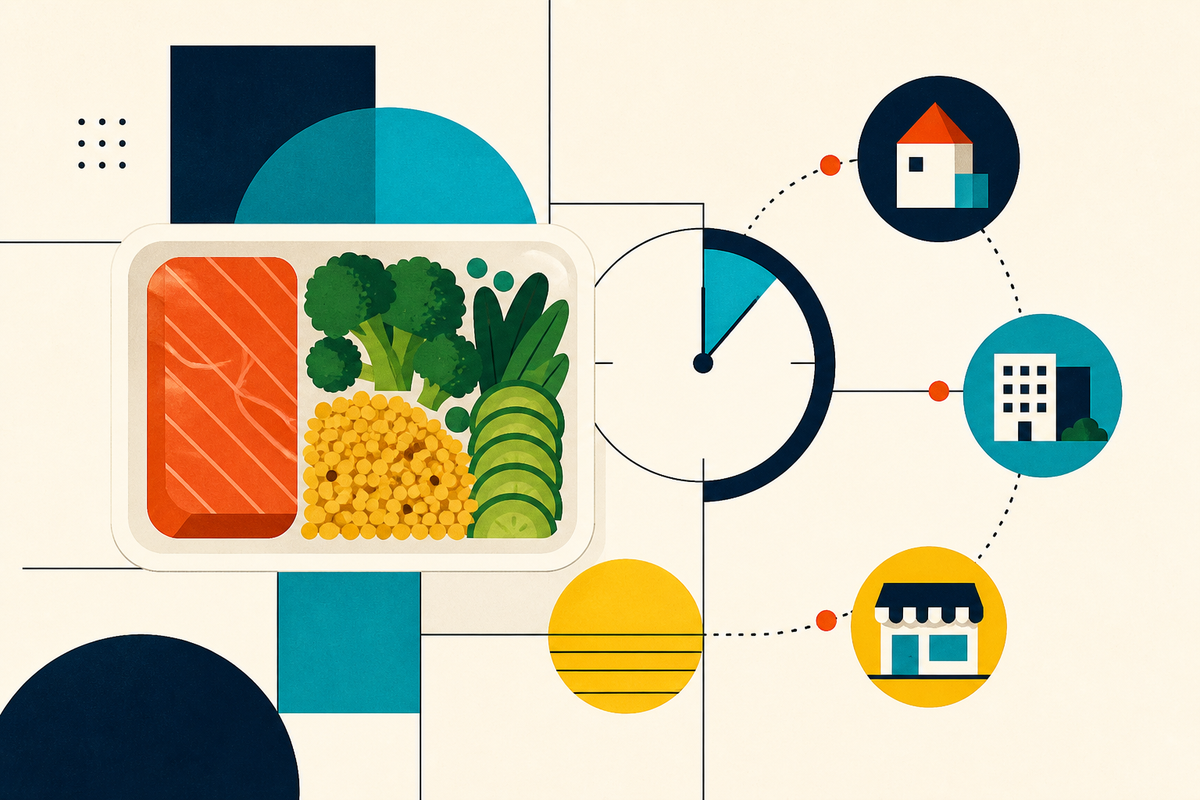
The most important instruction on a Factor meal is not an ingredient, a macro or a chef's flourish. It is the clock: heat for roughly two minutes. In that small interval sits the company's entire proposition. Grocery shopping disappears. So do chopping, sautéing, portioning and the little archaeological dig through the refrigerator at 7:14 p.m. Dinner becomes a scheduled delivery and one brief encounter with a microwave.
Factor is not a meal kit. There is no paper bag of parsley to forget in a crisper drawer and no recipe card promising 30 minutes while quietly borrowing another 15. The Illinois company cooks single-serving meals, chills them rather than freezing them, packs them with insulation and gel packs, and ships them to customers across the contiguous United States. Chefs develop the food; registered dietitians set and review nutrition standards. The customer picks a preference, edits a weekly box and reheats the result.
That division of labor is the product. Factor handles the work upstream so its customer can make a smaller decision downstream: roasted garlic chicken or a taco bowl? The service is aimed at busy adults who want structure without cooking, including people shopping by high-protein, calorie-conscious, keto, vegetarian or GLP-1-oriented preferences. It also suits the person whose alternative is less a home-cooked feast than an expensive delivery order, cereal or nothing.
The problem sounds mundane because it is. Dinner arrives every day, whether a household has planned for it or not. Recipes solve the knowledge problem. Groceries solve the ingredient problem. Factor is built for the motivation problem: the gap between knowing what a balanced dinner could look like and having the time or patience to produce it. The portion is fixed, the nutrition panel is visible before ordering and the cleanup is usually one tray and a fork.
Customers pay a premium for that compression. The fair comparison depends on the abandoned alternative. A disciplined home cook can spend less. Someone replacing restaurant delivery may save money and waiting time. Someone who routinely wastes groceries may value predictability more than the lowest cost per calorie. Factor does not need to win every dinner. A weekly box works if it becomes the reliable fallback for enough of them.
A fitness idea becomes a food operation
Nick Wernimont founded Factor in 2013 around the idea of performance eating. The early name, Factor75, reflected a founder-era belief that food accounts for 75 percent of athletic results. The company that emerged was less gym cult than practical food factory: restaurant-style meals with nutrition guardrails, delivered on a recurring schedule.
The route was not tidy. When investor Mike Apostal joined as CFO and COO in 2015, Factor was producing about $500,000 in annual sales and reportedly had two weeks of payroll left. Seed capital and revenue-based financing helped fund customer acquisition and expansion. The business then landed on the Inc. 5000 four years in a row, beginning in 2017. Flow Capital, one of its early financiers, says Factor posted 1,018 percent three-year growth between 2017 and 2019.
The clever part was not asking people to become better cooks. It was accepting that, on many nights, they did not want to cook at all.
By 2020, Factor expected roughly $100 million in annual revenue. HelloFresh agreed to buy it for up to $277 million in cash, including performance-based earn-outs and management incentives. The buyer had built its reputation on meal kits, which preserve the ritual of cooking. Factor added the adjacent occasion: the customer who wants the food finished. HelloFresh also brought procurement reach, fulfillment knowledge, technology and a large customer-acquisition machine.
The menu is an interface
Factor's current assortment is built to make nutrition legible at a glance. High Protein meals can contain 50 grams or more. Calorie Smart choices are generally around 550 calories or fewer. Keto meals target about 15 grams of net carbohydrates or less. Vegan and vegetarian options sit beside broad Chef's Choice selections. In 2026 the company said its menu had grown beyond 110 rotating dishes, with more than 70 add-ons including breakfast, salads, shakes, juices, snacks and extra proteins.
This is where Factor differs from a supermarket freezer and from chef-marketplace rival CookUnity. The company places nutrition categories at the center of selection and sells a consistent branded system rather than a directory of individual chefs. Against Fresh N Lean, Trifecta, Territory Foods and Snap Kitchen, the distinction is a mix of menu breadth, dietitian involvement, fresh delivery and the supply-chain scale of HelloFresh. None of those advantages makes the category easy. Taste has to survive reheating, new dishes have to run through industrial kitchens, and a chilled box has a less forgiving clock than a frozen one.
The business model begins with an auto-renewing weekly subscription. Customers can swap meals, change the box, skip weeks, pause or cancel before a cutoff. Revenue expands through premium dishes, shipping fees and add-ons. Factor also offers complimentary 20-minute nutrition-coaching calls, a Factor Form line of greens, protein and hydration products, and gift cards. The logic is familiar but disciplined: win dinner, then sell the neighboring moments of breakfast, snack time and training.
Factor organized complexity around a job, not a demographic. “I need a decent meal and cannot cook now” applies to an athlete after training, a nurse between shifts and a parent after pickup. One product can reach all three without inventing three separate brands.
The box is no longer the boundary
The revealing moves are now happening away from the front porch. Factor launched a business program in 2022, then introduced an automated workplace platform in May 2026. Employers can manage recurring orders, users, locations and billing from one dashboard. Individual trays handle staggered schedules better than a buffet that peaks at noon and wilts by two. Factor said the business unit shipped hundreds of thousands of ready-to-heat meals over the preceding year.
At Dartmouth College, branded smart fridges make Factor meals, snacks and drinks available 24 hours a day in residence halls, athletic centers and academic buildings. It is a modest machine with a large implication: the product can become unattended food infrastructure. Late study session, early practice, night shift - the fridge waits without a catering manager.
In January 2026, Factor made its U.S. retail debut in more than 70 Target stores across ten Midwestern states. The launch placed four high-protein meals under 580 calories in refrigerated deli aisles. Subscription offered predictable demand and a weekly habit; Target offers discovery during an ordinary shopping trip. The risk is that a carefully managed digital menu becomes one more plastic tray in a crowded case. The opportunity is a customer who wants one lunch, not a relationship.
Performance, without the lecture
Factor's marketing has returned to its athletic roots. A 2025 partnership with the New York Yankees led into a busy 2026: Serena Williams received a rotating collection of her selected meals, and Factor became the Official Performance Meal of IRONMAN North America. Its new Performance Collection divides into Endurance meals with more carbohydrates and calories for intense training and Strength meals centered on protein, complex carbohydrates and recovery.
The athlete halo is useful, but the everyday pitch remains more interesting. Most customers are not preparing for Kona. They are preparing for Wednesday. Factor's expertise lies in turning broad aspirations - eat more protein, keep calories in view, avoid cooking - into a repeatable purchase that requires little interpretation. Its chefs and dietitians make the visible choices. Production teams and refrigerated logistics make those choices show up on time.
There are tradeoffs. A Factor meal costs more than cooking efficiently at home. Single-serve packaging accumulates. Subscription cutoffs reward attention, even though the product is sold as relief from attention. Nutrition also cannot be reduced to a bright menu badge; customers with allergies or medical needs still have to inspect ingredients and consult clinicians. Convenience is a tool, not a complete food philosophy.
That puts Factor in a wide market. It competes with prepared-meal subscriptions, certainly, but also with supermarket dinners, frozen entrées, takeout, leftovers and the hopeful Sunday meal-prep container. Its advantage is not that a microwave tray is new. It is that the company wrapped culinary work, nutrition standards, recurring commerce and cold-chain delivery into a dependable two-minute ritual.
The market position is therefore premium convenience rather than clinical nutrition or bargain food. Factor gives shoppers more goal-oriented structure than a typical prepared-food case, but it remains consumer food, not medical treatment. The free dietitian conversation adds useful guidance without turning every order into a care plan. That middle ground is commercially roomy: health-conscious enough to justify attention, familiar enough to eat on an ordinary Tuesday.
The next chapter will show whether that ritual travels. If Factor can preserve quality while moving between subscriptions, smart fridges, offices and retail shelves, it becomes more than a meal-delivery brand. It becomes a network for the moments when hunger is punctual and human plans are not. The little underscore in Factor_'s name once looked like a design tic. Now it reads like an open field waiting for the next place to eat.