Forty-three servers are an odd place to begin a story about speed. They do not cross a finish line. They simply disappear from the bill. In a US broker deployment described by Exegy, a trading estate of 200 servers became 157 after the firm replaced in-process market-data feed handling with a centralized approach. Exegy puts the annual savings at $3.19 million. The customer is unnamed, and the result is company-reported. Still, the arithmetic gives us a useful way into a business usually discussed in millionths of a second.
- The job: translate exchange data into something trading systems can use, then help those systems act on it.
- The buyers: banks, brokers, market makers, investment firms and trading venues.
- The wager: central processing can spare applications from repeating expensive work.
Exegy sells market-data and execution infrastructure. Its clients need to know what markets are doing, often very quickly, across feeds that do not conveniently speak the same language. Its appliances, software and managed services make that information usable. A trader may see a price. An engineer sees everything required to deliver it.
The interesting question is where that work happens. If each application server translates the same incoming messages and rebuilds the same picture of the market, the firm has acquired a small bureaucracy of computers. Each member is industrious. The collective arrangement can be expensive.
The 43 machines that disappeared
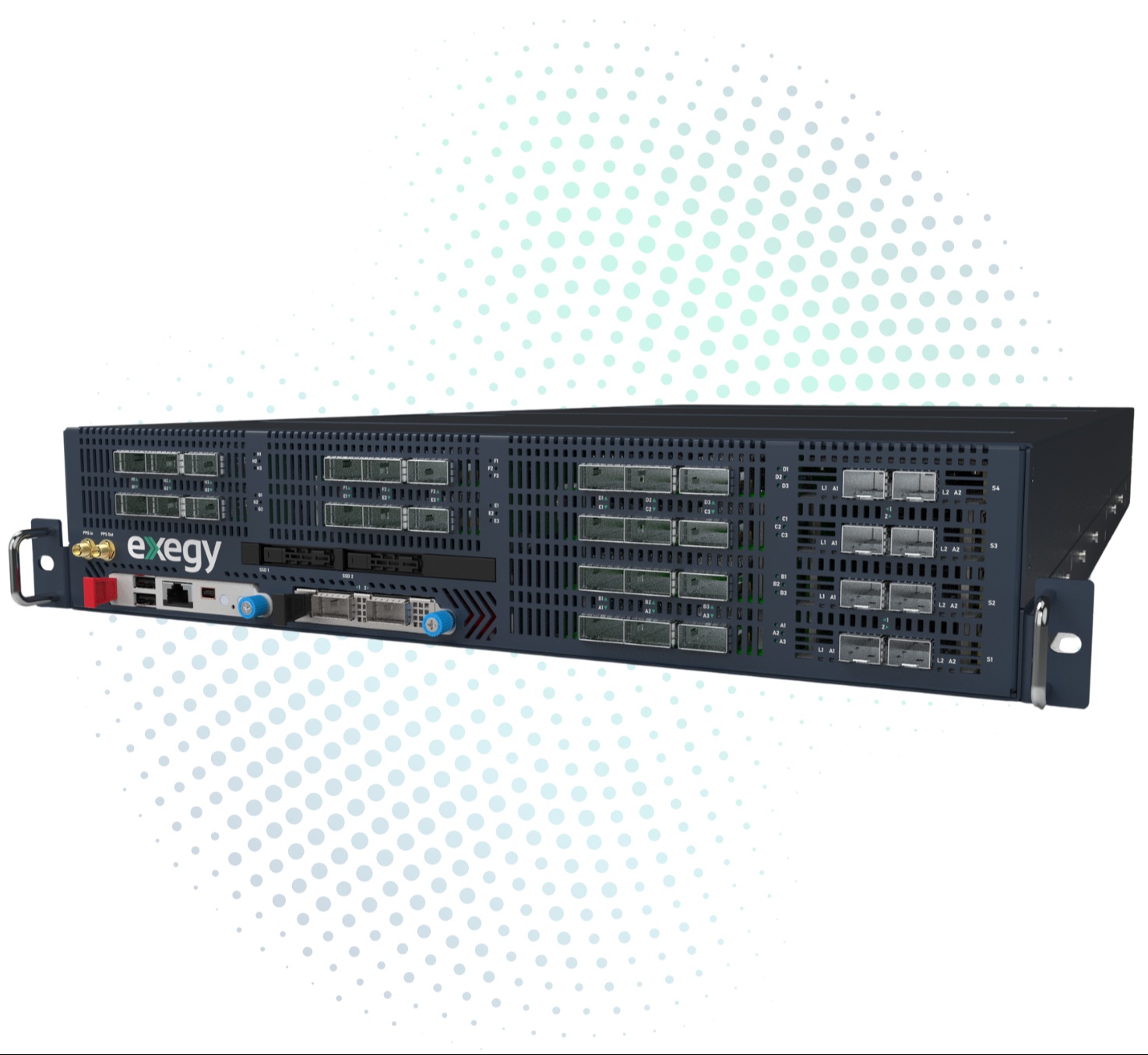
Nexus, Exegy’s newer market-data platform, centralizes feed handling and preprocessing in a managed appliance. It arbitrates feeds, builds order books and prepares data before distributing it to applications. The aim is to send each consumer information suited to its job, reducing the processing burden downstream.
That changes what a server is being paid to do. A pricing application should spend its resources pricing. A trading algorithm should spend them evaluating its strategy. Much of the preliminary translation can happen elsewhere, once, rather than inside every application.
The distinction matters. A technology capable of moving data quickly can still leave applications drowning in it. Exegy’s explanation of Nexus focuses on processing with the application’s needs in mind. The design problem stretches from ingestion to distribution, rather than ending when the raw feed has been decoded.
Announced in June 2025, Nexus drew on discussions with agency brokers, hedge funds and market makers. Exegy later described its collaboration with LDA Technologies on the appliance. The commercial appeal combines speed with power, space and operating expense. A nanosecond is difficult to picture. A rack that no longer needs renting is considerably easier.
A translator with a programmable chip
Exegy’s origins help explain its approach. The company was founded in 2003 to commercialize hardware-accelerated computing research from Washington University in St. Louis. The founding group brought together engineering faculty and business figures, including Ron Indeck, Ron Cytron, Mark Franklin, Roger Chamberlain, Jim O’Donnell and J.J. Stupp. Its ticker plant arrived in 2006.
A ticker plant takes incoming financial-market messages and makes them consistent and useful. That can mean decoding different formats, maintaining a book of available orders, filtering unwanted information and calculating a consolidated market view. The name is quaint; the workload is anything but.
Exegy’s signature technology is the field-programmable gate array, or FPGA. The useful distinction is in the name: circuitry can be configured for particular processing tasks. Exegy uses that hardware to accelerate the repetitive, time-sensitive work surrounding market data. The client’s application can then consume a normalized interface.
Move shared work upstream. Leave each application more room for its own job.
FPGA technology alone does not make Exegy unique. Its distinction is the combination of hardware engineering, software interfaces, coverage and managed operations. Pico’s Redline, for example, also sells low-latency normalization and managed feeds. Its InRush ticker plant emphasizes optimized software. Buyers have architectural alternatives, and comparing benchmark numbers without comparing configurations is a fine way to purchase a misunderstanding.
Buying back the engineering calendar
The portfolio offers several ways to divide responsibility. Axiom delivers normalized market data as a managed service, accessible through data centers or public cloud providers. Exegy advertises more than 300 data sources and interfaces through XCAPI or OpenMAMA. A broker entering another market can use a common interface instead of beginning every integration with a fresh exchange protocol.
For firms that want FPGA processing closer to their applications, nxFeed handles decoding, normalization and book building. nxAccess extends the hardware path into execution: software preloads orders, hardware logic triggers and updates them, and the engine sends them to the venue. nxFramework supplies development tools and reusable components for teams building their own FPGA applications.
There are also software feed handlers, the hosted DMA Platform for market access and risk functions, and Metro for professional options pricing, trading and risk management. These products serve different jobs. Buying a managed data feed and building a custom execution engine are different commitments of money and engineering time.
The corporate history follows that breadth. Marlin Equity Partners backed the Exegy-Vela combination in 2021. Enyx joined in 2022, adding FPGA trading products and development expertise. NovaSparks joined in January 2026, bringing further hardware-based market-data capabilities. Exegy committed to supporting existing NovaSparks products while investing in combined solutions.
Its business model is institutional: enterprise software, development technology, hardware platforms and ongoing managed services. Maintaining exchange connectivity and processing infrastructure becomes work a customer can contract out. The recurring service relationship is as consequential as the metal box.
The auction house with a different clock
OneChronos provides a useful counterpoint to the usual race-for-speed story. The US equities alternative trading system described auctions occurring approximately ten times a second, with matching designed to prioritize the best buyer-seller combination rather than simply the first order to arrive.
It uses Exegy Axiom. In a public account of the partnership, OneChronos head of engineering Iris McAtee praised the service’s stability and precision. That is a different emphasis from shaving the final fraction off a latency measurement. The data must support the market the customer is trying to build.
“We’re pleased with the stability and precision of Axiom.”
Iris McAtee, OneChronos head of engineering, 2023
Exegy therefore occupies several places in the trading stack: supplier to latency-sensitive strategies, outsourced data operator and infrastructure partner to venues. A market maker and an auction venue can both need reliable data while having different ideas about what to do with it.
A fast chip still needs a maintenance crew
Speed has an upkeep bill. Exchanges alter specifications. Feed handlers need testing and updating. Exegy’s 2025 FPGA cost study estimated about $5.35 million to develop a first in-house handler and roughly $9.8 million for coverage of 18 North American equity markets. It put annual in-house maintenance at $4.59 million, compared with an illustrative $1.8 million annual fee for its equivalent managed coverage.
Those are vendor model estimates, informed by a Tier 1 bank benchmark, rather than universal prices. An initial build bill and an annual service bill cover different periods. A sensible buyer would compare equal time horizons, the same coverage and the work retained internally. The broker’s $3.19 million saving is a separate deployment result, not the output of this cost model.
The operational problem is equally specific. Exegy’s 2026 infrastructure report surveyed and interviewed leaders at 61 global trading firms. Nearly three-quarters reported some disruption during high volatility, ranging from latency spikes to dropped data and outages. Market data was where stress appeared first. This does not establish an outage at the broker in the opening; it explains why average-day performance can be an inadequate buying criterion.
Exegy runs follow-the-sun support across North America, Europe and Asia. Its careers page reports that 26% of employees have stayed for a decade or more and 29% have advanced degrees. Engineering depth and accumulated operating knowledge are useful companions when a specification changes and the market is about to open.
Start with one expensive repetition
The practical lesson is to count repeated work before counting new machines. Measure how much processing applications devote to shared feed handling. Test bursts, recovery and downstream load. Compare the maintenance burden over several years. Then choose a feed or desk where central processing has a measurable economic case.
The case will vary. A firm using a few feeds, with modest latency needs and inexpensive software that already handles peaks, may gain little from a hardware overhaul. A bespoke strategy may warrant its own implementation. Central processing also deserves careful scrutiny for resilience, coverage and integration. Moving work upstream makes that shared infrastructure consequential.
Exegy’s September 2026 partnership with MarketsIO addresses another obstacle: migration. It pairs Exegy’s normalization with enterprise distribution, entitlements and integration technology, aiming to preserve existing application interfaces while firms modernize incrementally. The change can begin with one awkward dependency.
That is the appealing part of the story. Trading firms will continue chasing smaller units of time. Exegy also offers them a question large enough for everyone in the budget meeting to understand: how many times are we paying to do this same job?
Follow the data pipes
Explore Exegy, Nexus and Axiom. Read the company news and engineering and market commentary.
Follow Exegy on LinkedIn, X, Instagram and Facebook. Watch its YouTube videos or the FIA Expo executive interview.