Snow is an awkward material. It piles up, packs together, breaks apart and generally refuses to behave like water. Jelly has its own opinions. Getting both to behave inside a computer is the kind of problem Ethan Yuanming Hu has spent years making less forbidding. His widely shared Taichi demonstration put water, jelly and snow into a simulation in just 99 lines of Python. A small program, with a conspicuously large amount of physics hiding underneath.
The appeal was partly visual: coloured particles moving as recognisable materials. But the line count was the provocation. Here was something that looked difficult, presented in a form another programmer could pick up and change. The pleasure lay in the distance between the modest instructions and the busy little world they produced. You could see the bargain before you understood the mathematics.
Today Hu is the founder and CEO of Meshy AI, which generates 3D models from text and images. The interface has become friendlier still. A user can describe an object rather than write a simulation. Read across his work, the recurring question is how much machinery can disappear before the person using it loses the ability to make something worthwhile.
That question makes his career more interesting than a procession from university to startup. Each attempt at convenience creates a new obligation. A short program must still calculate correctly. A generated object must survive being edited. A company must discover whether anybody wants what its technology makes possible. Ease is a demanding product to sell.
A compiler beneath the snow
Hu graduated from Tsinghua University's Yao Class in 2017 and went to MIT. By then Taichi already existed as an open-source graphics project: his new research group welcomed him as the author of software implementing more than 40 graphics papers. He arrived with something other people could use, alongside the questions he intended to investigate.
At MIT, those questions reached beyond attractive pictures. Hu worked on ChainQueen, a differentiable simulator for soft robotics, with collaborators including Wojciech Matusik and Daniela Rus. Differentiability connects a simulated result back to the choices that produced it. That makes simulation useful for searching for a better design or action, as well as showing what happens.
His later work contributed to PlasticineLab, a system for learning how to manipulate deformable objects. Its task was wonderfully unglamorous: reason about material that changes shape when pushed. A rigid block can be described by where it is. Dough requires attention to what it has become. The computer needs a more useful account of the world than a handsome surface.
Taichi became a language and compiler for demanding visual computation. Its Python interface offered a familiar place to write while the system handled execution on computing hardware. Hu's March 2021 doctoral thesis brought together high performance, differentiable programming, sparse data and quantization. In 2022 it received MIT EECS's George M. Sprowls Thesis Award and an honourable mention from ACM SIGGRAPH.
The customer enters the picture
After his doctorate, Hu co-founded Taichi Graphics with Ye Kuang. By February 2022, the business had raised a $50 million Series A. Its proposed cloud platform would make 3D content easier to develop, share and work on together. The ambition followed naturally from the software: bring complicated graphics work within reach of more people.
The route to Meshy involved an uncomfortable lesson. Hu has described the original commercial effort as unsuccessful before the company turned towards generative AI. Technical achievement had given him a starting point. It had not settled which product people would repeatedly choose. A compiler can be tested against a specification; a business faces customers who are perfectly entitled to prefer something else.
By January 2024, he was introducing himself as Meshy's co-founder and CEO, and as “a coder and product builder.” The second half of that description matters. Building the underlying capability and choosing the experience through which somebody encounters it are different jobs. Meshy moved the invitation closer to the object a person wanted: describe it, or supply an image, and begin there.
The change also widened the audience. Writing graphics software presumes an appetite for graphics software. Wanting a miniature, a game prop or a visual reference requires no such commitment. The company could now meet people at the level of an intention. It still had to turn that intention into an object useful enough to keep.
The first model is the beginning
Hu's public explanations of 3D AI are often more practical than the surrounding excitement. In May 2024, he named UV unwrapping, topology, controllability and polygon counts as unfinished problems. These are the parts a casual viewer can miss. A model may look persuasive from one angle while giving the next person in the production process a miserable afternoon.
His priorities were quality, diversity and speed, with quality first. “Quality is paramount.” A quick preview lets someone reject a direction early; a slower final result can be acceptable if it is worth using. Diversity means handling more than a narrow set of familiar objects. The point is a useful range of choices, delivered at a pace that permits another attempt.
By 2025, Hu was describing users who took Meshy output into ZBrush or Blender for further work. Others used it as a three-dimensional reference for a two-dimensional concept. He also distinguished game studios working from existing artwork from people exploring objects through text. These are different starting conditions, even when the generation button looks much the same.
Consider the ordinary chair in a game scene. It needs a shape that reads well, surfaces that accept textures and a sensible amount of geometry. It must sit beside the rest of the scene without causing trouble. The final test happens after the impressive first view, when somebody tries to do something with it. Hu's account leaves plenty of room for that somebody.
“Quality is paramount.”Ethan Hu, 2024
A bigger number, a longer to-do list
On July 21, 2026, Meshy announced nearly $400 million in Series B financing at a $1.5 billion valuation. The company reported more than 12 million registered users and over 100 million models created. Those figures describe a business well beyond the scale of an academic software demonstration. They also describe a considerable population of people capable of finding the next awkward edge.
The funding was designated primarily for research and development and international expansion. Alongside it, Meshy introduced a 3D Agent that could help move a conversation, image or sketch through concepts towards a model. The product direction suggests that even a simple input box leaves work around it: deciding what to make, choosing among alternatives and getting the result into a usable form.
The numbers should be read with their dates attached. Registered users measure reach; models created measure activity. Neither tells us how many objects became finished games, printed keepsakes or discarded experiments. For a profile of Hu, their importance is the change in responsibility. He now leads a system used at scale, where the quality of the surrounding workflow matters alongside the model itself.
Meshy-reported figures, July 2026. Users and models are different measures.
Ten agents, one person changing his mind
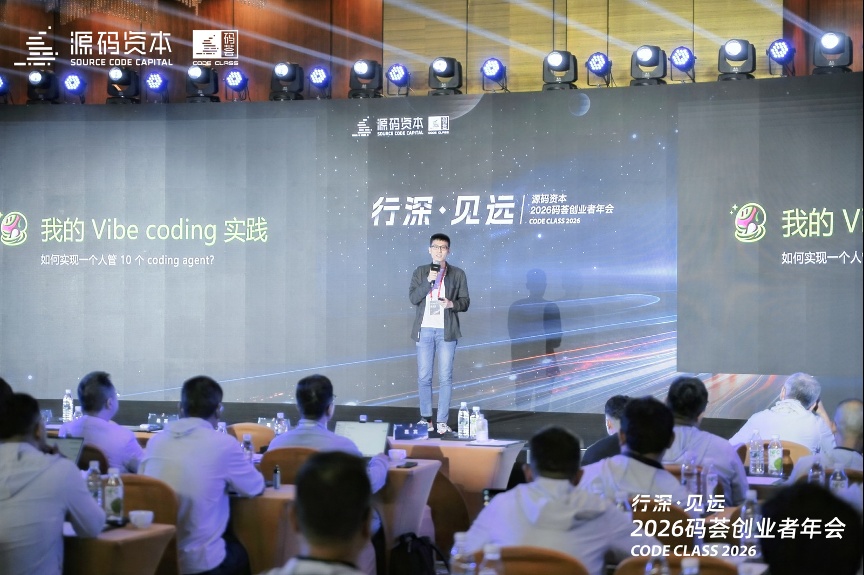
The effort to remove repetitive work has reached Hu's own desk. At Code Class 2026, he described managing ten coding agents and building a phone-accessible system so he could direct them by voice. The programmer who once compressed a simulation into a small program was now arranging for software to carry out more of the programming.
His account included a useful revision. After earlier enthusiasm for leaving generated code alone, experience had brought him back to this rule: “core code must be reviewed by a human.” He separated faster code production from the harder work of choosing architecture and identifying the user's problem. The admission makes his optimism easier to take seriously: a working method should change when it fails.
There is a familiar founder temptation to count whatever the new tool produces most visibly. Hu questioned token consumption as a measure of competence and preferred asking how long an agent could work effectively without intervention. That is a more exacting test. A busy screen can put on an excellent performance. Useful work has to leave something behind that survives inspection.
The ramen intermission
The public Hu is capable of leaving the product pitch alone. After SIGGRAPH 2024, he celebrated attending without a poster, talk, course or booth to prepare. There were friends, former labmates and mentors to catch up with, and ramen near the Colorado convention centre to recommend. For once, the hotel room did not have to double as a rehearsal studio.
His GDC speaker biography adds a small, oddly memorable preference: his favourite animal is the llama. Such details do little for a funding announcement and rather more for a human portrait. A person whose working vocabulary includes sparse computation and differentiable simulation can also have a perfectly straightforward opinion about a bowl of noodles.
The academic connections have acquired a second life. In explaining Meshy's fellowship programme, Hu recalled a $3,200 monthly MIT stipend, with half spent on rent in Cambridge. Fellowships helped him concentrate on research. He wrote that Snap and Meta, once supporters of his academic work, later became early Meshy enterprise clients. For the 2026 fellowship, Meshy offered research awards of $5,000 and $10,000.
That is a concrete version of giving something back: money and room for students to pursue graphics and multimodal AI. It also places the founder within a continuing network of researchers, companies and tools. The career has changed settings, but the people and institutions recur. An old research relationship can turn up again on the other side of a customer conversation.
An object wants a world
By September 2026, Meshy was extending its work beyond individual assets. Its Mora research architecture divides an interactive world among coding agents that produce logic, 3D generation that supplies structure and objects, and a real-time video model responsible for final imagery and audio. Mora 1 was presented as an early playable demonstration. A general-purpose world creation tool remained a longer-term goal.
The division is revealing. A world needs rules and continuity as well as pictures. Something should stay where it was put; an action should have a consequence. The system gives those obligations explicit places to live. It is an approach consistent with Hu's years spent worrying about what materials do beneath the image, though the company still has to prove how far the architecture can go.
Hu's stated ambition for the fellowship is to help build interactive entertainment that brings joy to billions of people. The scale belongs to the aspiration. The work remains in smaller units: a student with time to investigate, an artist with an editable starting point, a player with something interesting to try. The 99-line simulation made that relationship visible. Reduce the obstacle, and somebody else gets to find out what they can make.
Keep exploring
- Watch Hu at GDC 2026: from AI assets to AI-native gameplay ↗
- Watch the Taichi community's work in motion ↗
- The 2024 conversation about quality, diversity and speed ↗
- Hu on his research and the early Meshy product ↗
- His 2026 notes on coding agents and management ↗
- Inside the PlasticineLab research ↗
- July 2026: Meshy’s Series B announcement ↗
- The Meshy fellowship and Hu's letter to researchers ↗
- September 2026: Mora and Meshy 7.1 ↗