When Ethan Hu was very small, there was a peach tree below his family's university apartment. Every spring it flowered. Hu's question was not why. It was when. While he slept, did the tree continue quietly growing, or did it remain perfectly still until he looked again, then snap into the shape the world expected? Most children would be advised to go outside. Hu, whose parents taught computer science, had stumbled into a problem of simulation: what happens to a world when nobody is watching?
Games supplied another version of the puzzle. He watched relatives play Chinese Paladin, Red Alert and Age of Empires II. A whole place could exist inside a computer, built from arithmetic and rules. The discovery lodged deep. Long before the language of rendering, meshes or physics engines arrived, Hu was fascinated by the audacity of making a world and asking it to behave.
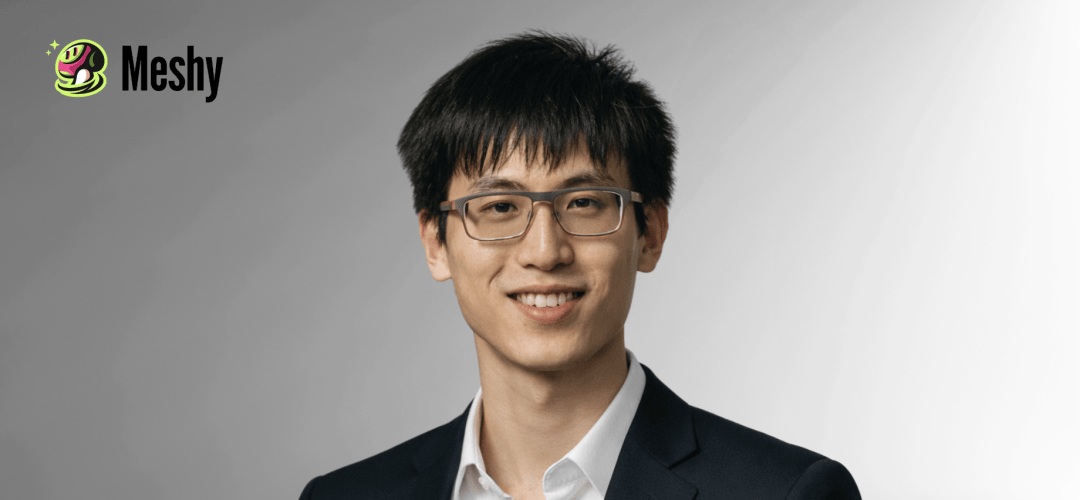
That childhood curiosity now has a distinctly commercial address in Sunnyvale. Hu is the founder and CEO of Meshy AI, a platform that turns sentences, pictures and sketches into 3D objects. A small studio can ask for a weathered treasure chest or a low-poly robot, inspect a preview, adjust its texture, rig it, and export it into familiar creative software. The promise is not that geometry has become trivial. It is that the door to geometry no longer resembles an entrance exam.
The compiler beneath the company
Hu's route to that door began in competitive programming and research. His public record lists gold medals in informatics contests before he entered Tsinghua University's Yao Class, a selective computer science program. He graduated with honor in 2017. An internship with Stephen Lin at Microsoft Research Asia led to undergraduate work on a photo-processing system that combined reinforcement learning, generative models and a differentiable editing pipeline. It was already characteristic Hu: take a craft with many hidden decisions and make those decisions legible to a machine.
At MIT, advised by Frédo Durand and William T. Freeman, he pursued the harder material of computer graphics: snow, fluids, smoke and soft bodies. His central project was Taichi, an open-source programming language and compiler designed to make high-performance visual computing easier to express. Graphics programs often demand an unpleasant bargain. A researcher can write for clarity or write close to the hardware for speed. Taichi tried to keep both.
The demonstrations had the useful quality of a magic trick whose apparatus was left onstage. A compact program could simulate water, jelly-like solids or a mound of snow. Taichi became known outside Hu's immediate research circle, accumulated a large open-source following and anchored his doctoral dissertation. In 2022, that thesis received MIT EECS's George M. Sprowls Thesis Award and an honorable mention from the SIGGRAPH Outstanding Doctoral Dissertation Award.
Taichi was not an accidental prelude to Meshy. It established Hu's favorite move: place a humane interface in front of fierce computation. With Taichi, the user wrote relatively direct Python-like programs while the compiler handled the machinery required to run them quickly. With Meshy, the user supplies words or an image while the system wrestles with shape, surface, texture and export. The audience changed from researchers to creators. The appetite for removing friction did not.
The third product or the last
A celebrated dissertation is not a product-market fit. After finishing his doctorate in 2021, Hu co-founded Taichi Graphics. The company first tried to commercialize technology adjacent to the open-source project. It did not work. A second product failed to catch, too. By Hu's account, the team came close to returning its investors' money. He imposed a brutal piece of performance management on himself: if the third attempt failed, he would fire himself as CEO.
The timing of that attempt mattered. Generative image systems had taught ordinary users that a sentence could become a picture. Three dimensions were more obstinate. A plausible 2D image needs to look right from one view. A useful 3D asset must survive a turn. Its geometry, topology, textures and proportions have to cooperate from every angle. It may need a controlled polygon count, a clean UV map, a skeleton for animation and an export format another application understands. A pretty front view can conceal a small republic of horrors around the back.
Meshy launched into that difficulty, first emphasizing AI texturing and then expanding into text-to-3D and image-to-3D generation. It was the third product. This time, users arrived. Hu later wrote that the company's revenue grew rapidly month after month; by July 2026, Meshy reported more than 12 million registered users and over 100 million models created. The company announced a nearly $400 million Series B at a $1.5 billion valuation.
Bars are visual indices, not a shared unit scale. Figures were disclosed by Meshy with its Series B announcement.
Those are startling numbers for a field that spent decades requiring expensive software, specialized training and a tolerance for menus nested like Russian dolls. Yet Hu's most credible public habit is his willingness to discuss what the numbers do not solve. In a 2024 interview, he estimated that generative 3D had addressed only about a tenth of its technical challenges. He named the stubborn pieces: topology, UV unwrapping, control and reducing polygon counts.
A fast preview, then the real work
Hu divides a good 3D system into quality, diversity and speed. Quality comes first; creators will wait for a model whose shape and texture are worth keeping. Diversity means the machine cannot be a gifted specialist in chairs and vases while becoming confused by everything else. Speed matters because a quick preview allows a person to reject a direction before an expensive final render. This is less romantic than saying creativity has been automated. It is also much more useful.
His picture of the creator's future still contains a creator. AI produces a starting point, takes on repetitive operations and offers variations. The person directs, chooses, corrects and brings taste. That distinction becomes especially important in games, where a model is rarely the final product. It must enter a scene, obey a budget, animate properly and sit beside assets made by other hands. The object has to work, not merely pose for its portrait.
Meshy's recent direction stretches beyond the single object. Its 3D Agent accepts conversation, text, an image or a sketch, proposes concepts and generates models in common formats. Hu has also talked about AI-native games and interactive experiences: not simply producing scenery faster, but changing what a game can do while someone is playing it. The old peach-tree question returns in a modern disguise. What should a digital world create when the player is not looking, and how quickly can it be ready when they turn around?
Graduates with honor from Tsinghua's Yao Class and joins MIT's graphics community.
Completes his MIT doctorate on Taichi and co-founds Taichi Graphics.
Launches Meshy after two earlier product pivots fail to find their market.
Meshy reports 12 million-plus users, 100 million-plus models and a nearly $400 million Series B.
Ten agents and one moving job
Hu's own work has become another experiment in delegation. In 2026, he described orchestrating ten coding agents, using command-line tools, containers and parallel workspaces to keep them productive. The spectacle of one executive supervising a small invisible engineering squad is amusing until one notices his more serious point: the role of a founder changes when execution becomes cheap and abundant.
He argues that some duties do not dissolve. Choosing the right people remains decisive. Culture still determines whether talented people flourish or leave. Judgment about which problems deserve attention becomes more valuable when many proposed answers can be produced at once. His favored management advice is old-fashioned enough to fit above a schoolroom door: surround yourself with the best people.
There is a pleasing circularity here. Hu spent his research career designing abstractions that let people command computers without attending to every mechanical detail. He is now reorganizing his own day around abstractions that let him command fleets of software without typing every line. Each layer of convenience creates a higher layer of responsibility. If the tool handles the how, the human becomes more answerable for the why.
Meshy's wager is that 3D creation will follow the same path. A blank viewport can be intimidating because it presents infinite possibility and no obvious first move. A sentence is friendlier. It gives the machine something to build and the person something to dispute. The result need not be perfect to be liberating; it needs to be tangible enough for the next decision.
Hu has moved from asking whether an unseen tree continues to grow to building systems that manufacture things no camera has seen. Between the two lies an unusual continuity: curiosity about rules, impatience with needless difficulty and respect for what remains unsolved. Meshy may make the first minute of 3D creation almost ordinary. The interesting work begins in minute two.