In 2023, Meshy made monsters by accident. The company’s early text-to-3D models carried visible artifacts: shapes could be odd, surfaces uneasy, details a little wrong. For a product trying to make polished assets, this was hardly a triumph. Then horror game developers arrived. An unsettling face or a crooked limb could serve the mood perfectly. The defect had found its audience.
That detail, recounted by Meshy marketing specialist Tony Liu, explains the company better than another glossy dragon demo. Meshy sells speed, but speed only matters when somebody can use the result. The horror developers did. As the company improved its models, the question changed from “Can AI make a 3D object?” to “What happens to that object after it leaves the generation window?”
- Meshy generates 3D models from words, images and sketches, then helps users texture, rig, animate, refine and export them.
- Its first unexpected users were horror game developers who liked imperfections in early output.
- The company now serves game teams, printer owners, educators, artists and developers using its API.
- The practical test is the final workflow: polygon budget, mesh quality, slicer result and rights to use the output.
The useful mistake
Meshy’s public product launched in 2023, two years after founder Ethan Yuanming Hu began the company. Hu, an MIT computer science PhD, knew computer graphics. Knowing graphics, however, did not make the first generations clean. Liu says Meshy’s original text-to-3D output was visibly flawed, while generation could take hours. Horror developers offered an answer to a classic startup problem: the first customer may love a feature for a reason the maker never intended.
Meshy did not build a permanent business by preserving the glitch. It treated those early users as proof that instant 3D could solve a real production problem, then went after the parts that made output hard to use. Meshy 1 shortened generation from hours to under a minute. Versions 2 and 3 added control over polygon counts, quad conversion and physically based materials, the maps that help a surface behave under changing light. Meshy 4 made a deceptively sensible change: it separated the model from its texture. A creator could judge the shape first, before a handsome surface hid an awkward silhouette.
“Our text-to-3D output often had visible artifacts. But we found our first real users in an unexpected place: horror game developers.”Tony Liu, Meshy, in Design News
The progression is a useful lesson for anyone building with generative AI. A first result that earns a laugh, or even a download, is only the beginning. A game artist has to mind polygon count, materials, collision, skeletons and file formats. A printer owner has to mind wall thickness, watertight surfaces, supports and build-plate dimensions. Meshy’s work has steadily moved toward those stubborn details.
A file is a promise to another tool
Today a user can type a prompt or upload an image, make a mesh, apply texture, remesh it, rig a character, add an animation and export to familiar formats such as GLB, FBX, OBJ, STL or 3MF. The browser workspace groups tasks around Image, 3D Model, 3D Printing and Animate. Plugins and an API bring generation into tools such as Blender, Unity and ComfyUI, or into a developer’s own software. The company also offers a conversational 3D Agent that can brainstorm concepts and turn a selected idea into a model.
The value grows at each handoff, where a pretty preview can still become an unusable asset.
The distinction matters most in 3D printing. A digital model can look complete while a slicer rejects its geometry. Meshy’s Auto Split addresses a prosaic obstacle: the object is too large for the printer or should be made in separate colors. It divides a generated draft model into capped parts, arranges them on a build plate and attempts to place seams where they are less conspicuous. The company says a preview takes about 40 seconds. Its Formlabs integration goes another step, letting a user order a professional print directly from Meshy. With Bambu Studio, the route is toward a home printer.
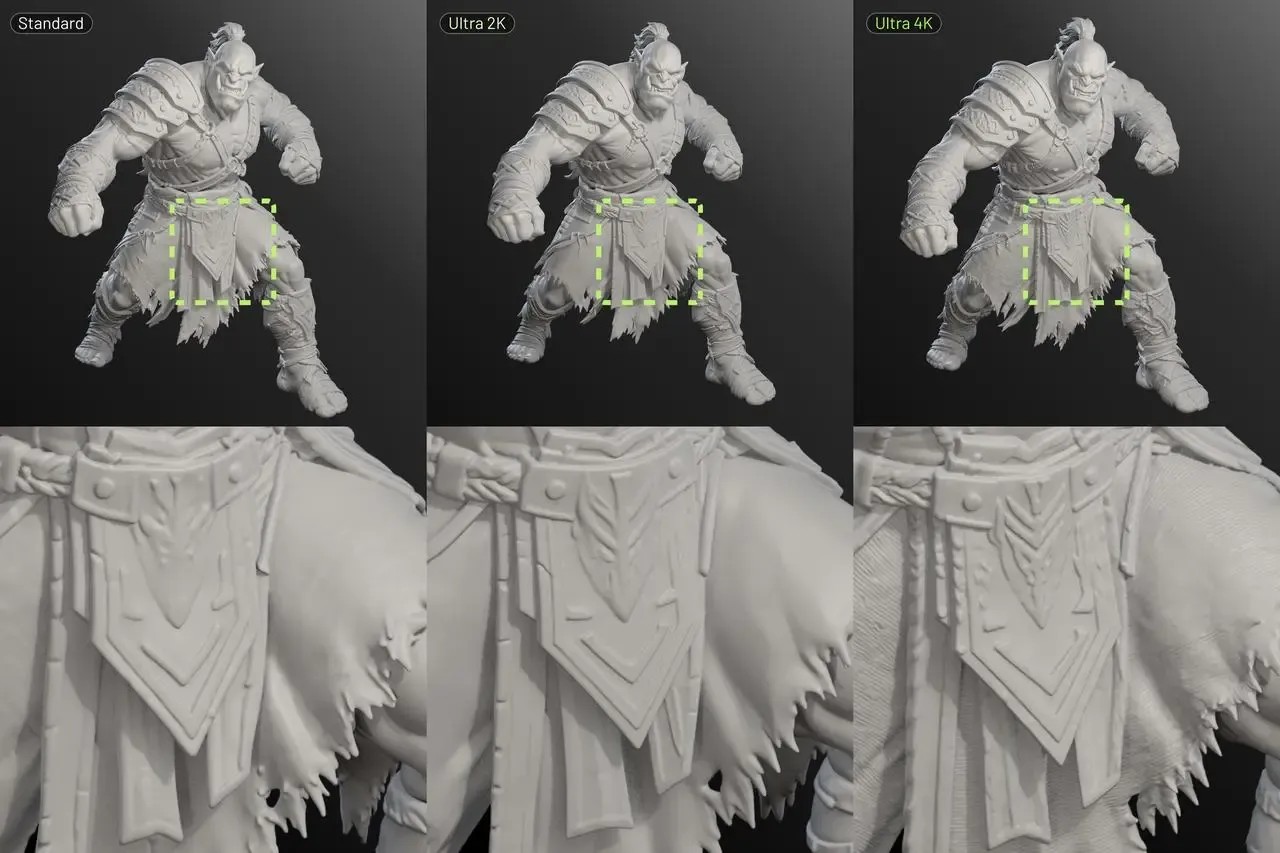
The image above illustrates another wrinkle. A texture can paint an engraving onto a surface, but it cannot create the ridge a printer needs or the silhouette a close camera will see. Meshy 7.1, released in September 2026, concentrates on geometric detail. Its Ultra 4K mode can produce raw meshes of up to 80 million triangles before simplification, according to the company. Such detail is expensive to generate and must still be reduced for many real-time uses. The number is meaningful because Meshy is treating geometry as something to measure, inspect and trade off, rather than only something to admire.
Who pays for the shortcut?
The audience is unusually mixed. A solo game developer can make a draft prop without learning every Blender control first. A studio can use the API to produce variations at scale. A printer owner can turn a photograph into a gift. In Seoul, teacher Jiho Han has students use generated models as starting points for critique, then refine them in Tinkercad or Blender and test the designs. His classroom example is telling: the first model is material for discussion, not a substitute for it.
Meshy makes money through subscriptions, usage credits and enterprise plans. A free tier lets people experiment; paid plans provide more credits and broader download and commercial-use options. The Pro plan has been listed at $20 a month, though plan prices and allowances can change. Generation and follow-on tasks consume credits. That gives the tool a low-friction entry point, while repeated iterations have a visible cost. The sensible user budgets for more than one attempt: a prompt may create a plausible shape on the first pass, but a useful asset often takes selection, cleanup and another pass.
The company says more than 12 million people had registered and over 100 million models had been created by July 2026. It announced a nearly $400 million Series B at a $1.5 billion valuation that month, with proceeds earmarked for research and global expansion. Those figures describe scale, not the quality of every model. Meshy itself has said that earlier versions did not fully meet professional users’ needs. A reported partnership or named customer also tells us less about depth of use than a shipped game, a successful print or a shortened production cycle.
The hard part is still hard
Meshy operates among other AI 3D services, including Tripo and Rodin, while established tools such as Blender and Maya remain the places where artists get exact control. Meshy’s bet is that generation plus the tedious steps after it can form one continuous workflow. It is a sensible market position: the alternative to a fast asset is often not another model generator, but a specialist’s hours, a marketplace search or a project quietly abandoned.
The company’s own research process has faced the same economics. While preparing Meshy 4, Hu’s team wanted GPU capacity that could expand for experiments without paying for idle machines. A Lambda case study says on-demand H100 clusters cut Meshy’s research turnaround roughly in half. The technical decision is less glamorous than a model launch, and perhaps more copyable: match compute spending to the uneven rhythm of experimentation, then release often enough to learn from use.
There are limits to the shortcut. For a fitted mechanical part, a precise CAD model may be the better starting point. For a hero character with exact art direction, hand work may still dominate the last mile. For 3D printing, a slicer preview and a physical test remain wise even when software says a file is ready. Meshy’s promise holds best where the expensive part is producing enough good options to choose from, and where a human can judge the output against the job it must do.
That is the odd arc of the company: first it found people who wanted something wrong, then it spent years making the results right in more demanding ways. The monster was a customer discovery. The business is the handoff.