Before Essex Property Trust bought BRE Properties, the two apartment companies were practically looking through each other’s windows. More than half of BRE’s holdings stood within two miles of an Essex property when the deal was announced. For an acquirer, that is an unusually useful kind of familiarity. You can study a spreadsheet. You can also walk down the street.
- Buy and operate apartments where new housing is hard to build.
- Keep the portfolio close enough to understand the neighborhoods.
- Use public capital to expand, while paying the very real costs of ownership.
Essex’s story is an argument for knowing a place deeply. It is also a reminder that expertise comes with boundaries. An apartment company can become very large while remaining exposed to a fairly small slice of the country. Whether that feels reassuring depends on what happens inside that slice.
A coastline is a business decision
George M. Marcus founded Essex’s predecessor in 1971. By its 1994 stock-market debut, the company had 16 multifamily communities. Its chosen territory eventually settled around Southern California, the San Francisco Bay Area and metropolitan Seattle. These are places where employment can attract renters, buying a home can be expensive, and adding housing can be difficult.
The mechanism is simple enough to explain over coffee. Rental demand depends partly on jobs and household formation. Competition depends partly on how many apartments arrive next door. Essex studies both. Its historical research framework considers employment, demographics, housing supply and affordability before capital goes into a property. The building is the visible purchase; the local economics are the underlying bet.
Apartment REITs such as AvalonBay, Equity Residential and UDR offer alternatives with different geographic mixes. Essex’s distinction is the concentration itself, supported by acquisition, development, redevelopment and operating teams. It sells neither a proprietary apartment nor a secret construction material. The intended advantage is judgment about where to own, what to pay and how to run the buildings.
The merger that changed the size limit
The BRE acquisition tested that judgment. Early approaches failed to produce an agreement. In 2012, BRE’s board rejected Essex’s proposal, and further overtures met resistance. The eventual sale process opened in 2013. Essex could see a business close to its own properties, with opportunities to operate overlapping portfolios more efficiently.
There was another obstacle: Essex’s own idea of its preferred size. Then-CEO Michael Schall had described an optimal net asset value of $10 billion or less. BRE forced a reconsideration. Management concluded that pursuing the combination would better serve shareholders. The useful detail is what changed: its willingness to accept greater scale inside familiar territory.
“For all intents and purposes, we’ve decided to stay focused on the West Coast.”
Michael Schall · then CEO · 2014
The merger closed on April 1, 2014. Essex’s annual filing recorded approximately $4.3 billion of consideration. The completion announcement’s $16.2 billion figure referred to the combined company’s total market capitalization. Those numbers describe different things. Confusing them turns a large acquisition into a much larger purchase that never happened.
What the resident actually buys
A renter encounters Essex through something more immediate: a floor plan, a monthly payment, a tour and a maintenance request. Its website lets people search communities and available apartments. Residents can use online tools to pay rent and request service. Selected apartments offer smart locks and remotely controlled thermostats. Amenities and technology vary by community.
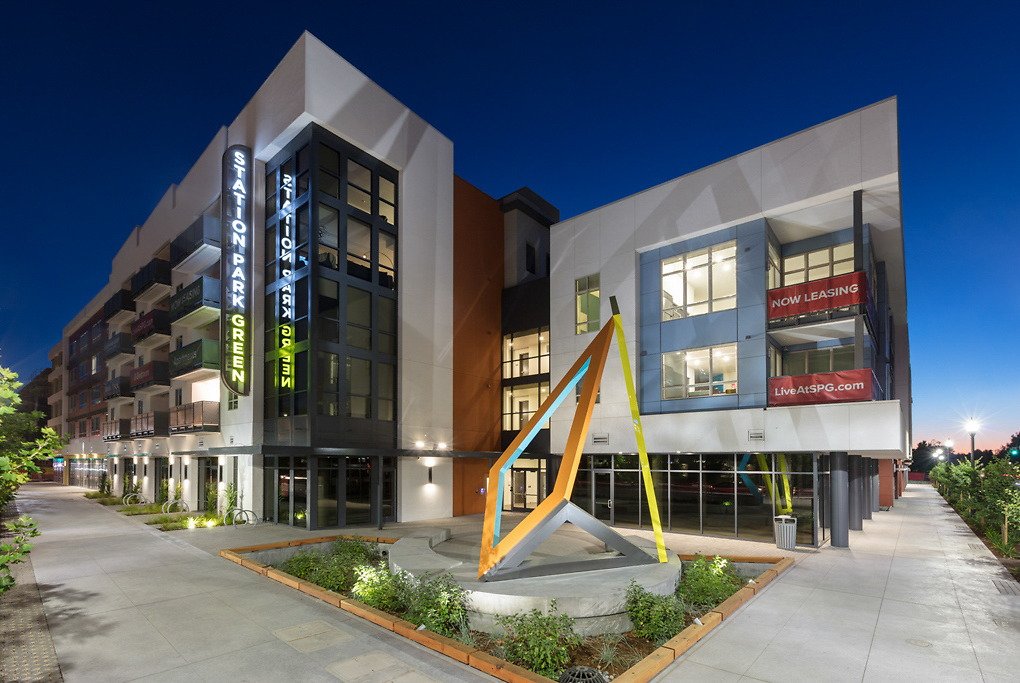
There is a small commercial business alongside the apartments. Essex leases retail spaces, including at Station Park Green. A shop downstairs can make a residential community more useful while introducing a different tenant and leasing problem. The product reaches beyond the apartment door, but the apartment remains the center of the economics.
Service requires people. At the end of 2025, Essex reported 1,689 employees, including 1,267 working on-site at operating communities. Its careers materials describe maintenance, community operations, leasing and corporate roles, alongside employee-led groups and wellness programs. A resident’s experience ultimately passes through those teams. An attractive photograph cannot complete a repair.
The bills behind the dividend
For shareholders, Essex packages property ownership into a listed REIT, trading as ESS. Rent and other property income support operating costs, financing, reinvestment and distributions. Affiliate management fees and investment income add other streams. Public equity, borrowing, property sales and co-investments help fund the portfolio. This is a capital-intensive business with recurring revenue and recurring obligations.
Income starts here. Property expenses, financing and capital needs still have claims on the cash.
Its latest reported quarter shows why the distinctions matter. In Q2 2026, same-property revenue increased 2.7%, and Core FFO per diluted share increased 1.2%. Total FFO per share fell 17.6%, primarily because of legal settlements. Essex disclosed a $36.5 million RealPage-related settlement and $19.3 million for another litigation matter. An adjusted operating measure can clarify performance while leaving substantial costs outside the adjustment.
Essex raised its full-year Core FFO guidance midpoint to $16.14. That was a forecast. As of October 23, the next quarterly earnings call was scheduled for October 28. Reading the company means keeping reported results, adjusted measures and expectations in separate columns.
The part worth borrowing
The transferable lesson is to define an area of expertise precisely, then examine opportunities within it before expanding the map. Essex’s history also suggests that a size preference deserves reconsideration when the specific economics change. Familiarity is valuable only when it improves decisions.
The conditions matter. Weak employment can soften demand. Expensive debt can undermine an attractive acquisition. Rising construction costs can squeeze development returns. And housing scarcity cannot lift rents beyond what households can afford indefinitely. Schall was discussing affordability as a constraint in 2019; Kleiman was discussing new Bay Area demand in 2026. Both belong in the picture. Essex’s business rests on the distance between needing a home and being able to pay for one.