Lance Swank’s first assignment at Sterling Group was outside the apartments. In the summer of 1976, he maintained the grounds at small rental communities. Evenings brought another job, at Sears and Roebuck. The future president and CEO was learning two businesses in which a customer could walk in and notice, immediately, whether somebody had done the work.
It is an unshowy opening for a real estate career. There is no acquisition to announce, no skyline to point at. Yet it gives Swank’s story its shape. An apartment is an investment, a construction project and somebody’s address, all at once. A person tending the grounds encounters the address first.
Today, he runs Sterling Group, the Indiana company founded by his father, Larry. Its work joins investment, development, construction and property management. Swank’s own career has moved through those connected responsibilities, into housing advocacy, and back to the question of who will keep the enterprise going. Buildings have completion dates. The people running them have a rather less convenient timetable.
A summer job becomes a longer education
Swank attended DePauw University from 1979 to 1983. Football occupied part of that period: the university’s football history lists him in each season from 1979 through 1982. He also belonged to Sigma Nu. His connection with DePauw would continue through advisory service, including its McDermond Center for Management & Entrepreneurship and Board of Visitors.
The work at Sterling continued during college. Between 1981 and 1983, he took on market research and site selection for rural rental housing in Indiana. That is a consequential change in perspective. Maintaining an existing community means responding to a place already built. Choosing a site asks what might work there, for people who have yet to move in.
Graduation in 1983 brought a full-time job with Sterling. The summer employment had become a career. The sequence is useful precisely because it has intermediate steps: grounds, research, locations, continuing responsibility. The distance between a first job and an executive role becomes easier to understand when the jobs in between remain in the picture.
Four divisions, one set of consequences
Sterling’s specialty is multifamily housing and self-storage. The company organizes that work through four core businesses: Sterling Investments, Sterling Development, Sterling Construction and Sterling Management. Swank has helped expand the organization into that integrated arrangement over his decades there.
The business language can sound abstract. Its practical meaning is easier to picture. The group arranging investment is connected to the group planning the development; construction is connected to management. A decision about what gets built eventually arrives on the desk of the people responsible for keeping it working. The organization has to live with its own handoffs.
For a leader, that makes the company more complicated than a list of projects. Investment partners, colleagues and residents have different relationships with the same property. Their expectations meet inside one operation. A satisfactory drawing is only the beginning of a much longer conversation.
His later podcast appearances return to relationships and operating discipline. The scale matters, but the structure explains more about his job. An operator must keep several kinds of work moving together, then keep doing it after the novelty wears off. Real estate is generous with nouns: asset, portfolio, platform. Swank’s career becomes more interesting when followed through its verbs.
An award with a family history
In 2012, Swank received the National Association of Home Builders’ Daniel M. Grady Memorial Award, recognizing his leadership in the association and commitment to affordable housing. His father had received the same award in 1997. At the time of Lance’s recognition, they were the only father and son to have received it.
That shared distinction places the family business in a wider housing story. Affordable housing involves the people who need a home and the institutions that make a development possible. Recognition for advocacy adds a public dimension to a career otherwise measured through property operations.
Swank became the Indiana Builders Association’s 65th president in 2017. The role put him in policy discussions with state government, with affordable housing among his responsibilities. He had also served on the board of the Builders Association of Elkhart County. His work was extending from individual communities to the conditions under which housing could be produced.
Industry associations give operators another audience. Colleagues who know the details of a project must explain those details to people writing the rules. The translation is important: a requirement that looks tidy on paper still has to pass through financing, construction and the running of an occupied building.
Daniel M. Grady Memorial Award · Affordable-housing advocacy
When the numbers refuse to agree
As chairman of NAHB’s Multifamily Council, Swank became a public voice on apartment-market conditions. His comments in 2023 and early 2024 covered a recurring tension: people could want apartments while financing and development remained difficult. Demand was one part of a project’s prospects.
In February 2023, he described strong demand alongside markets where supply was catching up, and pointed to regulatory costs, delays and financing challenges. By November, his comments addressed operating expenses at existing properties and the cost and availability of credit for new ones. Affordable properties were among those feeling the operating pressure.
The survey figures made room for that complexity. In the first quarter of 2023, the redesigned Multifamily Production Index registered 50, while the Multifamily Occupancy Index stood at 82. Both were sentiment measures. One concerned producing housing; the other concerned occupancy in existing apartments. A busy building and a difficult development market could occupy the same economy.
Above 50 means more respondents report good conditions than poor conditions. These are sentiment indices, not occupancy percentages or Sterling performance figures.
In February 2024, he again identified restrictive lending and expensive development loans, while noting caution about apartments arriving in the market. Read together, the comments suggest a habit of examining the whole assignment. Wanting to build, being able to finance it and deciding when to proceed are separate questions. Enthusiasm has its uses; it is a poor substitute for answering all three.
That distinction gives his advocacy an unusually practical subject. The question is how decisions made by lenders, rule writers and property operators meet inside a project. Each participant can judge the same proposal by a different test. A housing leader explaining the result has to keep those tests visible. Otherwise, a conversation about demand can leave the actual development decision almost untouched.
The surname and the preparation
The family story acquired another milestone in January 2019, when Sterling announced that Larry Swank II had become a partner. He had joined the company in 2002 and worked in roles ranging from seasonal maintenance technician to vice president of construction. The announcement described a progression through the business before the ownership change.
Lance, then identified as Sterling’s president, welcomed the appointment through the language of talent development and succession. The point was continuity: preparing people to carry the company into another generation. A family can pass along a surname with very little planning. Responsibilities benefit from a more deliberate approach.
“The development of talent is an important part of our culture.”
Lance Swank · 2019 partnership announcement
The current leadership group gives that continuity an organizational shape. Larry Swank is founder and chairman; Lance is president and CEO; Larry Swank II is COO and president of construction. Their shared name sits beside distinct responsibilities. Other executives lead management, investment, finance and legal affairs.
Succession also sits alongside the daily job of working with colleagues. A later conversation on The Multifamily Hangout addressed retaining talent, useful property data and technology in operations. For Swank, the leadership questions reach across both time scales: who can do the work today, and who will be equipped to take responsibility later?
It is also why the separate management business matters in a profile of the CEO. Management brings the organization back into contact with its earlier choices. The property keeps producing questions after the construction team has completed its assignment. A company spanning those stages has the opportunity to carry experience from one into the next. Whether discussing a colleague’s progression or the handoff between divisions, Swank keeps returning to the people responsible for that continuing work.
A rival in the award photograph
In 2025, Swank stood beside Mark Miles with a different award in hand. The Raymond “Gaumey” Neal Award recognizes lasting contributions within the DePauw and Wabash communities. They received it at Rivals, Our Tradition, during the week of the Monon Bell Classic. Miles represented Wabash; Swank represented DePauw.
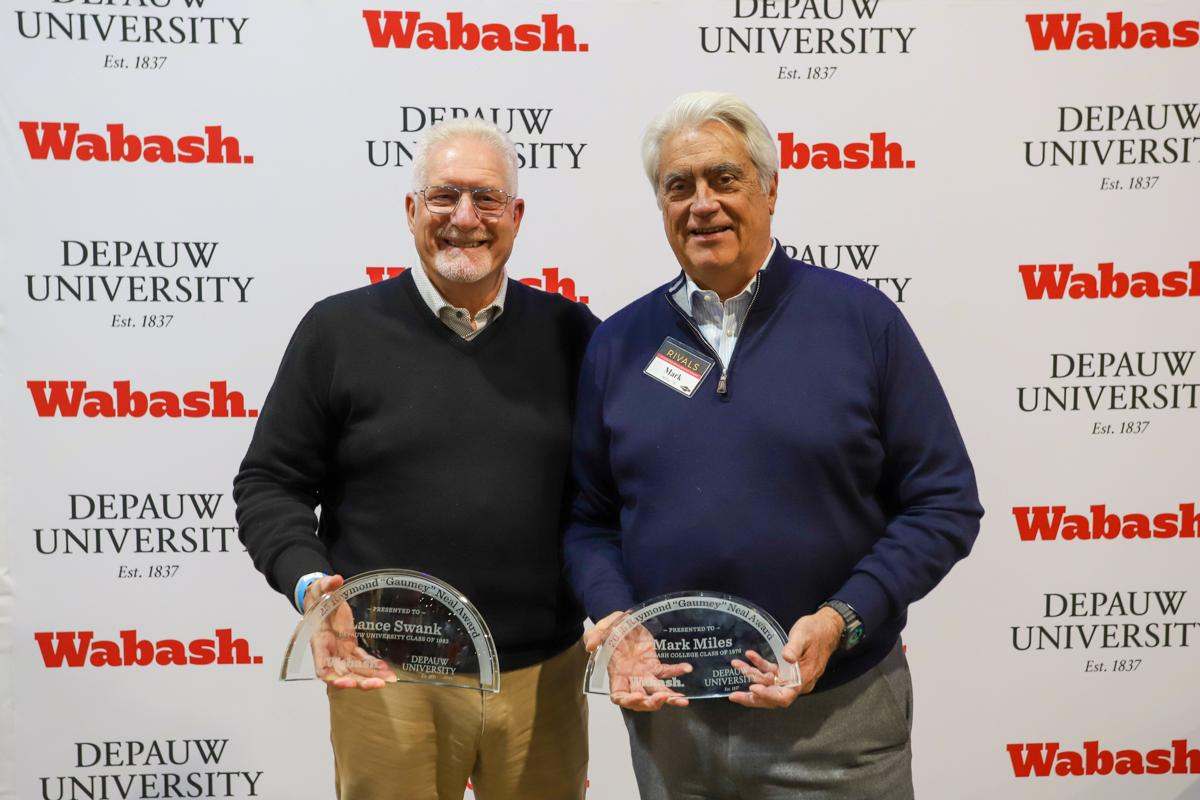
The photograph makes a pleasant footnote to the football years. The former DePauw player is back in the company of a college rival, with recognition for what came afterward. Some institutional loyalties survive graduation by turning into service. Swank’s university advisory work is one example of that continuing relationship.
His public life also includes work beyond the executive office. A 2017 biography recorded his involvement with the Penn Wrestling Club as president and his Bronze Level USA Wrestling coaching credential. Those dated details widen the picture without requiring a grand theory of his personality. They show another setting where experience could be passed along.
As Sterling approached its fiftieth anniversary in 2026, Swank’s year-end message thanked colleagues, partners and communities. His recent public conversations have continued to address leadership and real estate’s place in investment portfolios. The subject changes with the audience; the relationships keep appearing.
There is a useful way to read the career from that vantage point. The grounds work, the site research, the housing associations, the ownership planning and the alumni photograph all involve staying connected to a place or an organization after the first assignment. Sterling’s president has spent decades carrying the work forward. Somewhere between the first summer job and the anniversary, continuing became the story.