Before Erwin Thompson invested in the systems that keep things moving, he helped financial television reach its audience. At Bloomberg, he worked in broadcast engineering, with access to a terminal that offered another kind of education. Finance began to compete with engineering for his attention. Later, conversations with Columbia business students supplied an appealing calculation: their work paid more, and its mathematics looked easier than the engineering he was already doing.
He tells that turn with an engineer’s economy and a welcome absence of solemnity. The journey took him through BlackRock and UBS, then to EQT. Today he is chief executive of EQT Infrastructure Company, or EQIC, and a partner at EQT. The change in occupation is considerable. The recurring interest in how a system works is an inviting way to read the career that followed.
Three degrees, then a long stay
Thompson’s formal education spans electrical engineering, applied physics and business. He earned his bachelor’s degree at Tufts, a master’s in electrical engineering at Columbia University, and an MBA at Columbia Business School. The combination gives his career an unusual rhythm: study the physical system, study it further, then study the organization that finances it.
Before EQT, he worked on UBS Investment Bank’s Americas Infrastructure & Privatization advisory team in New York. Infrastructure was already a specific professional interest when he arrived at EQT in September 2009. That date matters because his tenure now spans seventeen years, long enough to have worked through several phases of the business rather than simply arriving for its current attention.
His partnership became effective on January 1, 2017, alongside six other promotions across EQT. It was an internal advancement within a growing firm: EQT then reported about 460 employees and fourteen offices. A career can be measured in job changes. Thompson’s has also been measured in the changing scale of the place where he stayed.
The wheels beneath the container
Consider Direct ChassisLink, usually shortened to DCLI. A chassis is the wheeled frame that carries a shipping container. It has little chance of becoming the star of a dinner conversation, yet it occupies a necessary position between a ship, a rail terminal and a truck journey. Thompson’s investment work includes this thoroughly practical corner of commerce.
In October 2017, DCLI announced an agreement to acquire approximately 72,000 domestic chassis from TRAC Intermodal, together with customer and hosting contracts. The proposed combination joined marine and domestic equipment and expanded the company’s reach across major American ports and rail terminals. Thompson described the operating fit between the two businesses and supported the management team’s growth plans.
The interesting detail is the combination. More equipment was part of the story; access to customers, locations and an asset-management platform was part of it too. A frame with wheels becomes more useful when it belongs to a network that can put it where a customer needs it. The machinery is simple enough to picture. Organizing its availability is a different task.
A freight business learns to see
DCLI also had a software dimension through Blume Global, formerly REZ-1. Its services covered asset management, logistics execution, shipment visibility and financial settlement. These are the administrative verbs behind a container’s apparent simplicity. The cargo may be in one place; the information needed to move it can be scattered among several participants.
Thompson’s explanation of the opportunity centered on visibility. In discussing Blume, he pointed to changing customer expectations around delivery speed and oversight. EQT’s work with DCLI also included a revised governance structure and an independent board drawing on its industrial network. The ambition involved better decisions as well as additional assets.
Thompson explained how adding relevant experience to the board supported management’s plan. That puts some of the investor’s work in the choice of people around a table. In this example, infrastructure ownership reaches from the freight yard to the software platform to the boardroom, with each affecting the other.
“Blume Global is a real game changer”Erwin Thompson, discussing DCLI
Selling most, keeping a stake
By March 2019, EQT announced an agreement to sell a majority interest in DCLI to funds managed by Apollo affiliates while retaining twenty percent. The business then operated roughly 235,000 chassis across more than 450 locations. EQT described growth in its domestic fleet and an expanded digital offering during its ownership.
Thompson commented on the transformation of DCLI and Blume and welcomed the continuing minority position. The transaction makes a useful stopping point in the freight chapter. An investor can remain involved after transferring control, and a company’s next phase can involve a different ownership arrangement from its previous one.
The figures belong to that moment in 2019. They show the reach of the business being sold, rather than a promise about its future. The episode also gives Thompson’s career a concrete object: a company handling containers, customers and equipment across a broad network. It is easier to understand active ownership when there are actual wheels attached.
The appeal of keeping a pole standing
Another 2019 investment placed Thompson near an even less theatrical part of infrastructure. EQT acquired Osmose Utilities Services, which provides inspection, maintenance and restoration services for utility and telecom infrastructure in the United States. Its headquarters remained in Peachtree City, Georgia, and Ron Childress continued as chief executive.
Thompson called attention to the company’s infrastructure characteristics and transformation potential. His comments also singled out its data-based sales strategy. The investment announcement connected demand with aging assets, regulation and the growing use of infrastructure for telecommunications. Maintenance, in other words, had a place beside expansion.
There is a pleasing lack of glamour here. A utility network includes physical equipment that needs attention. An investment story about inspection and restoration can be every bit as revealing as one about a new construction project. The question is what keeps an existing service working, and what a business can do better while providing it. Osmose supplies another example of the operating-company approach visible in Thompson’s work.
A charger starts well before the plug
In April 2025, Thompson and colleague Neha Jatar wrote about transportation’s opportunities for decarbonization. Their examples extended beyond passenger cars to equipment at ports and airports, school buses and the small vehicles moving trailers around freight yards. It is a useful change of scale: transport contains many working fleets whose needs differ from those of a household driveway.
Voltera, an EQT-backed business, illustrated the supporting infrastructure. Its work included acquiring real estate, arranging power connections, procuring chargers and providing operating software for fleet charging. At the time of their article, it owned twenty-one sites in key US hubs. That count describes April 2025, rather than a current inventory.
The plug is the part a driver sees. The site, electricity supply and operating arrangements make it possible to use. Thompson’s involvement continued at board level: He serves as a director of Voltera, as well as Arcwood Environmental. Across these businesses, the investment subject becomes a set of practical arrangements that allow a service to happen.
The new audience for an old necessity
Thompson’s role at EQIC puts him at the intersection of infrastructure investing and a wider investor audience. He has served as the company’s chief executive and a director since 2024. His writing in 2025 discussed the growing interest of high-net-worth investors in infrastructure and explained why the category now includes much more than roads, bridges and airports.
His examples ranged across digital networks, energy, transport and environmental services. The attraction, as he described it, involved long-term demand and the opportunity to support businesses with operating expertise. Those arguments are his investment perspective; they do not turn a long-term theme into a guaranteed result.
The institutional side of EQT remained substantial. In March 2025, EQT Infrastructure VI closed with €21.5 billion in total commitments from investors including pension funds, sovereign wealth funds, insurers and asset managers. That was a separate flagship fund, rather than EQIC. Keeping the distinction clear helps explain Thompson’s setting: his company operates within a larger infrastructure franchise, with different vehicles serving different investors.
AI still needs a place to live
Artificial intelligence has given infrastructure a more conspicuous public role. At EQT, the physical buildout includes EdgeConneX, a data-center developer and operator backed by the firm in 2020. Its expansion has involved local teams, permitting, energy and construction arrangements across markets. Behind the language of computing capacity sit the familiar complications of making a large project work in a particular place.
In April 2026, EQT announced a dedicated AI Infrastructure strategy seeded by EdgeConneX. EQT identified Jan Vesely and Christoph Balzer as its global leaders. The distinction matters in a profile of Thompson: this is the wider firm’s strategy, with its own leadership, and part of the environment in which his infrastructure career now sits.
The strategy brought digital infrastructure and energy into the same conversation. Power availability was a constraint on expansion, and collaboration across the portfolio was part of the proposed response. The fashionable subject has acquired an old engineering concern: a system needs its inputs. Computing ambitions must eventually meet electrical supply, connectivity and a construction schedule.
Seventeen years, and another conversation
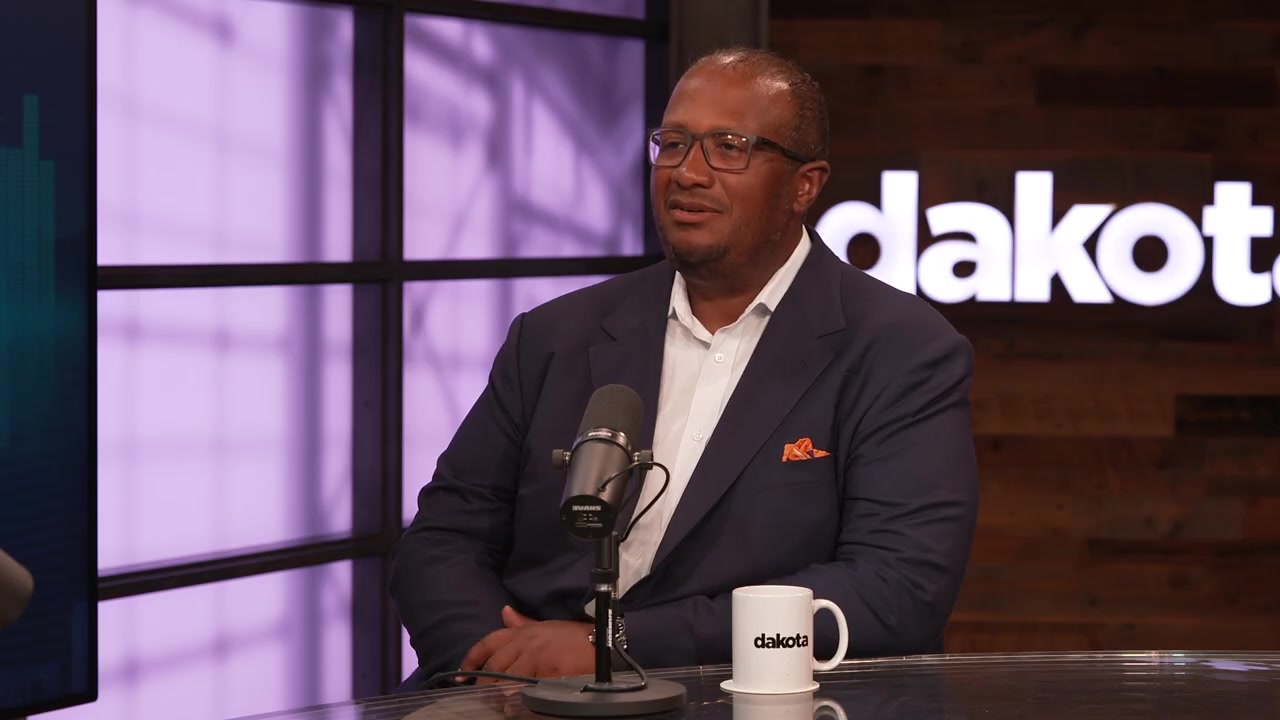
In September 2026, Thompson joined Robert Morier on Dakota Live! to discuss his career and infrastructure investing. The conversation returned to the engineering-to-finance transition and moved into the data-center and power buildout. It put the earlier career and the current investment debate in the same room.
The career brings several kinds of connection into view. DCLI pairs equipment with information. Osmose works on assets that keep utility and telecom services running. Voltera puts transport and electricity together on an actual site. Each example gives the broad category of infrastructure a different shape, and each has occupied a place in Thompson’s work.
There is also room for amusement in the distance traveled. Someone who once helped a financial broadcast function now appears in the financial conversation himself. The equipment has changed, as have the sums and the audience. The interesting work still happens where a plan meets the arrangements required to make it run. A chassis, a maintained utility asset or a charging site will rarely deliver a thrilling entrance. It can, however, keep the rest of the scene moving.
 WATCH THE CONVERSATION ↗